
The project manager of a website redesign has a formidable task, and poor planning could cost the company time and money. Before getting started, any project manager will want to be familiar with the process. Here are seven steps to help you efficiently guide the project across the finish line.

Executive Report



Executive Report
Subscribe today and receive top resources in your inbox
Subscribe-
From the Streets to the Conference Room: Kevin Johnson’s Real Life Redemption
In this episode of Executive Report, our Host Steve Taormino sits down with the Owner and CEO of Rea...
-
Michael Teitelbaum Celebrating Baltimore on a National Platform
Executive report host, Steve Taormino sits down with Michael Teitelbaum, President of Baltimore Maga...
-
Atlas Restaurants: Creating Unique Experiences Featuring Alex Smith & Steve Taormino
Host, Stephen Taormino, meets with Alex Smith, Founder of Atlas Restaurant Group to discuss building...
-
Working Through An Ever Changing World Of Change Featuring Chris McDonell & Steve Taormino.
Host, Stephen Taormino, meets with Chris McDonell, CEO of McDonell Consulting to discuss adapting to...
- View all




hide

hide

Executive Report
Subscribe today and receive top resources in your inbox
Subscribe-
From the Streets to the Conference Room: Kevin Johnson’s Real Life Redemption
In this episode of Executive Report, our Host Steve Taormino sits down with the Owner and CEO of Rea...
-
Michael Teitelbaum Celebrating Baltimore on a National Platform
Executive report host, Steve Taormino sits down with Michael Teitelbaum, President of Baltimore Maga...
-
Atlas Restaurants: Creating Unique Experiences Featuring Alex Smith & Steve Taormino
Host, Stephen Taormino, meets with Alex Smith, Founder of Atlas Restaurant Group to discuss building...
-
Working Through An Ever Changing World Of Change Featuring Chris McDonell & Steve Taormino.
Host, Stephen Taormino, meets with Chris McDonell, CEO of McDonell Consulting to discuss adapting to...
- View all
Why Engine Optimization Keywords Matter More Than Ever
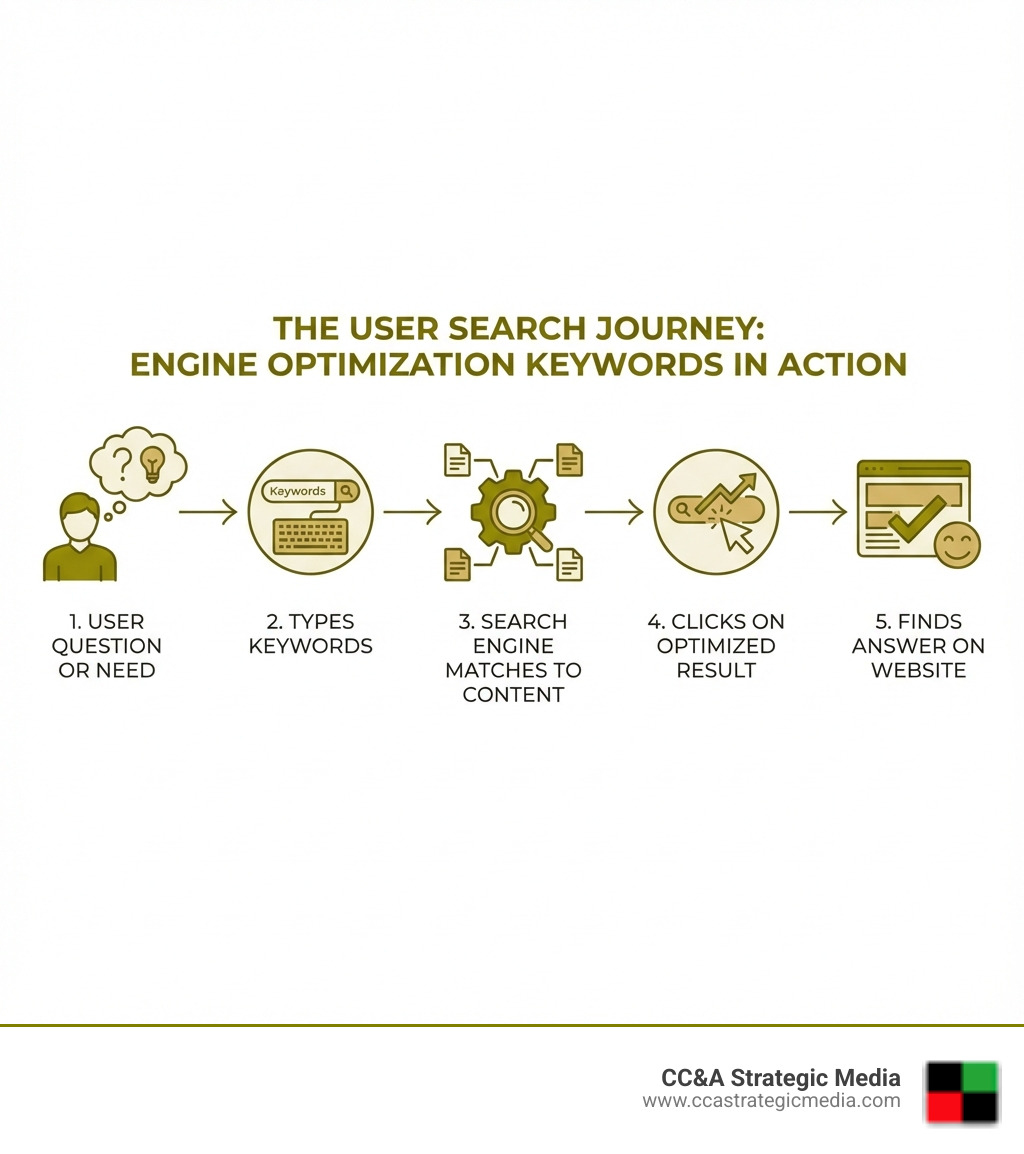
Engine optimization keywords are the essential building blocks that connect what your audience searches for to the content you create. While the term might sound like it’s about tuning car engines, in the digital marketing world, it refers to Search Engine Optimization (SEO)—the practice of improving your website’s visibility in search results through strategic use of keywords.
Quick Answer: What You Need to Know About Engine Optimization Keywords
- Keywords are search terms that people type into Google, Bing, or other search engines
- They set the foundation for SEO by helping search engines understand what your content is about
- Effective keyword research involves analyzing search volume, competition, and user intent
- Strategic placement of keywords in titles, headers, and content improves visibility
- The landscape is evolving with AI-powered search experiences requiring new optimization approaches
The numbers tell a clear story: organic search remains the dominant source of trackable web traffic, greater than paid advertising, social media, or display ads. Yet 67% of users now start their research in AI platforms instead of traditional search engines. This shift means understanding both traditional SEO keywords and emerging optimization strategies for AI-generated search results is critical for businesses seeking growth.
Without a smart keyword strategy, your content remains invisible to the people actively searching for solutions you provide. Ranking for the wrong keywords—or none at all—means your SEO efforts produce no meaningful results.
As Stephen Taormino, founder and CEO of CC&A Strategic Media, I’ve spent over 25 years helping businesses build effective engine optimization keywords strategies that convert audiences into customers. My expertise in SEO and marketing psychology has guided companies of all sizes toward sustainable growth through data-driven keyword research and implementation.
The Foundation: What Are Search Engine Optimization Keywords?
At CC&A Strategic Media, we believe that understanding the basics is paramount. In the context of SEO, engine optimization keywords are the words and phrases people type into search engines to find what they’re looking for. They are, quite literally, the foundation for your entire search engine optimization strategy. If you’re not ranking for terms your target audience actually searches for, then your SEO efforts, no matter how robust, will be meaningless.

The primary goal of SEO is to rank your web pages for these crucial keywords. But it’s not just about picking popular words; it’s about understanding the metrics behind them:
- Search Volume: This tells us how often a particular term is searched within a given period, typically monthly. A high search volume indicates broad interest, but often comes with a caveat.
- Keyword Competition: This metric provides a scale of how difficult it might be to rank for a selected keyword. High search volume often means high competition, making it harder for newer or smaller sites to break through.
- Relevancy: Perhaps the most critical factor. Relevancy measures how well a keyword matches what the user intends to find. If a keyword is highly relevant to your content, it’s a strong candidate, even if its search volume is moderate. In some cases, we find it most advantageous to target highly specific, lower-competition search terms that are incredibly relevant to our clients’ offerings.
As we often tell our clients in Perry Hall, MD, and across Maryland, keyword research is the first, indispensable step on your SEO journey. It informs your entire content strategy and provides an invaluable overview of the niche topics your audience finds interesting.
We dig deeper into this fundamental aspect in our guide on The Importance of Keyword Research.
Understanding Searcher Intent
Imagine someone types “coffee” into Google. Are they looking for a definition? A local café? A recipe? Without understanding their intent, we can’t provide the right content. This is why searcher intent is so vital for effective engine optimization keywords strategies.
Searcher intent generally falls into four categories:
- Informational Intent: The user is looking for information or answers to a question. For example, “What is the best way to brew coffee at home?” or “History of coffee beans.”
- Navigational Intent: The user wants to find a specific website or brand. For instance, “Starbucks website” or “CC&A Strategic Media login.”
- Transactional Intent: The user is ready to make a purchase or complete an action. Examples include “buy coffee beans online” or “order custom website design.”
- Commercial Investigation: The user is researching products or services with the intent to buy, but isn’t ready to commit yet. Think “best coffee makers reviews” or “SEO company Maryland comparison.”
At CC&A Strategic Media, we emphasize that while engine optimization keywords are the starting point for any page, intent should always guide our decisions about what that page should look like. As the saying goes in SEO, “Target the keyword, optimize the intent.” By understanding why someone is searching, we can create content that truly meets their needs.
Types of Keywords: From Broad to Specific
Not all keywords are created equal. We categorize them to better understand their competitive landscape and potential impact:
- Head Terms (Short-Tail Keywords): These are typically 1-2 words, like “coffee” or “marketing.” They boast high search volume but also extremely tough competition and often very broad, unclear intent. While ranking for these might seem appealing, it can take years, even for established sites, and the traffic might not be highly qualified.
- Body Keywords: These are slightly longer, usually 2-3 word phrases, like “organic coffee beans” or “digital marketing services.” They offer a balance between search volume and specificity.
- Long-Tail Keywords: These are usually 4+ word terms, such as “best organic fair trade coffee beans in Maryland” or “affordable digital marketing for small businesses Perry Hall MD.” Long-tail keywords have lower search volume individually, but collectively they make up a significant portion of all searches. Crucially, they tend to have much lower competition and more clearly defined intent, making them ideal targets for businesses, especially those new to SEO or operating in niche markets. For people new to SEO, long-tail terms are usually the best keywords to start with.
- Branded vs. Non-Branded Keywords:
- Branded Keywords include your brand name or variations of it, like “CC&A Strategic Media” or “Stephen Taormino marketing.” Ranking for these is usually easier, as users are already looking for you.
- Non-Branded Keywords are generic terms, such as “marketing agency Maryland” or “SEO services Perry Hall.” These typically have higher search volumes than branded terms and are harder to rank for due to increased competition. However, capturing non-branded traffic is essential for acquiring new customers, as it equates to market share. We believe the work involved in ranking for non-branded engine optimization keywords is well worth the effort due to the higher potential for growth.
Developing a comprehensive understanding of these keyword types is a core component of Best Strategies for Organic SEO.
How to Research Effective Engine Optimization Keywords
Effective keyword research isn’t just about guessing what people type; it’s a systematic process of findy and analysis. At CC&A Strategic Media, we start by putting ourselves in your audience’s shoes, asking: What words are they using? What questions are they trying to answer?

- Seed Keywords: We begin by brainstorming a list of “seed keywords”—broad terms related to your business or industry. For a local business in Perry Hall, MD, this might include “digital marketing,” “SEO,” or “web design.” These are our starting points.
- Keyword Modifiers: Next, we expand these seed keywords using modifiers. These are words people add to their searches to get more specific results, like “best,” “affordable,” “near me,” “services,” “guide,” or “for small business.” This helps us uncover long-tail opportunities.
- Content Gaps: We also analyze the search results for your competitors. By looking at who ranks first for relevant terms, we can identify what content they’re providing and, more importantly, how we can create something better, more user-friendly, and even more comprehensive for your target audience. This helps us spot “content gaps” that we can fill.
Our own internal guide, Google Keyword Planner, offers a fantastic starting point for this crucial phase.
Essential Tools for Your Keyword Arsenal
While our expertise is your greatest asset, we leverage a suite of powerful tools to conduct thorough keyword research:
- Google Keyword Planner: This free tool from Google is invaluable. It provides us with essential data directly from Google itself, including estimated search volumes and competition levels for engine optimization keywords. We use it to identify new keyword ideas and understand their potential. You can access it directly at Google Keyword Planner.
- Keyword Surfer (Chrome extension): A handy browser extension that gives instant keyword insights directly in the search results. Find it here: Keyword Surfer (Chrome extension).
- Ubersuggest: Provides keyword suggestions, content ideas, and competitive analysis. You can check it out at Ubersuggest.
- AnswerThePublic: This brilliant tool scans the web for questions your target audience asks online, helping us uncover question-based long-tail keywords. It’s excellent for understanding user intent. Explore it here: AnswerThePublic.
- SeedKeywords.com: A unique tool that lets us ask real people how they would search for something, often revealing valuable, unexpected terms. Visit it at SeedKeywords.com.
- Google Trends: Essential for understanding the popularity of keywords over time. A keyword’s long-term trend can be more important than its current monthly search volume. We use Google Trends to spot keyword popularity and ensure we’re targeting terms with growing interest.
- Google Search Console: This tool shows us which keywords your site already ranks for, even if you haven’t explicitly optimized for them. It’s a goldmine for identifying quick-win opportunities.
Analyzing Your Audience and Opportunities
Successful SEO goes beyond just finding popular keywords; it’s about connecting with the right people. This is why we dedicate significant effort to understanding your audience.
We start by developing detailed buyer personas. This involves asking crucial questions:
- WHO is your audience?
- HOW do they think they’re searching for your content?
- What words are they using, and what questions are they trying to answer?
- Is your content delivered and written in a way that will help them answer that question?
Our article, How to Create Buyer Personas, dives deep into this process.
We then analyze the Search Engine Results Pages (SERPs) for your target engine optimization keywords. By examining the top-ranking content, we identify what’s working for your competitors and, more importantly, how we can create even better content that fulfills your visitors’ needs more completely. This allows us to identify unique content opportunities and position your business as an authority in your field, whether you’re serving clients in Perry Hall, MD, or across the broader Maryland region.
Strategic Implementation: Putting Keywords to Work
Once we’ve identified your most promising engine optimization keywords, the next step is to strategically integrate them into your website. This isn’t about “stuffing” keywords; it’s about thoughtful on-page SEO that helps search engines understand your content’s relevance while providing an excellent user experience.
When we talk about on-page SEO, we’re talking about optimizing elements on your website. By including your chosen keywords in the right places, we help search engines understand what your content is about and who it can help. This is where keywords become the heart of your on-page optimization.
Crucially, modern SEO prioritizes content quality and natural language. Google’s algorithms are sophisticated enough to understand variations and synonyms of your focused words. The goal is to write compelling, useful content for people first, and search engines second. This approach naturally incorporates keywords without forcing them, leading to better rankings and a superior user experience.
As an agency rooted in technology, psychology, art, and science, we know that user experience is paramount. A fast, secure, and intuitive website that offers valuable content keeps visitors engaged, signaling to search engines that your site is a valuable resource.
To learn more about optimizing your content for both users and search engines, explore our insights on SEO Content Marketing Benefits.
On-Page Best Practices for Engine Optimization Keywords
Here’s where and how we strategically place engine optimization keywords for maximum impact:
- Title Tags: The title tag is what appears as the clickable headline in search results and in your browser tab. We craft unique, clear, and concise titles that accurately describe the page content, always including your primary keyword or a variation. We also keep them under about 60 characters to ensure they display fully.
- Meta Descriptions: While not a direct ranking factor, a well-written meta description with your focused keyword phrase can significantly improve click-through rates. It’s the short summary that appears below your title in search results, enticing users to click. We ensure ours are unique, informative, and compelling.
- URLs: Your page’s URL should be descriptive and user-friendly. We include your primary keyword in the URL, keep it as short as possible, use dashes between words, and remove any unnecessary characters. For example, instead of
yourdomain.com/p?id=123, we aim for something likeyourdomain.com/seo-services-maryland. - H1 Headers: This is your main headline on the page. We use only one H1 header per page, placed at the top, and ensure it clearly identifies the core topic, incorporating your primary engine optimization keyword naturally. It’s one of the most important SEO elements.
- Body Text: This is where you tell your story and provide value. We naturally integrate your SEO keywords throughout the body text, ideally within the first paragraph. We also use variations and synonyms, focusing on writing for your audience rather than for a keyword count. Keyword density is not a ranking factor; natural, helpful content is.
- Image Alt Text: All images on your site should have descriptive alt text. This short, descriptive phrase explains the image to search engines and visually impaired users. We use descriptive alt text that explains the relationship between the image and your content, and include engine optimization keywords when relevant and natural.
For a comprehensive overview of Google’s recommendations, we always refer to Google’s official SEO Starter Guide.
Common Mistakes to Avoid (and What NOT to Do)
While the principles of using engine optimization keywords seem straightforward, it’s easy to fall into common traps that can harm your SEO efforts. We help our clients steer clear of these pitfalls:
- Keyword Stuffing: This outdated and harmful practice involves excessively repeating keywords in your content in an attempt to manipulate rankings. Google’s algorithms are smart enough to detect this, and it can lead to penalties. Instead, we focus on natural language and providing value.
- Ignoring User Intent: Creating content around keywords that don’t match what the user actually wants is a waste of effort. If someone searches for “best SEO company Maryland” and you give them an article on “what is SEO,” you’ve missed the mark. Always “target the keyword, optimize the intent.”
- Focusing on Keyword Density: There’s no magic percentage of keywords you need to hit. Keyword density is not a ranking factor. Instead of counting keywords, focus on writing great content around a topic and using keywords naturally where they make sense.
- Generic Anchor Text: When linking internally or externally, avoid vague phrases like “click here” or “read more.” Instead, use descriptive anchor text that includes engine optimization keywords for the destination content. This helps both users and search engines understand what the linked page is about.
- Keyword Cannibalization: This occurs when multiple pages on your website target the same or very similar keywords, essentially competing against each other in search results. This dilutes your authority and makes it harder for any one page to rank well. Our article on Avoiding Keyword Cannibalization provides strategies to prevent this.
The Next Frontier: From SEO to Generative Engine Optimization (GEO)
The world of search is undergoing a profound change. The rise of Generative AI and Large Language Models (LLMs) like ChatGPT, Google’s Search Generative Experience (SGE), and Bing Copilot is fundamentally changing how users find information. This shift introduces a new paradigm we call Generative Engine Optimization (GEO).
Historically, SEO focused on helping your website rank high in a list of search results. With generative engines, the goal is shifting from mere ranking to content visibility within AI-generated answers. Users are increasingly getting direct, synthesized responses from AI, often without needing to click through to individual websites. In fact, 67% of users now start their research in AI platforms, and a staggering 89% trust AI-recommended content more than traditional search results.
This evolution means that traditional SEO tactics, while still foundational, need to be augmented with strategies specifically designed for AI.
Here’s a quick look at how the tactics are evolving:
| Traditional SEO Tactics (Focus: SERP Ranking) | Emerging GEO Tactics (Focus: AI Citation/Visibility) |
|---|---|
| Keyword Density | Semantic Comprehension & Entity Relationships |
| Backlinks (Quantity & Quality) | Author Authority & Credibility Signals |
| Page Speed & Mobile Responsiveness | Structured Data (Schema.org) & Context |
| On-Page Keyword Placement | Citation Quality, Relevance & Freshness |
| Meta Descriptions (CTR) | Conversational Content & FAQ Sections |
| Content Length | Factual Density & Statistical Data |
| Headings (H1-H6) | Logical Information Architecture & Summarizability |
What is Generative Engine Optimization (GEO)?
Generative Engine Optimization (GEO) is a novel approach to help content creators improve the visibility of their content within generative engine responses. Unlike traditional SEO, which focuses on ranking in a list of results, GEO aims to get your content cited, summarized, or directly used by AI models when they answer user queries.
It’s a black-box optimization framework because the inner workings of these AI models are often proprietary. This makes it challenging but crucial for creators to adapt. GEO focuses on different visibility metrics beyond just traditional search rankings, such as:
- Citation Frequency: How often your content is directly referenced by the AI.
- Position in AI-Generated Lists: Where your information appears in a synthesized answer.
- AI Referral Traffic: The traffic driven to your site from AI platforms.
- Content Freshness: How up-to-date your information is.
- Overall Authority Score: A measure of your content’s perceived credibility by AI.
The fundamental difference from traditional SEO is that GEO prioritizes semantically comprehensive content, clear entity relationships, and strong citations and sources as signals of authority. It’s less about keyword exact matches and more about contextual understanding and trustworthiness. Our team continuously researches these advancements, drawing insights from foundational work like the Original research on GEO.
Practical Strategies for the New Era of Search
The shift to generative engines means we need to adapt our content strategies. Here are some practical approaches we employ at CC&A Strategic Media to optimize for this new landscape:
- Adding Statistics: Generative engines love data. Incorporating relevant statistics, especially recent ones, can significantly boost your content’s visibility in AI responses. Research shows adding statistics can increase AI visibility by over 32%.
- Citing Sources: Credibility is key. Properly citing authoritative sources makes your content more trustworthy to AI models, increasing the likelihood it will be referenced. Adding relevant citations and quotations can boost content visibility by up to 40%.
- Structured Information: Well-organized content is easier for AI to parse and summarize. This means:
- Using clear, hierarchical headings.
- Breaking information into digestible chunks with bullet points and lists.
- Implementing comprehensive FAQ and Q&A sections, which can increase AI citation rates by up to 35%.
- Using structured data (Schema.org) to explicitly tell AI models what your content means.
- Enhancing Author Authority: AI models are increasingly evaluating the credibility of content creators. We recommend clearly demonstrating author expertise through biographies, credentials, and institutional affiliations. Building recognized expertise can increase your citation probability by up to 45%.
- Semantic Optimization: Beyond individual engine optimization keywords, we focus on comprehensive semantic coverage. This means using synonyms, related terms, and providing sufficient context to ensure AI models fully understand the topic. Writing in natural, conversational language also aids AI comprehension.
As we evolve our strategies, we continually integrate these GEO tactics with established best practices in Successful Off-Site Strategy SEO to ensure a holistic approach.
Frequently Asked Questions about Engine Optimization Keywords
When working with clients, we often encounter similar questions about how to best leverage engine optimization keywords. Here are some common ones:
How many keywords should I target per page?
We recommend focusing on one primary keyword and a small cluster of 3-5 related secondary keywords per page. This approach allows us to create comprehensive, focused content that satisfies a specific search intent without diluting its effectiveness. Each page should ideally serve a unique purpose and address a particular facet of your audience’s needs. Trying to rank for too many unrelated keywords on a single page often leads to poor results, as it signals to search engines that your content lacks focus.
What is keyword difficulty and why does it matter?
Keyword difficulty (KD) is a metric that estimates how hard it is to rank on the first page of Google for a specific keyword. It’s usually presented on a scale (e.g., 0-100), with lower scores indicating easier ranking opportunities.
KD matters because it helps us prioritize our efforts, especially for new websites or businesses trying to break into competitive markets like those in Maryland. Targeting keywords with lower KD scores (often long-tail keywords) allows us to gain traction, build authority, and generate initial traffic. As your website’s authority grows, we can then strategically target more competitive, higher KD keywords. Without considering KD, you might spend significant resources chasing keywords that are virtually impossible to rank for, leading to frustration and wasted effort.
How often should I update my keyword strategy?
The digital landscape is constantly shifting, so your keyword strategy shouldn’t be a one-and-done project. We recommend reviewing and updating your keyword strategy quarterly or at least semi-annually.
Here’s why:
- Search Trends Change: New products, services, or events can cause certain keywords to surge or decline in popularity. Google Trends is invaluable here.
- Industry Changes: Your competitors’ strategies evolve, and new competitors may enter the market.
- Your Site’s Authority Grows: As your website gains authority, you may become capable of ranking for more competitive keywords that were out of reach before.
- Algorithm Updates: Search engine algorithms are continuously updated, which can subtly change how keywords perform.
Regular updates allow us to capitalize on new opportunities, adapt to changes, and maintain your competitive edge.
Conclusion
The journey to effective online visibility, whether for a local business in Perry Hall, MD, or a larger enterprise across Maryland, always begins and ends with understanding engine optimization keywords. They are the indispensable bridge between your audience’s needs and the valuable content you provide.
At CC&A Strategic Media, we’ve seen how a holistic strategy—one that combines meticulous keyword research, precise on-page implementation, and a forward-thinking eye toward the evolving future of search—can drive sustainable business growth. The core principle remains: user-first content is paramount. As search continues to evolve, embracing new challenges like Generative Engine Optimization alongside traditional SEO will be crucial for staying ahead.
Don’t let your valuable content remain unfinded. Let us help you steer the complexities of engine optimization keywords and the ever-changing digital landscape. Discover how our SEO Marketing Services can build your keyword strategy and open up your business’s full online potential.

