Core Foundations of Performance Content Strategy Development
When evaluating why some digital initiatives generate substantial growth while others produce only vanity metrics, the difference almost always traces back to how leadership defines purpose. Traditional content creation tends to focus on editorial calendars, publication volume, and top-line traffic numbers. In contrast, performance content strategy development treats content as a tangible business asset designed to generate measurable financial returns, shorten the sales cycle, and support scalable operations.
Modern executives and firm partners understand that digital attention without operational alignment creates wasted spend. A documented strategy generates roughly three times more leads per dollar than an undocumented one, yet many organizations still operate on intuition rather than structured architecture. Aligning strategic objectives with bottom-line revenue requires establishing foundational clarity, as detailed in The Complete Guide to Performance Marketing Basics.
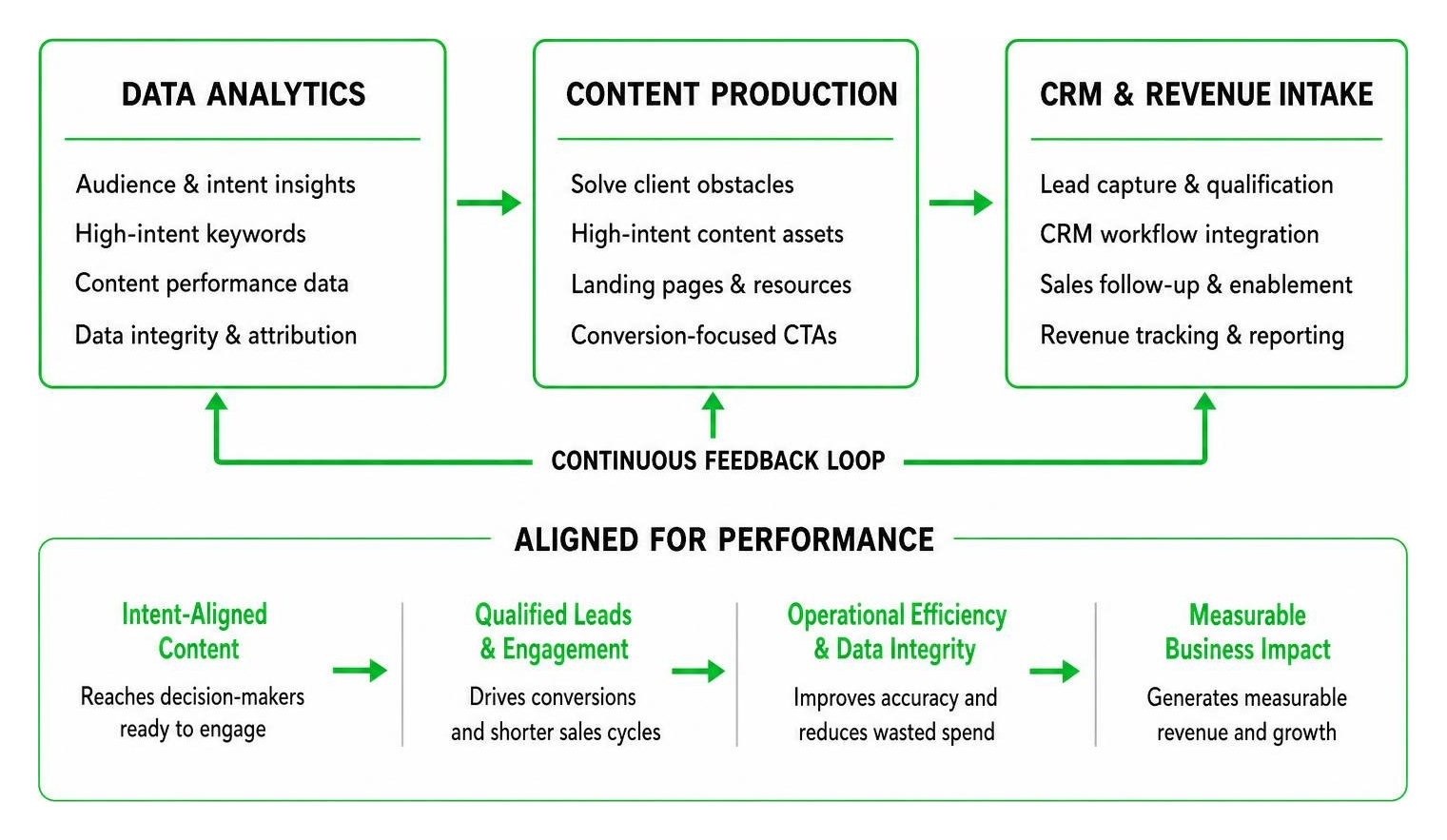
The shift toward performance content means looking at your digital presence not as an online brochure, but as an interactive sales enablement system. Every article, guide, and landing page must solve a specific client obstacle, answer high-intent queries, and integrate cleanly into your intake or CRM workflow.
Performance Content Strategy Development for Measurable Business Impact
Driving genuine commercial impact requires marketing teams and leadership to focus on commercial intent rather than broad, unfocused traffic. When an individual lands on your website, their journey must guide them effortlessly toward a meaningful next step. Metrics such as revenue per visitor, qualified lead velocity, and customer acquisition cost provide the true scorecard for content performance.
Maintaining exceptional data integrity is essential for this level of precision. Across corporate environments, only forty-two percent of companies express satisfaction with their internal data hygiene, and only forty percent are confident in its completeness. When customer data is fragmented, attributing lead generation or client retention to specific content assets becomes impossible.
Organizations that connect data hygiene with user experience unlock powerful conversion advantages. Prioritizing commercial intent keywords ensures that your editorial team addresses decision-makers ready to engage your services, lowering acquisition costs and enhancing lifetime value.
Defining KPIs Across the Full Conversion Funnel
A robust performance engine requires dedicated key performance indicators tailored to each phase of the client relationship. In the awareness phase, the objective centers on high-intent visibility, qualitative reach, and brand authority. As prospective clients move into the consideration stage, the indicators shift toward deep engagement, resource downloads, and repeat visits.
At the bottom of the funnel, where decisions happen, conversion metrics must dominate. Here, leadership evaluates consult requests, quote submissions, form completions, and direct phone inquiries. For organizations seeking reliable execution standards across every digital touchpoint, adopting A Practical Guide to Proven Marketing Best Practices establishes the operational discipline required to track conversions accurately.
Beyond the initial transaction, retention and client expansion signals offer valuable feedback on service satisfaction. Tracking how existing clients consume educational resources, updates, and specialized content allows management to identify cross-sell opportunities and maintain long-term loyalty.
A Step-by-Step Framework to Plan and Research High-Converting Content
Building high-converting digital assets requires an operational framework that eliminates guesswork. High-performing organizations do not begin by writing; they begin by conducting rigorous research into their buyers, competitors, and historical performance data.
Developing precision profiles of your core buyers establishes the foundation for every editorial decision. When mapping audience profiles, you must isolate primary motivations, friction points, decision criteria, and trust triggers. For a structured approach to identifying client demographics and behavioral drivers, review How to Create Buyer Personas.
Once audience profiles are complete, conduct an exhaustive inventory and audit of your current digital library. Categorize existing pages into four operational buckets: keep as is, update and expand, consolidate into a stronger pillar, or permanently retire. This content governance prevents keyword cannibalization, cleans up outdated messaging, and focuses search authority on your highest-performing assets.
Research Methods for High-Intent Content Production
Effective intent mapping requires analyzing actual customer conversations, sales logs, and CRM notes rather than relying solely on third-party keyword tools. While search data reveals overall search volume, your front-line intake specialists and account managers understand the exact questions clients ask before making an investment. Integrating search volume insights through The Importance of Keyword Research with real-world customer inquiries allows you to build topical authority that directly solves client objections.
Competitive analysis provides another strategic lever for content planning. By uncovering structural gaps in competitor positioning and identifying topics they have overlooked, you can capture underserved market demand. Executing a comprehensive audit, guided by How to Identify Competitors, ensures your editorial roadmap secures defensible territory rather than duplicating generic industry content.
Integrating Traditional SEO and AI Search Optimization
The modern search environment operates on two distinct yet connected tracks. Traditional search engine optimization focuses on keyword rankings, backlink profiles, technical crawling, and traditional search results. Simultaneously, artificial intelligence engines and conversational search platforms synthesize information directly, citing high-authority sources in generated summaries.
Traditional search optimization prioritizes organic rankings, clicks, and page traffic through comprehensive keyword targeting, site speed, metadata, and backlink volume. In contrast, modern AI search optimization targets direct AI citations, answer placement, and brand authority using structured, modular answers with clear semantic hierarchy. It relies on semantic schema markup, entity clarity, and factual accuracy to satisfy contextual, conversational, and complex multi-part prompts.
Succeeding in this evolving landscape requires integrating structured data, schema markup, and clear formatting so that automated engines can easily parse your primary takeaways. Exploring comprehensive SEO Content Marketing Benefits helps organizations balance standard search engine requirements with emerging AI citation channels.
Orchestrating Multi-Channel Distribution and Content Formats
Producing exceptional content accounts for only half of the performance equation; systemic distribution completes the investment. Without an organized multi-channel distribution plan, even the most insightful guides remain undiscovered by target audiences.

A unified publishing model ensures that foundational research gets repurposed efficiently across formats and platforms. To design integrated campaigns that maintain message continuity across every touchpoint, implement the steps outlined in How to Create a Full-Scope Marketing Campaign in 7 Simple Steps.
Maximizing format efficiency allows organizations to scale production while preserving executive time. An extensive research guide can be transformed into multiple executive video briefs, email newsletter breakdowns, visual summaries, and interactive assessment tools. Integrating multimedia assets with a dedicated Video Marketing Strategy expands reach across executive audiences who favor concise visual storytelling.
High-ROI Formats for Modern Performance Marketing
Different formats fulfill distinct functional roles across the client decision journey. In-depth pillar guides and comprehensive industry reports anchor search authority and establish thought leadership. Sixty-nine percent of business leaders note that detailed case studies represent one of the most persuasive formats for validating operational capability and closing new accounts.
White papers and proprietary benchmark reports continue to provide tremendous value, with fifty-five percent of enterprise marketers utilizing them to secure qualified inquiries. Infographics also serve an important role, utilized by sixty-seven percent of organizations to translate complex data into digestible visual insights. Combining these assets with structured acquisition campaigns using How to Increase Lead Generation builds a dependable lead pipeline.
Email marketing remains one of the highest-performing distribution channels available, delivering a median return on investment of one hundred twenty-two percent. However, maintaining inbox deliverability and list quality requires disciplined operational hygiene. Implementing the protocols in How to Lower Email Bounce Rates safeguards sender reputation and ensures high-value communications reach verified prospects.
Unifying Organic Search, Paid Amplification, and Automation
High-performance marketing eliminates silos between organic production and paid acquisition. When an organic content asset demonstrates exceptional engagement and conversion efficiency, leadership should amplify its reach through targeted distribution.
Employing precision PPC Services ensures perfect message match between paid ad creative, landing page copy, and the underlying value proposition. This cohesive narrative builds trust immediately, lowering cost-per-acquisition while improving conversion velocity.
Once a prospective client enters your digital ecosystem, marketing automation workflows must deliver relevant follow-up content based on observed user behavior. By tailoring post-conversion sequences using How to Keep Customers Using Marketing Automation, businesses can nurture leads continuously without demanding manual intervention from business development personnel.
Scaling Performance Content Strategy Development Through Testing and Governance

Publishing cadence plays a measurable role in digital performance; organizations that publish between two and four high-quality pieces per week consistently achieve the strongest compound returns on visibility and lead volume. However, velocity must never compromise strategic rigor. Documented editorial guidelines, clear review stages, and transparent ownership models prevent operational bottlenecks and maintain quality standards.
Testing Frameworks: A/B, Multivariate, and Qualitative Validation
Optimization is not a one-time project; it is an ongoing discipline of incremental refinement. Structured experimentation should test single variables across hero headlines, call-to-action phrasing, page layout, and trust badge positioning to isolate what drives conversion behavior.
Small modifications frequently yield substantial financial returns. Testing button microcopy, clarifying form field descriptions, or removing unnecessary steps often increases conversion rates significantly. Combining quantitative experimentation with technical performance reviews, such as monitoring Core Web Vitals and load speeds, ensures that technical friction never undermines your marketing investments.
Measurement, Multi-Touch Attribution, and Avoiding Strategic Pitfalls
One of the most dangerous traps in content marketing is the pursuit of vanity metrics. High page views, social impressions, and casual clicks mean little if they fail to generate pipeline value or qualified inquiries. High-growth organizations focus instead on multi-touch attribution models that credit content assets for their true role across the complete client lifecycle.
Evaluating first-touch, assisted, and last-touch conversions provides executive teams with visibility into which pieces initiate brand discovery and which close business. Furthermore, prioritizing post-sale engagement supports sustained business health. Reviewing How to Increase Customer Retention ensures your performance content continues to serve existing clients, driving ongoing retention and maximizing lifetime value.
Frequently Asked Questions About Content Strategy
What is the difference between traditional content strategy and performance content strategy?
Traditional content strategy focuses on brand storytelling, editorial calendars, and top-of-funnel reach, often treating traffic and awareness as the final goal. Performance content strategy starts with desired business outcomes, such as qualified leads, consult requests, or closed revenue, and engineers every piece of content to achieve those goals. It integrates search engine optimization, conversion architecture, technical speed, and CRM tracking into a unified system that measures success by actual commercial return.
How often should high-performance content assets be tested and audited?
Organizations should audit their full content library on a quarterly basis to identify performance decay, outdated factual references, and consolidation opportunities. Meanwhile, conversion rate optimization and A/B testing on primary landing pages should run continuously, provided the site generates sufficient traffic to reach statistical significance. Regular quarterly reviews ensure that underperforming pages are updated or retired before they drain domain authority.
How can marketing teams balance production speed with exceptional content quality?
Marketing teams balance speed and quality by building a modular content production framework supported by internal subject matter experts. Rather than asking senior leaders to write full articles from scratch, marketing teams conduct brief, structured interviews to extract core insights. The editorial team then transforms that raw expertise into multiple formats, including articles, social assets, videos, and email updates, using established style guides and governance workflows.
Conclusion
Building a high-impact digital presence requires moving past fragmented, ad-hoc publishing and adopting a performance-driven operational system. When you align your content strategy directly with business objectives, client intent, and conversion architecture, every article, guide, and campaign becomes a measurable driver of enterprise value.
As a strategic advisor, I have seen that sustainable growth happens when marketing, technology, and operations work in unison. Establishing an outcome-focused framework gives your firm the clarity and resilience needed to lead your market.
To explore how our holistic marketing and operational growth approach can help scale your organization, discover the advantages of the Strategic Ops Marketing Approach developed by CC&A Strategic Media.