Why Most Law Firms Struggle to Grow Beyond Referrals
Lawyer client acquisition strategies are the systems, channels, and processes a firm uses to consistently attract, engage, and convert new clients. Choosing the right mix can be the difference between a practice that grows and one that stagnates.
To understand the strategic landscape, we can look at the primary channels through a SWOT analysis lens. Referral systems offer high trust and low cost, representing a core strength, but their finite nature is a critical weakness. Local search visibility and digital directories provide broad, consistent visibility to capture active demand. Paid search campaigns and local service ads offer rapid lead flow and measurable returns, though they require ongoing capital. Content marketing and search engine optimization build long-term authority that compounds over time, while professional networking platforms expand organic reach. Email newsletters remain a highly underutilized asset for client retention and re-engagement.
The numbers tell a clear story. Around 70.8% of attorneys still identify referrals as their primary source of new business. That is not a bad thing on its own, as referrals carry trust that no ad can replicate. The problem is that referrals have a ceiling. Your network is finite. Referral sources retire, change industries, or simply forget to recommend you. When the pipeline dries up, it usually does so overnight.
Most attorneys know this. And yet, only 27% invest in paid digital advertising, and fewer than 15% use email newsletters to stay in front of past clients and prospects. The gap between what firms could be doing and what they are actually doing is significant, and it represents real revenue left on the table.
The strongest firms are not abandoning referrals. They are building systems around them, layering digital channels, content, and intake processes into a growth infrastructure that does not depend on any single source.
I am Roxanne St. Marie, Marketing Director at CC&A Strategic Media, and I have spent nearly two decades working inside law firms and legal marketing agencies, building the intake systems, CRM workflows, and multi-channel lawyer client acquisition strategies that turn inconsistent pipelines into predictable growth engines. Everything in this guide is grounded in what actually works at the operational level, not just in theory.
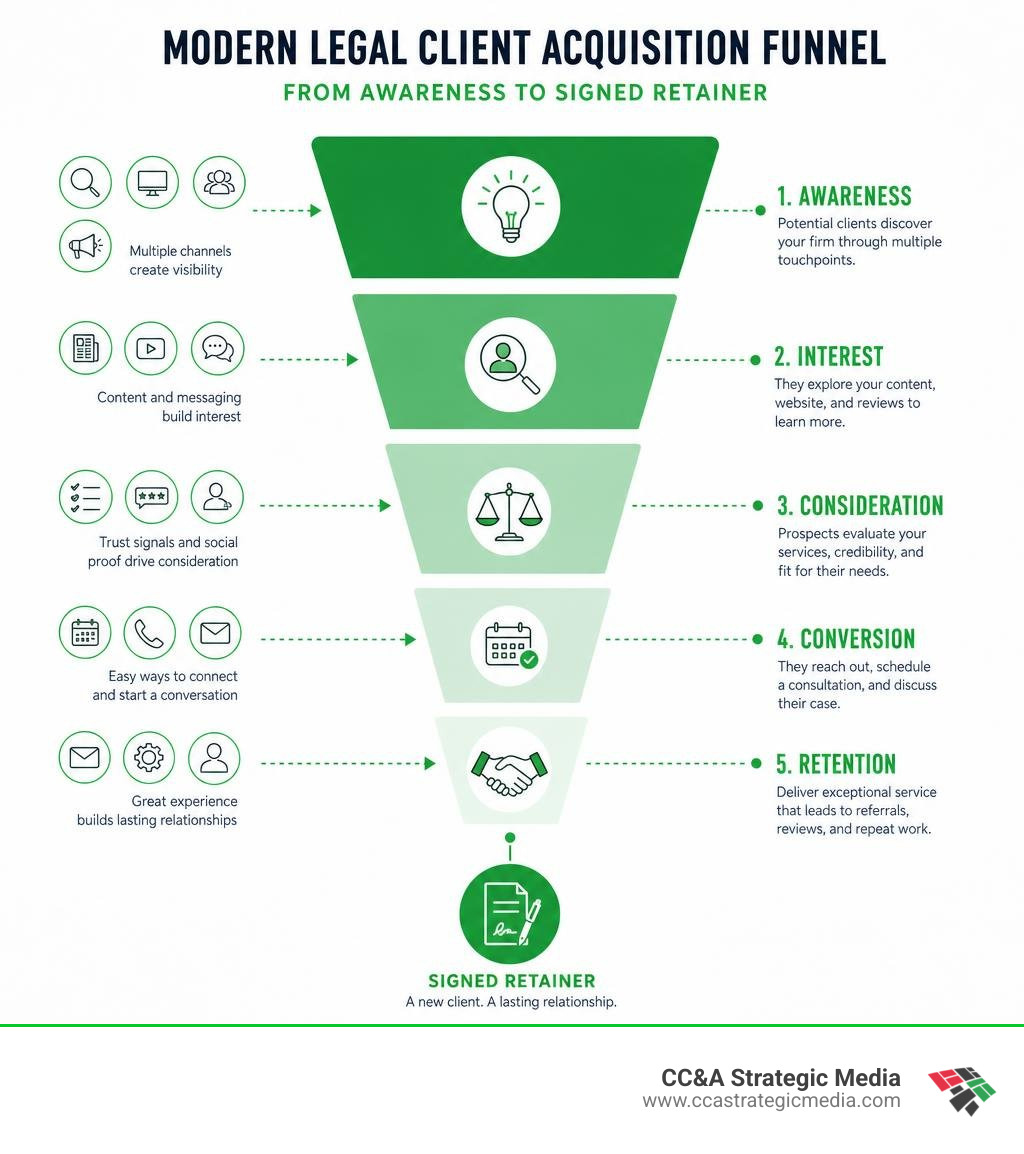
Know your lawyer client acquisition strategies terms: the attorney business development plan helps establish a baseline, while implementing practical attorney marketing tips and executing comprehensive law firm growth strategies ensures long-term success.
The Shift from Random Referrals to Systematic Growth

Relying on random, word-of-mouth referrals is a high-risk approach to business development. When a firm operates this way, its growth is entirely dependent on external factors that cannot be controlled, such as the health of a referral partner’s business or broader economic shifts. True business infrastructure requires a shift in mindset. You must view client acquisition not as a series of disconnected, ad-hoc marketing campaigns, but as an integrated operational system.
To achieve sustainable growth, a firm must establish operational alignment between its business development efforts and its daily operations. This means that every touchpoint, from the initial digital interaction to the final onboarding step, is measured, optimized, and connected. When you align your intake processes with your marketing campaigns, you immediately improve conversion rates without spending an additional dollar on advertising.
Building a strategic roadmap is the first step toward breaking the feast-or-famine cycle. Instead of guessing which marketing channels might work, successful firms analyze their historical data, identify their most profitable case types, and construct a predictable path to reach their goals. This systematic approach transforms business development from a source of anxiety into a disciplined, repeatable operational function. For a deeper look at establishing this foundation, you can explore our guide on how to Stop Winging It: A Strategic Roadmap for Law Firm Growth.
Evaluating Modern Lawyer Client Acquisition Strategies

To build a high-performing acquisition engine, you must look at your marketing through an economic lens. Many firms focus on vanity metrics, such as website traffic, social media impressions, or search engine rankings. While these metrics are helpful indicators of brand awareness, they do not pay the bills. The only metrics that truly matter to the health of your business are client acquisition cost and the cost-per-signed-case.
Understanding your client acquisition cost allows you to make informed decisions about where to allocate your budget. By dividing your total marketing and sales spend by the number of new clients acquired over a specific period, you establish a baseline for profitability. However, the cost-per-signed-case is an even more precise metric because it factors in your intake conversion rate. Two firms can spend the exact same amount on a marketing campaign and generate the same number of leads, but the firm with a disciplined, rapid intake process will achieve a significantly lower cost-per-signed-case. For a comprehensive breakdown of how to build and measure these systems, read The Ultimate Guide to Law Firm Marketing and Growth.
Digital Channels and the Role of Search Visibility
Search engine optimization is the foundation of digital visibility. When prospective clients face high-stakes legal challenges, their first instinct is to search for answers online. If your firm does not appear at the top of these search results, you are effectively invisible to a massive segment of your market. Organic search engine optimization involves creating deep, authoritative content that directly addresses the questions, risks, and fears your ideal clients are experiencing.
Local search visibility is equally critical. Optimizing your Google Business Profile, maintaining consistent name, address, and phone number citations across the web, and systematically generating high-quality client reviews are essential steps to dominate the local map pack. Additionally, leveraging premium listings on major legal directories can supplement your organic visibility, helping you capture high-intent search traffic. To understand how to maximize your local presence using modern search tools, read about The Local Advantage for Law Firms Using Google LSAs.
Comparing Paid Media and Organic Lawyer Client Acquisition Strategies
To build a balanced revenue portfolio, you must understand the differences between paid media and organic channels. Paid search ads offer instant predictability, allowing you to turn the lead-generation faucet on or off at will. Organic search equity, on the other hand, is a long-term asset that compounds over time, driving down your average acquisition cost as your authority grows.
Paid search ads are highly effective for capturing prospects who are actively seeking legal representation right now. However, because legal keywords are among the most expensive in digital advertising, running these campaigns without highly optimized landing pages is a fast way to burn through your budget. Social media advertising allows you to target prospective clients based on detailed demographic and behavioral data, making it an excellent channel for building awareness and nurturing prospects before they need your services. To learn more about utilizing social platforms effectively, read The Legal Guide to Dominating Facebook Advertising and Getting Clients.
Building an Authority Engine Through Niche Positioning
Many attorneys make the mistake of trying to be everything to everyone. They list dozens of practice areas on their websites, hoping to cast as wide a net as possible. In reality, a broad focus dilutes your authority and forces you to compete directly with every other general practitioner in your market. Niche specialization is the key to removing competition entirely.
When you narrow your focus to a tightly defined target audience, you stop being a commoditized service provider and become the obvious, go-to expert for that specific problem. Market differentiation is not about claiming to be the best; it is about being the only firm that solves a highly specific, complex challenge. This positioning allows you to command premium fees, simplify your marketing messaging, and dramatically increase your conversion rates. To discover how to identify and dominate your specific category, read The Innovative Lawyer’s Guide to Niche Dominance.
Establishing Authority with Educational Content and Published Assets
One of the most effective ways to demonstrate your niche expertise is through educational content and published assets. Rather than shouting about your credentials, you should focus on educating your target market. When you create deep, insightful resources that explain the stakes, risks, and potential outcomes of a complex legal situation, you build trust before the prospect ever speaks to an attorney.
A published book is the ultimate client development tool for establishing this level of authority. A book is inherently compliance-friendly because its primary purpose is to educate rather than advertise, allowing you to bypass many of the restrictive rules surrounding attorney advertising. When a prospective client or a referral partner holds a physical book written by you, your perceived authority instantly multiplies. To learn how to move beyond traditional word-of-mouth and build this kind of deep authority, read the strategic insights in How Attorneys Get Clients: What Works Beyond Word of Mouth.
Leveraging Employee Advocacy and LinkedIn Networks
LinkedIn has evolved into a powerful business development platform, particularly for B2B and commercial practices. However, many firms make the mistake of focusing solely on their company page. On LinkedIn, company pages typically reach only two to three percent of their followers. In contrast, personal profiles and employee posts achieve a baseline reach of ten to fifteen percent, which can easily double or triple with coordinated team engagement.
An effective LinkedIn strategy relies on employee advocacy. When the attorneys and professional staff at your firm consistently share industry insights, case studies, and educational content from their personal profiles, they humanize the brand and expand the firm’s collective reach. By implementing a coordinated team boosting approach, where colleagues engage with and comment on each other’s posts within the first hour of publication, you can amplify your content’s reach by three hundred to four hundred percent. This systematic approach turns professional networking into a scalable digital asset.
Optimizing the Intake Pipeline to Prevent Revenue Leaks
You can build the most sophisticated marketing engine in the world, but if your client intake systems are weak, you are simply lighting money on fire. Operational data shows that thirty-five percent of all inquiries to law firms never receive a response. Furthermore, forty-two percent of potential clients reach out to more than one firm simultaneously, meaning that the speed-to-lead is the single most critical factor in conversion rate optimization.
Contacting a lead within five minutes makes them twenty-one times more likely to convert compared to waiting thirty minutes. When a prospect reaches out, they are experiencing a high-stress situation and want immediate reassurance. If your intake team does not respond instantly, that prospect will move down the list to your competitor.
To prevent these costly revenue leaks, you must treat intake as a disciplined sales process. This involves standardizing intake scripts, utilizing automated SMS and email follow-ups to maintain engagement, and clearly defining who owns the intake process within your firm. By reducing friction at the onboarding stage and using compliant, automated payment systems, you can ensure your firm gets paid faster while reclaiming hundreds of hours of lost billable revenue annually. For practical advice on streamlining these processes, read How to Market Your Law Firm Without Losing Your Mind.
Integrating Traditional Networking with Digital Ecosystems
A modern, resilient law firm does not rely on a single marketing channel. Instead, it builds an omnichannel marketing system that seamlessly blends traditional, face-to-face networking with advanced digital ecosystems. This integration ensures that your firm is visible wherever your ideal clients and referral partners spend their time, creating multiple touchpoints that build trust over time.
Diversifying your revenue portfolio is just as important as diversifying a financial investment portfolio. By balancing offline relationships with digital visibility, you protect your firm against sudden market changes, algorithm updates, or the loss of a key referral source. When your digital presence supports your real-world relationships, your business development efforts become highly scalable and predictable.
Systematizing Professional Referrals Beyond Word of Mouth
Referrals will always be a valuable source of business, but they should not be left to chance. You can systematize your referral networks by building intentional, structured relationships with professional advisors who serve the same client base but do not compete with your services. These advisors, such as corporate consultants, accountants, and financial planners, can become consistent sources of high-value cases.
To move these relationships forward, you can use a structured relationship ladder. This involves moving a contact systematically from initial research and introduction to regular communication, joint educational projects, and eventually, a mutual referral partnership. By establishing a systematic follow-up process, such as sending regular updates, sharing educational resources, or hosting joint webinars, you keep your firm top-of-mind without ever appearing transactional.
Balancing Offline Relationships with Digital Lawyer Client Acquisition Strategies
Maintaining a strong digital presence does not replace the need for deep, personal relationships; rather, it amplifies them. When a referral partner hands your book or business card to a prospect, that prospect will immediately look you up online. Your digital footprint must validate the glowing recommendation they received.
This is where reputation management and online reviews play a critical role. Having a consistent stream of positive client reviews on your Google Business Profile and legal directories builds instant credibility. Additionally, using regular email newsletters to share valuable, non-promotional insights with your existing network ensures that past clients and professional contacts remember your expertise long after their cases are resolved, driving both repeat business and organic referrals.
Frequently Asked Questions about Legal Growth
How do law firms calculate and optimize Customer Acquisition Cost (CAC)?
To calculate your customer acquisition cost, you must look at your total marketing and sales spend over a specific period and divide it by the number of new signed cases acquired during that same timeframe. For example, if you spend ten thousand dollars on marketing in a month and secure ten new clients, your acquisition cost is one thousand dollars per client.
To optimize this metric, you must look beyond your ad spend and focus heavily on your intake conversion rate. By improving your speed-to-lead, utilizing structured intake scripts, and implementing automated follow-up sequences, you can convert a higher percentage of your existing leads into signed cases, instantly lowering your cost-per-signed-case without increasing your marketing budget.
What are the ethical considerations when using client testimonials and online reviews?
Attorneys must navigate strict compliance guidelines and state bar rules when advertising their services. Most jurisdictions prohibit making misleading statements, creating unjustified expectations about outcomes, or referring to oneself as a certified specialist without formal credentials.
When utilizing client testimonials and online reviews, you must ensure that they are honest, unsolicited, and accompanied by the necessary state-specific advertising disclosures. Additionally, you must maintain meticulous recordkeeping of all marketing materials and public communications to remain compliant with regulatory standards.
Why do traditional referral networks eventually hit a growth ceiling?
Traditional referral networks are limited by the physical size of your professional circle and the finite number of hours you can spend networking. Because these networks rely on personal relationships, they are highly vulnerable to market changes, such as a key referral partner retiring, moving, or shifting their business focus.
Without a supporting digital ecosystem to generate inbound interest, a referral-dependent firm will eventually hit a growth ceiling where it cannot scale its caseload on demand. Transitioning to a systematic, multi-channel acquisition strategy brings predictability and scalability to your pipeline.
Conclusion
Building a modern, predictable client acquisition system requires a shift from passive, relationship-dependent business development to a disciplined, operational infrastructure. By combining the power of local search visibility, high-authority content, systematic referral programs, and rapid intake optimization, your firm can build a resilient pipeline that drives sustainable growth.
At CC&A Strategic Media, we help growing firms design and execute these custom, data-driven strategies. Our unique approach is rooted in marketing psychology, advanced technology, and operational science to deliver true business growth.
To help you implement these systems without overwhelming your internal staff, we offer Strategic Ops.
Strategic Ops is not just marketing or fractional CMO support, it is the operational foundation behind your growth that is built from a proven system. With CC&A Strategic Ops, you receive a fractional leadership team providing strategic planning from an entire fractional team working within a proven system to turn your brand into a compelling growth engine. You also get dedicated marketing coordination focused on execution across all outreach and engagement channels, powered by an aligned fractional staff within a proven system. Finally, we deliver full-stack agency service execution from websites, SEO, and social media to integrated funnel campaigns, paid media, performance-driven content, video, and PR.
We extend your team with experienced, growth-driven marketing professionals focused on measurable impact.
If you are ready to build a reliable pipeline and scale your practice, explore our CC&A Strategic Media Marketing Services today.