Why Most Law Firms Are Invisible Online — And What to Do About It
The most effective
lawyer content marketing ideas are not about writing more — they are about building a system that turns your expertise into a steady stream of clients.
Here is a quick overview of what works in 2026:
| Content Marketing Idea |
Purpose |
| Service-focused blog posts |
Capture clients searching for answers |
| Long-form guides (3,000+ words) |
Build authority and earn backlinks |
| Short-form Q&A content |
Get cited by AI tools like ChatGPT and Perplexity |
| Attorney introduction videos |
Build trust before the first call |
| Email newsletters |
Nurture leads who are not ready to hire yet |
| Targeted service pages |
Rank in relevant search results |
| Infographics and visual explainers |
Earn shares and simplify complex legal topics |
| Podcasts |
Reach the large portion of the population who listen regularly |
| Case studies and testimonials |
Convert high-intent visitors into consultations |
Consider this: 96% of people seeking legal advice use a
search engine at some point in their process, and 74% visit a law firm’s website before taking any action. Yet most law firm websites offer little more than a list of services and a phone number. That gap — between what potential clients need and what most firms provide — is exactly where content marketing wins.
The firms that grow consistently are not the ones with the biggest advertising budgets. They are the ones that show up with the right answer at the right moment, whether that moment is a search at 11pm or an AI-generated response in ChatGPT. Content marketing is what makes that possible. And in 2026, with AI reshaping how people find legal help, the stakes for getting this right have never been higher.
I’m Roxanne St. Marie, Marketing Director at CC&A Strategic Media, and my nearly two decades of experience inside law firms — from front desk to executive leadership — have shown me how the right
lawyer content marketing ideas translate directly into client growth and operational strength. In the sections below, I’ll walk you through the strategies, formats, and systems that actually move the needle.
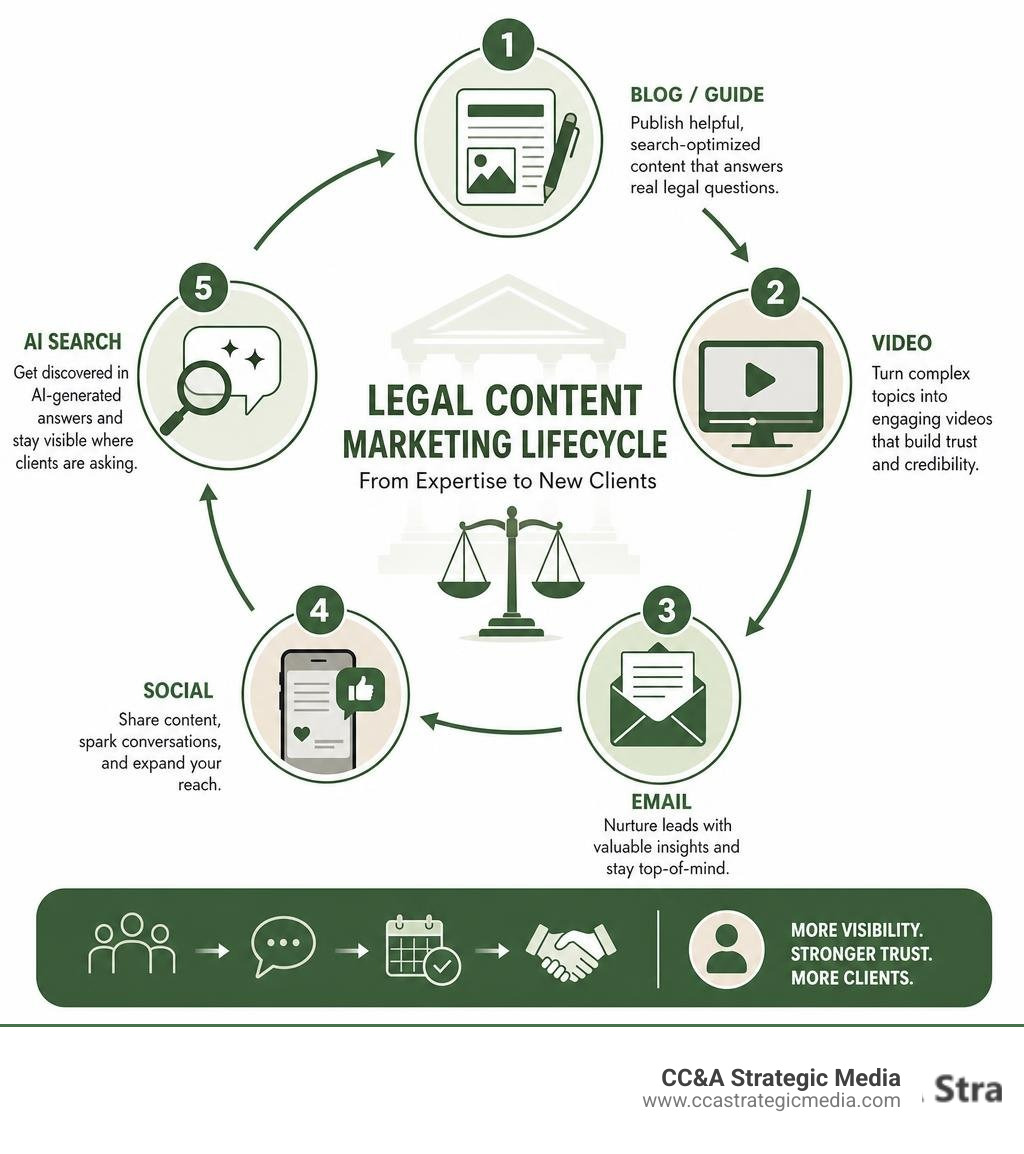
To build a comprehensive strategy, firms should focus on core concepts such as
attorney marketing tips, a structured
attorney business development plan, and sustainable
law firm growth strategies.
The Shift from Traditional Legal Advertising to Strategic Content Systems
Traditional legal marketing has long relied on high-cost, outbound campaigns that treat legal services like a generic commodity. Billboards, television spots, and aggressive paid search campaigns can yield temporary spikes in visibility, but they do not build lasting business equity. Once the advertising budget stops, the lead flow instantly vanishes. This is rented attention, and in a highly competitive digital landscape, it represents an inefficient use of capital that places a constant strain on firm operations.
Strategic content marketing represents a fundamental shift in how firms approach client acquisition. Instead of interrupting potential clients with promotional messages, an authoritative content system positions your firm as the natural solution to their immediate challenges. When we build a library of high-value content, we are investing in a permanent corporate asset that compounds in value over time. Rather than paying for every individual click, your firm establishes a continuous, organic discovery loop that brings qualified prospects to your digital doorstep.
From a strategic business perspective, content systems perform a critical operational function: they pre-qualify prospects before they ever speak to your intake team. When a potential client spends time reading your detailed guides, watching your explanatory videos, and reviewing your breakdown of complex processes, they develop a sense of trust and familiarity. By the time they request a consultation, they are already convinced of your expertise. This dynamic transforms your client acquisition funnel, resulting in higher conversion rates, shorter sales cycles, and a significantly lower cost per signed case. To understand how this fits into the broader operational health of your firm, explore
The Ultimate Guide to Law Firm Marketing and Growth.
To fully appreciate this strategic evolution, we can examine the strengths, weaknesses, opportunities, and threats of moving from traditional advertising to a content-driven system. The primary strength of a content system lies in its compounding organic reach and trust-building capabilities, while the main weakness is the initial time investment required to build authority. The opportunity is clear: firms can capture high-intent digital traffic that bypasses traditional ads entirely. Conversely, the threat of sticking solely to traditional methods is complete invisibility in an increasingly AI-driven search ecosystem where users demand immediate, authoritative answers rather than promotional slogans.
High-Impact Lawyer Content Marketing Ideas for Sustainable Growth
To build a content system that consistently generates signed cases, partners must move past the outdated practice of publishing sporadic, generic articles. A successful content engine requires a disciplined framework that aligns your firm’s legal expertise with the actual search behavior and psychological needs of your target audience. We must design our content around structured pillars that address the specific questions prospects ask during their most challenging moments.
This systematic approach requires a clear understanding of search intent. We categorize search queries into distinct tiers, ranging from top-of-funnel informational searches to bottom-of-funnel commercial intent. A firm that only publishes broad, academic articles will attract traffic that has no intention of hiring a lawyer. Conversely, a firm that only publishes promotional sales pages will miss the opportunity to capture clients early in their decision-making journey. The key is to build an integrated content architecture that guides users seamlessly from curiosity to consultation. To learn how to manage this process without overwhelming your internal resources, read our guide on
How to Market Your Law Firm Without Losing Your Mind.
Developing Client-Centric Lawyer Content Marketing Ideas
The foundation of any high-converting content strategy is the development of detailed client personas. We must look beyond basic demographics and focus on the emotional state, primary anxieties, and practical obstacles our clients face. A person searching for legal assistance is often dealing with a highly stressful life event. They are not looking for complex legal jargon or self-congratulatory firm histories; they are looking for clarity, reassurance, and a clear path forward.
To capture this audience, our content must speak directly to these anxieties in plain, accessible language. We recommend writing at an eighth-grade reading level to ensure maximum accessibility and engagement. Every piece of content should address a specific, high-intent question that a client would ask during an initial consultation. By addressing these concerns openly, your firm demonstrates empathy and immediate value, which are the cornerstones of digital trust. For a deeper look at why publishing consistent, educational articles is vital for modern business development, see
Inbound Marketing: Why Businesses Need a Blog.
Implementing Multi-Format Lawyer Content Marketing Ideas
A modern content system must accommodate the diverse ways people consume information. While long-form written content remains the bedrock of search engine optimization, integrating multiple formats allows your firm to maximize its reach and build deeper connections with prospects. Video content, for example, is an incredibly powerful tool for humanizing your attorneys. A simple, professionally produced video explaining a complex process can break down barriers of intimidation and encourage a hesitant prospect to reach out.
We also advocate for a highly efficient repurposing workflow to get the most out of every piece of content you create. A comprehensive, long-form guide can serve as the foundation for an entire marketing campaign. The core insights from that guide can be adapted into a series of short-form social media updates, distilled into an informative email newsletter, and discussed in detail during a podcast episode. This multi-format approach ensures that your firm remains top-of-mind across various digital touchpoints without requiring you to constantly reinvent the wheel. To understand the compounding advantages of this approach, read about the
SEO Content Marketing Benefits.
Optimizing for the Future: AI, AEO, and Search Engine Evolution
The search landscape is undergoing its most significant disruption in decades. In 2026, search is no longer just about ranking ten blue links on a results page. More than half of all legal-related queries are now processed through AI-powered answer engines, including search engine overviews and conversational platforms. To maintain digital visibility, modern firms must transition from traditional search engine optimization to Answer Engine Optimization and Generative Engine Optimization.

These generative engines do not simply point users to websites; they synthesize information from various sources to provide direct, natural-language answers. To be cited as a trusted source by these AI models, your content must be structured in a way that machines can easily read, extract, and verify. This means using clear, direct headings, implementing comprehensive schema markup, and maintaining high entity density by naturally incorporating relevant legal concepts and terminology. For a practical look at how these advanced technologies can streamline your overall marketing operations, read about the
4 Practical Ways AI Solves Legal Marketing Woes.
To help your leadership team navigate this technological transition, we have compiled a comparison of how traditional search optimization differs from modern, AI-driven visibility strategies.
| Optimization Dimension |
Traditional SEO |
AI-Driven GEO |
| Primary Target |
Keyword-focused search engine algorithms |
Conversational AI engines and large language models |
| Content Structure |
Long-form articles optimized for keyword frequency |
Structured Q&A formats with clear semantic definitions |
| Technical Requirements |
Meta tags, clean URLs, and basic link building |
Schema markup, structured data, and entity verification |
| Authority Signals |
Domain authority and total backlink volume |
Digital trust, direct citations, and brand mentions |
| User Experience |
Skimmable text with clear calls to action |
Conversational clarity and immediate, extractable value |
Measuring ROI and Building a Scalable Content Infrastructure
A common mistake among law firm partners is treating content marketing as an creative experiment rather than a disciplined business investment. To ensure sustainable growth, firms must establish a robust measurement framework that connects content performance directly to financial outcomes. While tracking website traffic and social media engagement is useful for assessing initial reach, these are vanity metrics if they do not convert into signed cases and revenue.
We advise firms to focus on metrics that reflect true operational efficiency. This includes tracking the number of qualified inquiries generated by specific content assets, the conversion rate of those inquiries into scheduled consultations, and the ultimate client acquisition cost. By establishing a clear attribution model, your leadership team can identify exactly which content topics and formats deliver the highest return on investment. This data-driven approach allows you to allocate your marketing resources with precision, ensuring that your budget is always directed toward the strategies that actively grow your firm. To build a comprehensive, long-term roadmap that aligns your marketing efforts with your business goals, read
Stop Winging It: A Strategic Roadmap for Law Firm Growth.
Frequently Asked Questions about Legal Content Marketing
How long does it take to see measurable business growth from content marketing?
Content marketing is a long-term business strategy that operates on a compounding return model. While paid advertising can deliver immediate traffic, organic content systems require time to build search authority and establish trust with search engines. Most firms begin to see early indicators of success, such as increased organic traffic and higher search rankings for targeted terms, within three to six months of consistent publishing.
The true financial returns of a content system typically manifest between six and twelve months. During this period, the compounding effect of your published assets begins to take hold. Older articles continue to attract traffic and generate leads without additional cost, while new content expands your digital footprint. Over time, this organic acquisition channel becomes highly efficient, significantly reducing your overall client acquisition cost compared to paid advertising models.
Should attorneys write their own content or outsource the execution?
The most successful content strategies utilize a collaborative model that leverages the unique strengths of both internal legal minds and external marketing professionals. Attorneys possess the deep legal knowledge, nuanced understanding of client challenges, and authentic voice that give content its authority. However, expecting busy partners to regularly write long-form articles, edit video transcripts, and manage technical optimization is an inefficient use of highly billable time.
We recommend a system where attorneys provide the strategic direction, core insights, and final quality control, while professional writers and content strategists handle the execution. Attorneys can record short audio outlines or conduct brief interviews with the content team to download their expertise. The marketing team then translates these insights into optimized, multi-format assets. This workflow ensures that your content remains legally accurate and highly authoritative while freeing your attorneys to focus on client advocacy and billable work.
How does AI impact legal marketing compliance and ethics?
The integration of artificial intelligence into legal marketing workflows offers incredible efficiency gains, but it also introduces unique ethical responsibilities. Professional bar associations maintain strict rules regarding attorney advertising, including prohibitions against misleading statements, unsubstantiated claims of expertise, and the unauthorized practice of law. Because AI tools are prone to generating generic or occasionally inaccurate information, publishing automated content without rigorous human oversight poses a significant compliance risk.
At our agency, we view AI as a powerful drafting and research assistant, not a replacement for human expertise. Every piece of content generated with the assistance of AI must undergo thorough review and editing by an experienced attorney before publication. The final output must reflect the firm’s actual expertise, adhere to all applicable professional responsibility rules, and include appropriate disclaimers to ensure that educational information is never construed as formal legal advice.
Conclusion
Building a dominant online presence in 2026 requires moving past superficial marketing tactics and investing in a highly disciplined, client-centric content system. By shifting your focus from short-term advertising to an authoritative digital infrastructure, your firm can establish lasting trust with prospective clients, secure visibility in both traditional and AI-driven search engines, and achieve sustainable financial growth.
At CC&A Strategic Media, we specialize in helping growth-minded law firms design and execute custom marketing systems that align with their operational goals and brand values. Our holistic approach combines advanced technology, analytical depth, and deep marketing expertise to drive meaningful business growth for our clients. If you are ready to stop renting attention and start building a permanent client acquisition asset, explore our
CC&A Strategic Media Marketing Services and schedule a consultation with our strategic advisory team today.