The Quiet AI Takeover in Legal Marketing — And What It Actually Means for Your Firm
How AI is quietly taking over legal marketing (and who it benefits most) is one of the most important questions law firm leaders can ask right now — and the honest answer cuts through a lot of noise.
Here is the short version:
- AI works best in intake automation, lead follow-up, and ad optimization — areas where speed and consistency directly drive revenue
- AI fails most often when firms use it to publish raw, generic content with no strategy or human oversight
- The real competitive edge is not smarter content — it is signing cases faster than the competition
- Early adopters are using AI to close the response gap, not to replace their marketing teams
- Who benefits most — firms of any size that pair AI tools with strong fundamentals and clear measurement
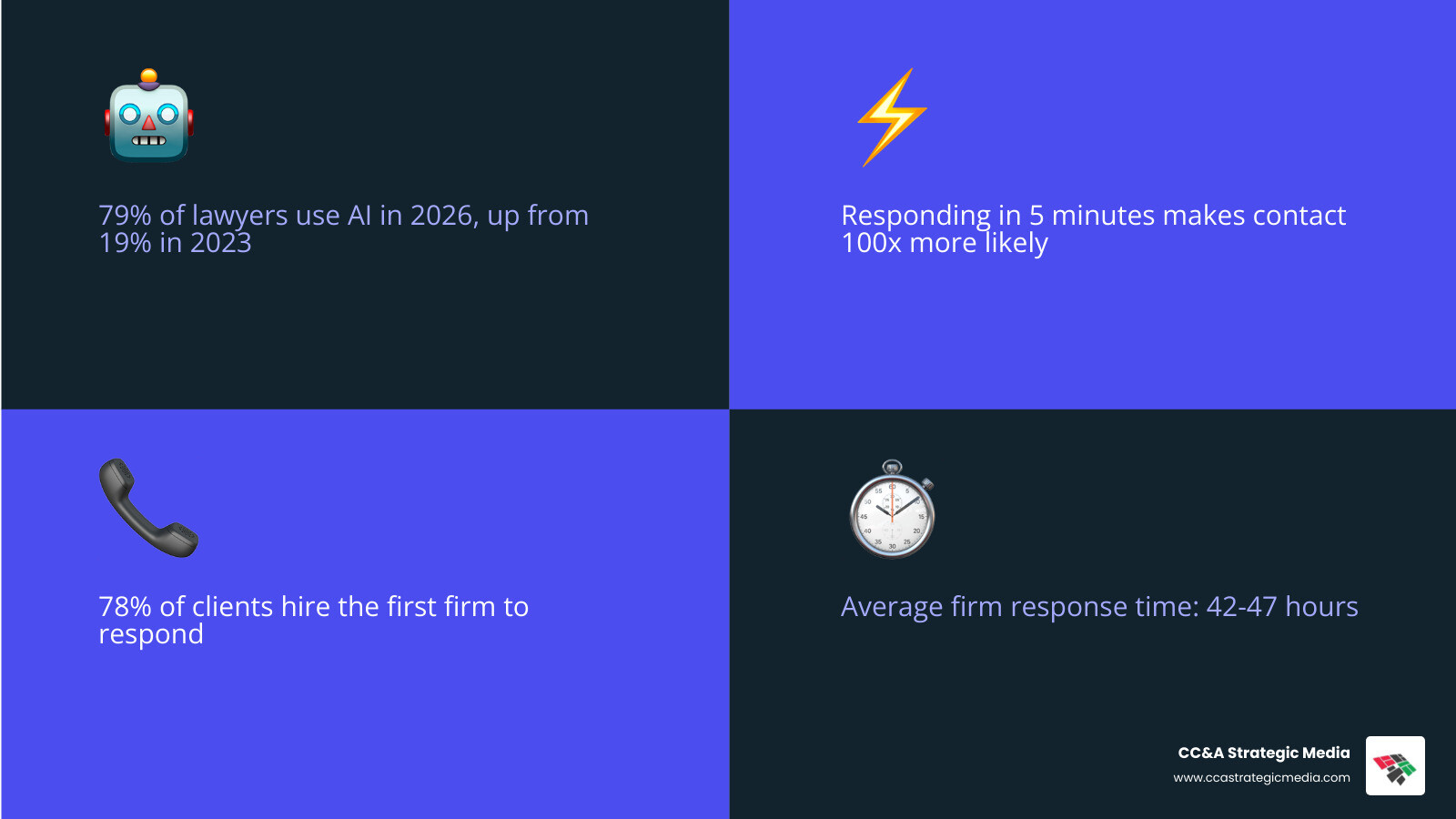
The data tells a striking story. In May 2026, 79% of lawyers report using AI — up from just 19% in 2023. Yet most are using it for basic tasks that do not move the revenue needle. Meanwhile, a smaller group of firms is using AI in a fundamentally different way: not to generate blog posts, but to answer leads in seconds, qualify callers at 3 AM, and feed real case data back into their ad platforms.
The gap between those two groups is growing fast.
Seventy-eight percent of legal consumers hire the first firm to respond — not the most credentialed, not the most visible — the first one to pick up. Yet 48% of law firms are still unreachable by phone, and 39% take more than two hours to respond to a new lead. AI does not fix a bad strategy. But it does eliminate the operational gaps that cost firms signed cases every single day.
I’m Roxanne St. Marie, Marketing Director at CC&A Strategic Media, and my perspective on AI in legal marketing is grounded in nearly two decades of hands-on experience — from managing intake teams at a high-profile firm to building CRM and automation systems that connect marketing directly to signed clients. The insights in this guide reflect what I have seen work, and fail, at every level of a law firm’s growth operation.
Speed and Consistency: The Real Competitive Advantage in 2026
In the legal industry, we often talk about “authority” and “prestige” as the primary drivers of client acquisition. While those matter, the hard data from 2026 suggests a more pragmatic reality: speed is the ultimate currency.
The “5-minute rule” is no longer just a suggestion; it is a mathematical certainty for growth. Research shows that calling a new legal lead within five minutes makes a successful contact 100x more likely than waiting just 30 minutes. If you wait longer, your lead quality drops by a staggering 80%. Despite this, the average law firm response time still hovers between 42 and 47 hours.

This is where AI provides a genuine business infrastructure layer. AI-powered intake systems offer 24/7 availability, ensuring that a potential client reaching out at 2:00 AM on a Saturday receives an immediate, intelligent response. Firms implementing these systems see conversion rate improvements of 30% to 60% simply by capturing after-hours leads that would have otherwise gone to a competitor.
Building a The Complete Guide to Business Strategy for Lawyers requires acknowledging that your firm is often judged by its first interaction. When a firm uses AI to answer within 30 seconds, they see a 40% increase in conversion. Compare that to the 8% conversion rate for firms that take five minutes or more.
| Metric | Traditional Intake | AI-Driven Intake |
|---|---|---|
| Response Time | 2 – 48 Hours | < 30 Seconds |
| Availability | Business Hours | 24/7/365 |
| Contact Likelihood | 1x (Baseline) | 100x Higher |
| Conversion Rate | 8% – 10% | 35% – 40% |
To scale effectively, you must understand Why Your Law Firm Needs a Professional Answering Service to Scale, and in 2026, that “service” is increasingly an AI-human hybrid that guarantees consistency every single time the phone rings.
Where AI Actually Works: Intake, Follow-up, and Ad Optimization
If you want to move the needle on your Marketing Efficiency Ratio (MER), you have to look beyond content. The firms winning with AI aren’t using it for content—they’re using it to sign cases faster. We see the most profound results in three specific operational areas:
1. Intelligent Intake and Qualification
AI voice agents and chatbots are no longer the clunky “Press 1 for Sales” menus of the past. Modern AI for Law Firms 2026: Intake, Research, and Voice Agents can screen callers, capture critical case facts, and even schedule consultations directly into your calendar. One firm we studied tripled its conversion rate from 10% to 35% by using AI-powered screening to ensure attorneys only spoke with qualified, high-value leads.
2. Relentless Follow-up
Most firms give up on a lead after two or three attempts. However, data shows that 95% of converted leads are reached only by the sixth contact. AI-driven “conversion infrastructure” automates this persistence through personalized email and SMS sequences that feel human but require zero manual effort. This ensures no lead falls through the cracks of a busy staff’s schedule.
3. Advanced Ad Optimization
Our PPC Services now rely heavily on machine learning to combat the rising costs of legal keywords, which can reach $400 per click. AI helps in three ways:
- Smart Bidding: Algorithms adjust bids in real-time based on the likelihood of a lead becoming a signed case.
- Fraud Detection: AI identifies and blocks competitor clicks and bot traffic, preventing wasted spend.
- Audience Targeting: By analyzing successful case data, AI finds “lookalike” audiences that mirror your best clients.
Whether you are looking at Digital Marketing Strategies or other legal services, these tools allow for multi-channel coordination that was once only available to firms with million-dollar monthly budgets.

How AI Is Quietly Taking Over Legal Marketing (And Who It Benefits Most)
The firms winning with AI aren’t using it for content—they’re using it to sign cases faster. This shift in focus marks the transition from “marketing as an experiment” to “marketing as business architecture.”
Early adopters are no longer asking if AI can write a blog post; they are asking how AI can reduce their cost per signed client. This leadership mindset is what separates the firms that will dominate the next decade from those that will struggle to keep up with rising acquisition costs.
Strategic Implementation: Signing Cases Faster
To implement AI effectively, you must move beyond tactical “bolt-ons.” The most successful firms are integrating AI directly into their CRM and data feeds. By feeding signed case data—not just lead data—back into platforms like Google and Meta, you train the AI to find more of your most profitable cases. This creates a feedback loop of operational leverage that grows more powerful over time.
Measuring ROI: Beyond the Click
True ROI isn’t measured in clicks or even leads; it’s measured in signed retainers. In 2026, top-performing firms are achieving Marketing Efficiency Ratios of 18:1 to 21:1 by using AI to track the full funnel.
We encourage our clients to move toward attribution modeling that calculates the exact cost per signed client. When you know that an AI-driven intake system reduced your acquisition cost from $1,650 to $920, the decision to scale becomes a matter of math, not guesswork.
Where AI Fails: The Risks of Generic Content and No Strategy
While AI is a powerhouse for operations, it is frequently a liability for content creation when left on autopilot. 92% of brands failed at generative search AI SEO by 2026 because they focused on quantity over quality.
AI fails in legal marketing when:
- It produces raw output: Publishing unedited AI text leads to “hallucinations” (fake citations) and brand dilution.
- It lacks E-E-A-T: Google’s algorithms prioritize Experience, Expertise, Authoritativeness, and Trustworthiness. Generic AI content has none of these.
- There is no strategy: AI can generate 100 blog posts in an hour, but if they don’t target the right keywords or solve a client’s problem, they are just digital noise.
Using SEO Services effectively in 2026 means using AI for keyword intelligence and first drafts, while ensuring every piece of content has strict attorney oversight. Without the human element, you risk ethical compliance issues and a significant drop in organic visibility as search engines move toward “AI Overviews” that only cite truly authoritative sources.
Frequently Asked Questions about AI in Legal Marketing
How does AI improve the cost per signed client?
AI improves the cost per signed client by increasing the conversion rate of the leads you already have. By responding in seconds rather than hours and automating the follow-up process, you sign more cases from the same ad spend. Additionally, AI fraud detection in PPC prevents you from paying for “junk” clicks, further lowering your acquisition costs.
Why do most law firms fail when using AI for content creation?
Most firms fail because they treat AI as a “publish” button rather than a “drafting” tool. They produce high volumes of generic content that lacks specific nuance, specific legal expertise, and a unique brand voice. Search engines now penalize this “mass-produced” content, leading to a loss in rankings and trust with potential clients.
What is the “5-minute rule” and how does AI enforce it?
The 5-minute rule states that your chances of qualifying a lead drop precipitously after five minutes of inactivity. AI enforces this by providing instant, automated responses via SMS, email, or AI voice agents the moment a lead form is submitted. This “instant-on” capability ensures your firm is always the first to respond, which is the single biggest factor in winning a new case.
Conclusion
The quiet takeover of AI in legal marketing isn’t about replacing lawyers; it’s about replacing the inefficiencies that hold law firms back. By focusing on speed, consistency, and data-driven optimization, you can build a firm that is not only more profitable but also more resilient.
At CC&A Strategic Media, we believe in a holistic approach that combines advanced technology with the psychology of sales and marketing. Sustainable growth comes from alignment across your entire business—from the first ad a client sees to the moment they sign a retainer.
Ready to move past the hype and build a system that actually signs cases? Build your firm’s future with a custom content strategy and let us help you turn AI into your firm’s greatest competitive advantage.