Why Marketing Analytics Turns Data Into Better Decisions
Marketing Analytics is the practice of collecting, organizing, and analyzing marketing data to see what drives attention, leads, revenue, and long-term customer value. For business owners and law firms, the fastest way to start is to set clear goals, track a small set of meaningful KPIs, and use the findings to improve the next campaign.
The goal is not to collect every possible metric. It is to answer practical questions: Which channels bring qualified leads? Which messages earn trust? Where is budget being wasted? Strong marketing analytics helps you find useful signals, make clearer decisions, and invest in the work most likely to improve business results.
That matters because many organizations are overloaded with data but short on direction. Marketing analytics connects brand messaging, content, email, paid media, public relations, events, SEO, AEO, and GEO to business outcomes. It helps teams move from “we think this worked” to “here is what changed, why it likely changed, and what we should do next.”
I’m Reagan Collins and I’m a Marketing Manager at CC&A Strategic Media. My work in Marketing Analytics focuses on turning complex performance data, audience behavior, and campaign insights into clear strategy that helps organizations make smarter decisions and build sustainable growth.
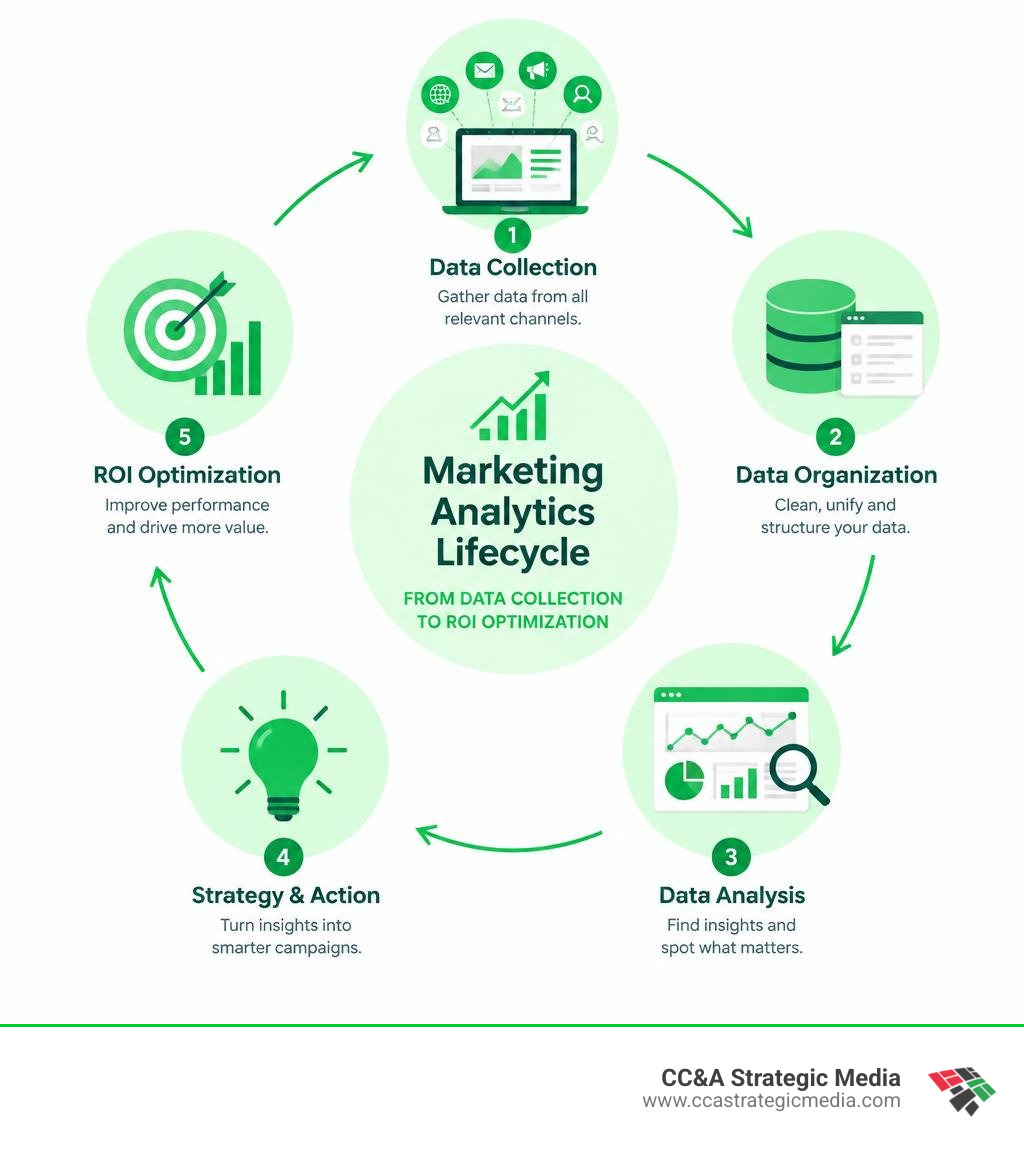
Building an effective analytics engine works hand in hand with core marketing best practices, an authoritative brand messaging strategy, and a structured email marketing funnel.
Core Dimensions of Modern Marketing Analytics
Making sense of customer data requires a clear structure. When an organization collects raw metrics without a taxonomy, teams end up drowning in numbers. In fact, research shows that eighty percent of companies collect more data than they know what to do with, while thirty-eight percent of marketing executives report a serious lack of internal data skills. To turn that chaos into clarity, we break modern analytics into three distinct dimensions: descriptive, predictive, and prescriptive analysis.
Descriptive analytics looks backward. It answers the question, “What happened?” This covers your baseline website visits, email open rates, click-through rates, and historical lead volume. It is like reviewing last month’s performance report. You get the final tally and see which channels produced results, but it does not tell you how to improve the next campaign.
Predictive analytics uses historical patterns, statistical models, and machine learning to ask, “What is likely to happen next?” By analyzing past buying cycles and customer engagement, predictive models estimate future conversion rates, forecast seasonal demand, and identify prospects showing high intent before they ever fill out a form.
Prescriptive analytics represents the most advanced layer by answering, “What specific action should we take?” Rather than simply forecasting a trend, prescriptive systems recommend budget shifts, suggest ideal content delivery times, or dynamically alter ad creative to maximize return on investment.
When these three tiers operate together, they create a complete view of the buyer journey. Instead of treating every digital touchpoint as an isolated event, your team can observe how brand messaging influences initial discovery, how mid-funnel content builds authority, and how downstream interactions ultimately produce closed revenue.
Conducting an internal SWOT analysis helps marketing leaders evaluate their analytical maturity. The internal strengths might include rich first-party customer records, while weaknesses often involve disconnected software silos. External opportunities appear when adopting automated predictive scoring, whereas threats emerge when shifting privacy regulations disrupt outdated tracking scripts. Aligning these elements ensures your measurement strategy produces real business clarity.
| Analytics Type | Core Focus Question | Primary Business Application | Key Value Metric |
|---|---|---|---|
| Descriptive | What happened in our past campaigns? | Historical reporting, channel traffic reviews, content consumption | Aggregate volume, historical conversion rates |
| Predictive | What trends are likely to happen next? | Lead propensity scoring, churn modeling, pipeline revenue forecasting | Forecasted lifetime value, expected conversion velocity |
| Prescriptive | What concrete action should we execute now? | Automated budget reallocation, dynamic messaging, smart bidding rules | Incremental return on investment, acquisition efficiency |
Evaluating Multi-Channel Performance Across Search and Media
Modern discovery is no longer restricted to typing a few keywords into a traditional search bar. Today, potential buyers discover solutions across search engines, direct AI chat interfaces, specialized social platforms, and digital video. Because of this shift, measuring search visibility requires evaluating standard Search Engine Optimization (SEO), Answer Engine Optimization (AEO), and Generative Engine Optimization (GEO) side by side.
While traditional SEO tracks keyword rankings, organic traffic, and backlink authority, AEO measures how effectively your content provides direct answers for voice search and featured snippets. GEO evaluates how prominently your brand appears within synthesized AI overviews and conversational large language models. Tracking all three ensures your authoritative content remains visible regardless of how your audience searches.
Paid media campaigns require the same level of disciplined scrutiny across search ads, paid social, and retargeting channels. Tracking paid metrics alongside comprehensive modern digital marketing services enables teams to balance short-term lead generation with long-term brand equity, ensuring every advertising dollar supports measurable pipeline growth.
Measuring Audience Engagement and Conversion Impact
High traffic volume means very little if visitors bounce without interacting with your messaging. Measuring meaningful engagement requires looking past vanity metrics like raw impressions and digging into dwell time, scroll depth, asset downloads, and multi-page viewing paths.
Understanding these signals becomes much simpler when evaluating how audience engagement is measured through unified behavioral scoring models. When visitors repeatedly read case studies, watch product demonstrations, and attend webinars, they display genuine buying intent.
To bridge the gap between marketing interest and closed revenue, organizations rely on lead scoring best practices that assign numerical values to specific prospect actions. When a prospect crosses a defined threshold, your sales team receives a warm, qualified lead with full visibility into the exact content that drove their interest.
Essential Frameworks for Attribution and Experimentation
Determining which marketing effort deserves credit for a sale has always been a major puzzle for executives. If a client reads an organic article, attends a webinar, clicks a retargeting ad, and finally books a consultation through an email newsletter, single-touch attribution models fail to capture reality. First-touch models overvalue top-of-funnel awareness, while last-touch models credit only the final conversion mechanism.

Multi-touch attribution solves this blind spot by distributing credit across multiple customer interactions. Linear models distribute credit equally, time-decay models give greater weight to touchpoints closer to the conversion event, and position-based models emphasize the first discovery and final conversion steps.
For broader strategic planning, Marketing Mix Modeling (MMM) uses multivariate regression analysis to quantify how various marketing channels, pricing changes, and external market conditions influence total sales over time. By incorporating enterprise AI campaign insights, modern MMM platforms help marketers separate correlation from true causation, allowing leadership to understand the precise incremental lift generated by each channel.
Designing Marketing Analytics Experiments
Guesswork is the enemy of efficient marketing. Rigorous marketing experimentation relies on structured A/B testing and controlled multivariate trials to validate assumptions before rolling out major budget changes.
Every experiment starts with a clear hypothesis, such as proposing that clarifying a value proposition on a landing page will lift conversion rates. The team then splits incoming traffic between a control version and the experimental variant. Maintaining statistical significance requires sufficient sample sizes and careful controls to prevent seasonal shifts or external promotional pushes from acting as confounding variables.
These testing protocols form the backbone for teams executing how to create a full scope marketing campaign in 7 simple steps, ensuring that creative messaging, ad targeting, and landing page layouts are continuously optimized based on verified empirical performance.
Calculating Brand Equity and Customer Lifetime Value
Strong brands command price premiums and enjoy higher customer retention rates. Measuring brand value involves analyzing brand architecture, tracking branded search query growth, assessing revenue premiums compared to generic market alternatives, and monitoring customer loyalty metrics over time.
Customer Lifetime Value (CLV) represents the total net profit an organization expects to earn from a customer relationship throughout its duration. Calculating CLV involves multiplying average purchase value by purchase frequency, and then multiplying that figure by average customer lifespan.
Comparing CLV against Customer Acquisition Cost (CAC) yields the critical CLV-to-CAC ratio. A healthy business model typically maintains a ratio of three to one or higher, proving that marketing investments generate sustainable, compounding returns rather than fleeting transactional spikes.
Building an Agile Marketing Analytics Technology Stack
Executing modern analytics requires an integrated technology foundation. Modern stacks combine specialized data collection platforms, secure data warehousing, business intelligence engines, and automated reporting interfaces.
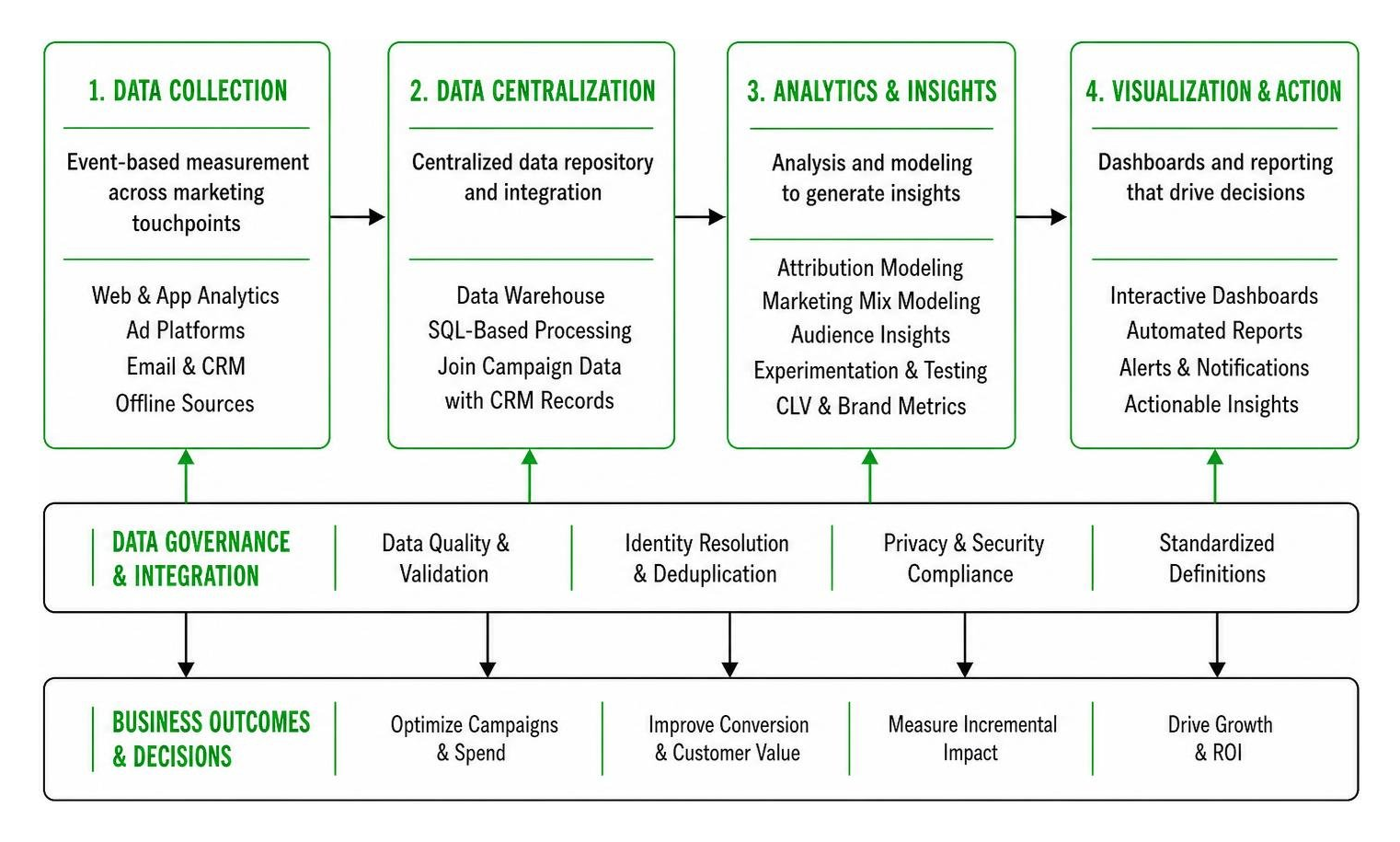
Teams begin by configuring Google Analytics using an event-based measurement model to track custom interactions, pipeline milestones, and user navigation paths across web properties. These behavioral signals flow into centralized data repositories where analysts use structured query language (SQL) to join campaign metadata with customer relationship management (CRM) records.
Deploying an audience insights platform allows teams to uncover deep demographic traits, content affinities, and purchase motivations. Coupling these data layers with visualization dashboards transforms complex spreadsheets into clear, visual narratives that executives can understand and act upon in seconds.
Integrating AI within Marketing Analytics Systems
Artificial intelligence has fundamentally changed how marketing teams process information. Machine learning algorithms can automatically parse millions of rows of data to detect unexpected performance drops, identify emerging customer segments, and flag rising acquisition costs long before human analysts spot the trend.
AI-powered natural language processing also enables conversational reporting interfaces, allowing marketing leaders to type plain-language queries and receive instant visual breakdowns of campaign trends. Marketers looking to build these capabilities into their organizations frequently pursue professional AI marketing analytics training to master automated forecasting, algorithmic attribution, and machine learning workflows.
Managing Budget Allocation and Data Governance
Marketing budgets must balance short-term demand capture with long-term brand development. As privacy regulations expand and third-party browser cookies disappear, relying on third-party tracking has become unsustainable. Organizations must pivot toward robust first-party data capture through permission-based opt-ins, exclusive content, and direct customer interactions.
Establishing clear data governance protocols ensures compliance with regional data privacy laws while safeguarding customer trust. When planning financial resources, structuring a business marketing budget around clean, first-party data intelligence allows leaders to eliminate wasted spend and direct capital toward channels that deliver proven revenue.
Career Trajectories and Strategic Execution
Demand for skilled marketing analytics professionals continues to climb across professional services, technology firms, and corporate enterprises. Labor statistics project thirteen percent employment growth for market research analysts from 2022 to 2032, translating to roughly 94,600 annual openings across the industry, while specialized marketing data analyst roles show an expected nineteen percent growth trajectory.

Success in this field requires combining technical competence with strategic communication. While mastering SQL, data visualization tools, and statistical modeling provides the technical foundation, the most valuable professionals excel at data storytelling. They translate complex analytical findings into actionable business advice that non-technical stakeholders and executive leaders can trust to guide high-stakes investments.
Frequently Asked Questions about Marketing Performance Tracking
What is the most reliable way to begin tracking marketing performance?
The most effective starting point is conducting a complete audit of your existing first-party data assets and customer touchpoints. Identify three to five core business metrics that directly reflect financial health, such as qualified lead volume, customer acquisition cost, and conversion rate. Configure a clean analytics platform with verified event tracking, establish a consistent tracking taxonomy, and review performance trends regularly before introducing advanced predictive modeling.
How do multi-touch attribution and marketing mix modeling differ?
Multi-touch attribution tracks individual, user-level digital interactions across specific touchpoints like search ads, marketing emails, and organic visits. Marketing Mix Modeling operates at an aggregate level, using top-down statistical regression to measure the influence of all online and offline marketing channels alongside broader external factors like pricing and economic trends. MTA provides tactical campaign optimization, whereas MMM guides macro-level budget allocation.
How does generative AI alter standard marketing measurement?
Generative AI streamlines analytics workflows by automating manual data normalization, drafting initial performance summaries, and monitoring live campaign feeds for performance anomalies. It allows marketing managers to query massive datasets using conversational language and receive real-time scenario forecasts, transforming performance reporting from a retrospective weekly task into a continuous, proactive optimization cycle.
Conclusion
In my work with CC&A Strategic Media, I focus on connecting marketing strategy with clear, practical analytics that help businesses make smarter decisions. Sustainable growth comes from understanding audience behavior, digital reputation, search visibility, and brand consistency. Data points the way, but human insight, strategic thinking, and strong messaging turn those numbers into real customer trust.
Transforming raw numbers into lasting revenue demands operational consistency. Through our Strategic Ops approach, we provide organizations with the complete operational foundation behind sustainable growth, combining a Fractional Leadership Team, Dedicated Marketing Coordination, and Full-stack Agency Service Execution. If you are ready to eliminate data confusion, align your marketing investments with real business goals, and build an analytics engine that drives measurable revenue, I invite you to connect with me and explore partnering with CC&A Strategic Media leadership to accelerate your organization’s growth.