Build an Email Marketing Funnel That Converts and Retains
An email marketing funnel is a planned set of automated emails that moves people from first sign-up to purchase, repeat business, and referral. Build one by matching every email to a customer action: capture the opt-in, send a useful welcome message, nurture interest with relevant education, trigger conversion emails when intent is high, and follow up after purchase to support retention.
Unlike a broad marketing funnel that includes search, social media, ads, and sales outreach, email is a permission-based channel you own. That makes it especially useful for building a direct relationship over time. A strong funnel does not treat every subscriber the same. It uses their sign-up source, page visits, content clicks, stated preferences, and purchase behavior to make the next message more useful.
For business owners and marketing leaders, the goal is not simply more opens. It is a clearer path from lead capture to measurable revenue and customer loyalty. Start by understanding your target audience for email marketing, then create a sequence that answers their questions before asking for the sale.
I am a marketing manager with experience building integrated B2B technology and professional-services marketing strategies across email, content, SEO, and digital campaigns. I approach the email marketing funnel as part of a connected customer journey, where clear messaging and useful data help turn attention into trust and growth.
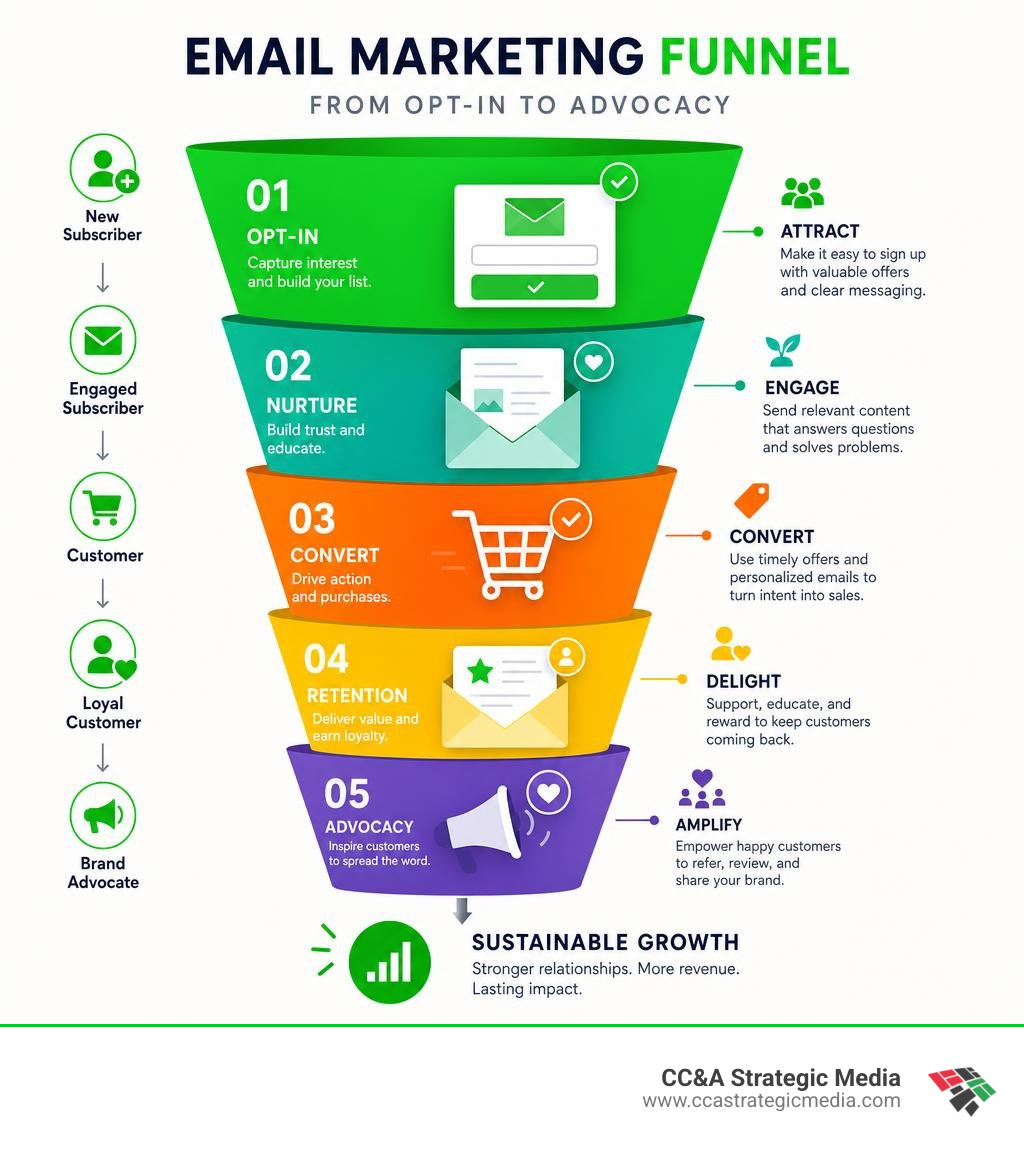
Developing an effective funnel also requires aligning your automated sequences with a cohesive brand messaging strategy and broader multichannel initiatives like social media branding to ensure clear, consistent messaging across every touchpoint.
Understanding the Strategic Mechanics of Email Funnels
Acquiring new clients has become increasingly expensive as digital ad channels grow more crowded. When paid acquisition costs climb, your owned audience assets become your greatest competitive advantage. An email funnel acts as an automated bridge between initial curiosity and lasting client loyalty. Rather than relying on constant manual outreach or hoping a prospective buyer remembers your website, a well-engineered email architecture systematically guides prospects forward. It uses behavioral triggers to deliver the exact message a prospect needs at the exact moment they need it.
This process relies heavily on micro-commitments. When someone hands over their email address in exchange for an insightful resource, they have taken a foundational step. By delivering immediate value and continuing to present relevant, helpful insights, you earn the right to ask for larger commitments, such as booking an evaluation call or purchasing a product. As highlighted in Shopify’s email marketing funnel analysis, email creates a compounding trust mechanism that outperforms third-party advertising by turning one-time clicks into ongoing brand equity.
The Shift from Broad Awareness to Lifecycle Progression
Traditional email marketing often treated subscribers like a captive audience at a movie theater, blasting the exact same generic weekly newsletter to everyone on the list regardless of their needs. This batch-and-blast approach ignores where individual people stand in their decision-making process. Modern lifecycle marketing replaces scheduled broadcasts with event-based workflows that react dynamically to subscriber actions.
When you implement practical lifecycle email marketing ideas, you align your messaging with the subscriber mindset. A prospect who just downloaded a beginner whitepaper needs foundational clarity and problem-solving concepts, while someone who visited your service comparison page three times this week requires proof of capability, technical differentiation, and a clear call to action. Aligning content with user behavior improves funnel velocity, moving leads toward a purchase decision without artificial friction or awkward sales pressure.
Capturing Zero-Party Data to Power Segmentation
The most effective email architectures do not guess what subscribers want; they simply ask. Zero-party data is information that a subscriber intentionally and proactively shares with your brand. Unlike third-party data or inferred behavioral tracking, zero-party data gives you direct insight into a buyer’s specific goals, industry, company size, or timeline.
You can collect this high-value data through interactive onboarding quizzes, preference centers, and tailored opt-in forms. For instance, when an e-commerce beauty brand or professional services firm asks a lead about their primary operational challenge during sign-up, they can immediately place that contact into an automated track tailored to solving that exact problem. Incorporating buyer intent signals into dynamic personalization ensures that every email feels like a custom one-on-one conversation, elevating engagement rates and establishing immediate credibility.
Anatomy of a Modern Email Marketing Funnel: Key Stages Explained

A comprehensive lifecycle sequence is not a single linear track. It is a dynamic ecosystem designed to guide prospects through distinct stages of awareness and commitment. According to Klaviyo’s email funnel revenue research, automated lifecycle flows generate outsized returns compared to standard promotional campaigns because they deliver timely relevance rather than broad speculation.
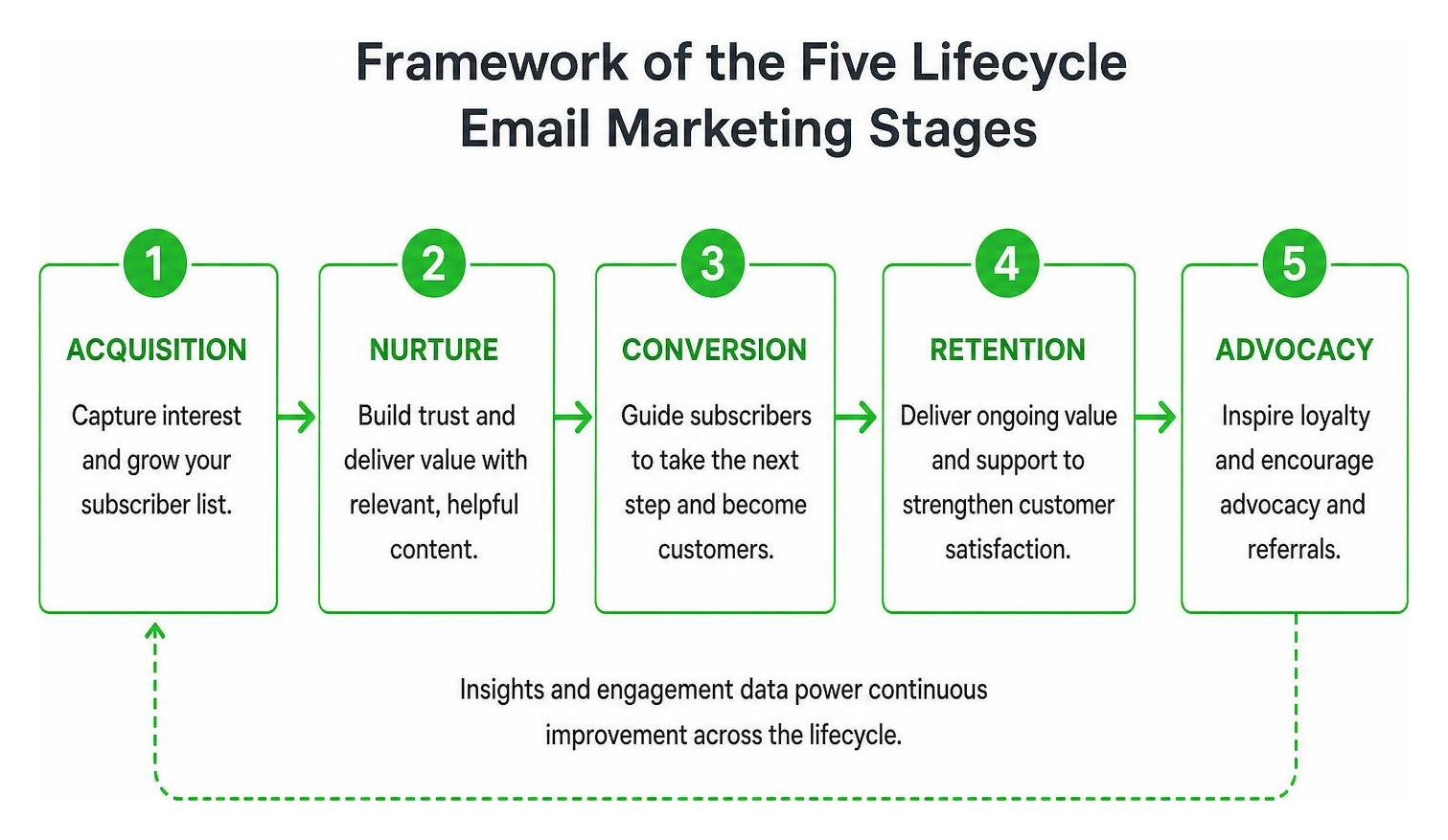
Stage 1: Acquisition and the Initial Welcome Sequence
The journey begins at the acquisition touchpoint. When a visitor lands on your website, a timed opt-in form or valuable lead magnet captures their contact information. The welcome sequence that follows is the single most critical flow you will ever build. Welcome flows across industries consistently deliver some of the highest engagement rates and revenue per recipient of any email asset.
Your welcome sequence must fulfill three goals immediately. First, deliver the promised lead magnet without delay. Second, introduce your brand mission and core values to set clear expectations for future communications. Third, begin shifting the subscriber’s perspective by addressing common misconceptions in your industry. If you run a technical consultancy or an e-commerce shop, this initial sequence sets the tone for a collaborative relationship rather than an aggressive transactional pitch.
Stage 2: Lead Nurturing and Consideration Flows
Once the welcome phase concludes, subscribers enter the consideration stage. At this point, the buyer recognizes their core operational challenge but is evaluating different ways to solve it. Your objective here is not to push for an immediate closing pitch, but to provide authoritative educational content that establishes your team as an industry leader.
Use this sequence to integrate compelling social proof, detailed case studies, and clear technical differentiation. Address common buyer hesitations before they turn into objections. If you provide business software or professional consulting, share real-world scenarios showing how similar organizations solved complex bottlenecks, reduced overhead, and achieved measurable operational efficiency.
Stage 3: Conversion and Cart Abandonment Triggers
When a prospect demonstrates high intent, such as repeatedly viewing a product page, reviewing case studies, or abandoning an online checkout, automated conversion triggers must fire. These emails are designed to eliminate friction and provide clear, confident calls to action.
Effective conversion emails combine gentle urgency cues with supportive customer service. Rather than assuming the prospect chose not to buy, treat the abandoned cart or incomplete form as a sign that they might have questions. Incorporate answers to frequently asked questions, highlight flexible payment or contract options, and remind them of the tangible value waiting on the other side of their decision.
Stage 4: Onboarding, Retention, and Re-Acquisition
The conversion event is the beginning of the customer relationship, not the finish line. Post-purchase and onboarding flows are crucial for driving product adoption, reducing buyer remorse, and securing high client lifetime value. These early post-sale communications should guide the new client through setup, highlight overlooked features, and celebrate quick operational milestones.
Implementing thoughtful client retention strategies inside your email system protects your recurring revenue. Retention flows should check in periodically, offer advanced best-practice guides, and proactively identify accounts that may need additional support. For subscribers who go silent or pause their service, structured win-back flows can re-ignite engagement with relevant updates, new service capabilities, or exclusive incentives.
Stage 5: Brand Advocacy and Community Expansion
The final stage of the lifecycle transforms satisfied clients into active brand advocates. Loyal customers who achieve consistent success with your products or services are often eager to share their experiences with peers, provided you make the process straightforward and rewarding.
Design automated flows that invite satisfied clients to leave reviews, participate in client spotlights, or join exclusive VIP loyalty programs. For product-based businesses, this stage introduces intelligent cross-selling logic based on past order history. For B2B organizations, it provides a channel to introduce strategic service expansions, executive roundtables, and referral incentives that turn a single client into an ongoing source of qualified leads.
Executing Step-by-Step Automation Across Customer Lifecycles
Building a high-performing email engine requires enterprise-level orchestration and clean operational hygiene. Rather than setting up isolated autoresponders, you need an integrated architecture that routes contacts based on their real-time engagement and profile attributes. Modern marketing automation solutions provide the visual workflow builders and behavioral segmentation rules necessary to execute these complex paths seamlessly.
As outlined in CleverTap’s lifecycle stages guide, treating email as an event-driven lifecycle engine rather than a static campaign channel ensures your business remains responsive to market changes. By defining strict entry and exit criteria for every stage, you ensure that subscribers never receive conflicting messages or irrelevant promotions while evaluating a strategic proposal.
How to Build an Email Marketing Funnel for B2B and B2C Audiences
While the fundamental lifecycle stages remain consistent across all business models, the execution differs dramatically between B2B and B2C audiences. Understanding these differences ensures your sequences match your audience’s buying habits and operational realities.
| Funnel Dimension | B2B Email Marketing Funnel | B2C Email Marketing Funnel |
|---|---|---|
| Primary Audience | Buying committees, department heads, executives | Individual consumers, end-users |
| Sales Cycle Duration | Extended (weeks, months, or quarters) | Short (minutes, days, or weeks) |
| Decision Drivers | ROI, risk reduction, operational efficiency | Emotion, convenience, personal preference |
| Primary Content Focus | Whitepapers, case studies, technical consultations | Product highlights, lifestyle visuals, user reviews |
| Conversion Action | Booking a demo, consultation, or custom proposal | Direct online checkout, subscription sign-up |
| Sequence Complexity | Multi-branch logic based on job title and intent | Fast-moving triggers based on browsing and cart actions |
In B2B environments, your emails must speak to multiple stakeholders who care about compliance, implementation timelines, and measurable financial returns. In consumer marketing, the focus shifts toward visual storytelling, immediate social proof, and seamless mobile checkouts that capture fast-moving intent.
Avoiding Common Automation Pitfalls and Delivery Bottlenecks
Even the most thoughtfully written email copy will fail if your technical delivery infrastructure is compromised. Marketers frequently encounter common pitfalls of marketing automation, such as creating overly tangled branching logic that sends duplicate emails, or failing to establish global suppression rules that prevent message fatigue.
Technical deliverability requires constant attention to your sender reputation. To lower email bounce rates, start by enforcing strict list hygiene, removing inactive or invalid addresses, and setting up proper sender authentication protocols including SPF, DKIM, and DMARC records. A healthy domain reputation ensures your carefully crafted lifecycle sequences consistently reach the primary inbox rather than languishing in the spam folder.
Performance Tracking and Funnel Optimization
Measuring Success Across Your Email Marketing Funnel

Measuring the performance of a multi-stage email system requires looking beyond top-level open rates. With modern inbox privacy protections caching assets and generating automated opens, forward-thinking marketing teams focus on behavioral engagement and financial outcomes.
Evaluate your funnel using a balanced scorecard of leading and lagging indicators. Stage-specific click-through rates reveal whether your educational messaging resonates with your audience, while click-to-conversion rates demonstrate whether your landing pages and service offers match the expectations established in your email copy. Tracking revenue per recipient serves as the ultimate benchmark for lifecycle flow efficiency across both introductory and expansion sequences.
Long-term metrics provide essential context for strategic health. Cohort retention lift helps you evaluate how effectively your post-purchase onboarding reduces churn over a ninety-day or annual timeline. In addition, funnel velocity tracking uncovers where prospects stall in the decision-making process, allowing you to refine your educational materials and accelerate sales cycles.
Continuous A/B Testing and Sequence Refinement
Optimization is an ongoing process of refinement rather than a one-time project. High-performing growth teams regularly test individual elements within their email sequences to discover what drives the strongest response from their audience.
Focus your experimentation on meaningful variables. Test contrasting value propositions in your subject lines to see which pain points capture attention. Experiment with plain-text personal formatting versus rich visual templates during consideration phases to determine what builds deeper trust with technical buyers. Audit your sequence drop-off points regularly to identify emails with high unsubscribe rates or low engagement, revising the underlying copy, timing, or call to action to keep subscribers moving smoothly forward.
Frequently Asked Questions About Email Marketing Funnels
What is the primary difference between an email marketing funnel and an email blast?
An email blast is a single, static message broadcast to an entire list at a specific time, regardless of individual interests or lifecycle stages. An email marketing funnel is an automated, behaviorally triggered architecture that delivers personalized messages to individuals based on their specific actions, entry points, and readiness to buy.
How often should subscribers receive emails during a nurture sequence?
Cadence should always be dictated by engagement levels and the natural complexity of your offering. For high-intent welcome sequences, sending three to four educational emails over the first ten days maintains momentum. For ongoing B2B nurture tracks, a consistent weekly or bi-weekly schedule keeps your brand top of mind without causing audience fatigue or elevated unsubscribe rates.
Which metrics are most important for diagnosing a leaky funnel stage?
The most effective diagnostic metric is the stage-by-stage click-through rate combined with exit rates. If a specific email in your sequence experiences a sharp decline in clicks or a sudden spike in unsubscribes, it usually indicates a disconnect between what the subscriber expected and the content provided. Auditing these specific touchpoints allows you to repair the leak and restore healthy conversion flow.
Conclusion
Building a high-performing email marketing funnel is not about filling inboxes with endless promotional pitches. It is about creating a structured, customer-centric journey that honors the subscriber’s time, provides actionable value, and smoothly guides them toward a mutually beneficial business relationship. When you align your messaging with real customer behavior, your email ecosystem transforms from a simple messaging tool into a reliable engine for scalable growth.
If your team is ready to audit its current lifecycle workflows, modernize its technical delivery infrastructure, or launch an integrated marketing strategy that drives sustainable revenue, we can help. I invite you to connect with our team at CC&A Strategic Media to turn your audience data into a lasting competitive advantage. You can also explore my other marketing insights to stay ahead of the latest trends in digital strategy and customer lifecycle marketing.