Core Components of an Effective Messaging Framework
A comprehensive brand messaging strategy serves as the bridge between internal core values and external audience engagement. When market conditions shift rapidly, the way an organization communicates must reflect clarity, authority, and emotional resonance. Achieving consistent market expansion requires more than transactional copy. It demands a structured approach to communication that resonates across every touchpoint. Organizations that align their communication framework discover that clarity directly correlates with sustainable revenue performance.
At CC&A Strategic Media, we approach communication by analyzing data, understanding core organization values, and evaluating target demographics to drive meaningful business expansion. By integrating sales psychology with marketing technology, we help business leaders elevate their market voice. Our Strategic Ops framework provides the operational foundation businesses need to execute high-impact strategies. Through fractional leadership, dedicated marketing coordination, and full-stack execution, Strategic Ops translates abstract ideas into measurable marketplace growth.
Brand Positioning vs Brand Messaging Strategy
Understanding the functional distinction between brand positioning and brand messaging is critical for business leaders. Brand positioning represents the internal strategy detailing how an organization sits within the competitive market relative to alternatives. It outlines target categories, primary differentiators, and functional capabilities in market-agnostic terms. Brand positioning acts as the blueprint for internal alignment, setting boundaries for strategic direction.
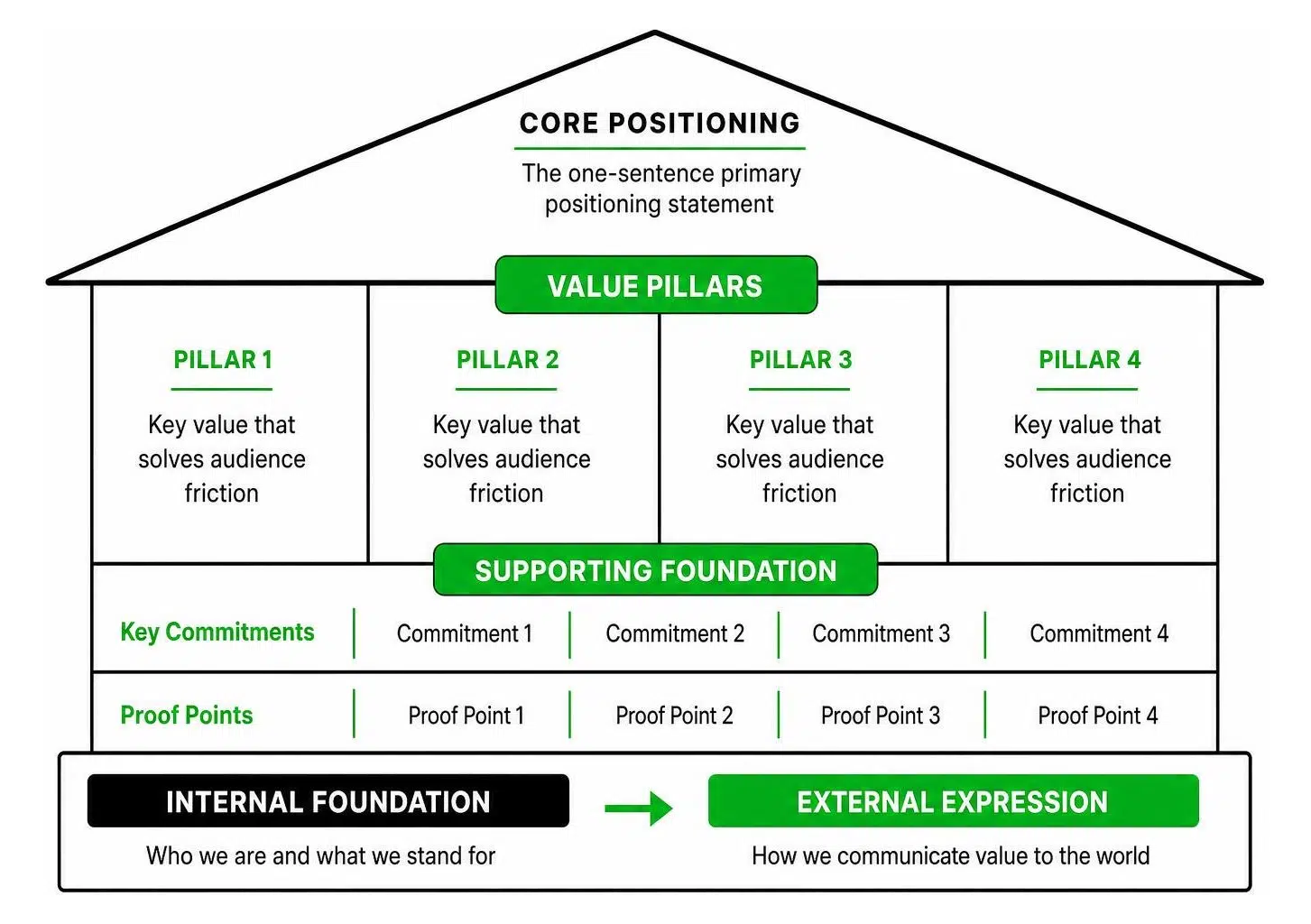
Brand messaging is the external expression of that positioning strategy. If brand positioning is the internal foundation, brand messaging is the bridge built to reach the customer. This relationship operates on a parent-child model. Positioning defines the organizational context, while messaging translates those operational truths into dynamic narrative copy. Understanding how to nail your brand positioning and messaging ensures that internal strategy aligns perfectly with customer communication. Strategic brand marketing relies on this dual structure to build audience trust over time.
The Psychology of Emotion in Brand Messaging Strategy
A fundamental reality of human behavior is that decisions are entirely emotional rather than purely logical. Neuroscientific research conducted by Dr. Antonio Damasio demonstrated that individuals with damage to the emotional centers of the brain retain logical capacity but struggle to make simple decisions. Logic processes facts and functional features, but emotion creates the non-logical leap required to reach a buying decision.
Organizations often focus heavily on functional product features while overlooking subconscious customer rewards. B2B decision-makers and business leaders purchase solutions to eliminate internal friction, lower operational stress, or elevate personal leadership standing. Effective strategic communication targets these subconscious rewards. Moving from basic product statements to brand-led identity allows companies to transcend simple transactional comparisons, creating deep market alignment and trust.
A functional messaging house organizes verbal strategic assets into an operational tool for content creators, sales professionals, and corporate leaders. Building a complete narrative framework requires structural discipline. At its peak lies the core positioning statement, supported by three to four foundational value pillars that solve target audience friction. Beneath these pillars lie specific organizational commitments and tangible proof points.
| Strategic Component | Internal Brand Positioning | External Brand Messaging |
|---|---|---|
| Primary Audience | Internal teams, board members, and executive leaders | External prospects, active clients, and channel partners |
| Core Objective | Establish market position and define functional category | Motivate action, build trust, and drive client conversions |
| Tone & Structure | Analytical, operational, and category-focused | Conversational, empathetic, and value-oriented |
| Execution Output | SWOT analysis, category maps, and positioning statements | Value pillars, taglines, website copy, and campaign creative |
Executing a complete SWOT analysis early in this planning phase provides vital strategic depth. Evaluating internal strengths and weaknesses alongside external opportunities and threats ensures that value pillars reflect genuine operational capabilities rather than hopeful claims.
Building Your Unique Selling Proposition and Narrative
Developing a distinctive selling proposition requires identifying a specific market gap and executing a narrative baseline shift. Rather than asserting incremental superiority over competitors, high-performing organizations create contrast between current industry norms and a superior future state. This contrast relies on balanced market tension. If a new positioning concept is too subtle, the market finds it boring; if it is too extreme, the market views it as risky. Achieving balance means changing market baselines while keeping solutions grounded in customer needs.
In my career leading marketing strategy across technology and professional service environments, I have observed that authentic narrative strategy always outperforms artificial promotion. Early in my career, I led a message overhaul for a growing software firm. The company possessed superior feature capability, but prospective clients struggled to understand its unique value. By shifting our narrative away from product features toward solving operational complexity, we transformed baseline market conversations. This focus on clear identity elevated market presence, demonstrating how a refined brand messaging strategy drives sustainable growth.
Audience Centricity, Personas, and Customer Values
A high-performing messaging strategy relies on accurate customer persona development and deep psychographic mapping. Relying solely on basic firmographic or demographic data leaves messaging superficial. Utilizing the Jobs-to-Be-Done framework allows organizations to map the functional, emotional, and social outcomes clients seek when hiring a partner.
Establishing client alignment also requires addressing core operational trust drivers. Organizational trust relies on demonstrating organizational empathy by understanding client challenges, maintaining absolute operational transparency in professional interactions, validating service capabilities through documented project execution, and maintaining long-term reliability through consistent client performance.
Integrating these core trust pillars creates human-centric communication. Prioritizing client value outcomes builds genuine social proof that builds brands over time.
Practical Steps to Implement and Align Messaging Across Channels

Translating high-level strategy into everyday execution across channels requires cross-functional alignment. A primary narrative must adapt gracefully across website copy, executive keynotes, digital content, and direct sales conversations without losing its core identity. Establishing clear tone guidelines and explicit voice boundaries keeps messaging focused across distribution channels.
Integrating visual identity with verbal narrative creates a unified client experience. Visual elements reinforce verbal tone, ensuring that written communication matches visual design. Through CC&A Strategic Ops, we help businesses implement strategic messaging across channel networks, providing fractional leadership and tactical agency support to deliver unified marketing campaigns.
Internal Alignment and Overcoming Organisational Friction
Corporate narrative strategies frequently decay inside the organization due to internal friction, functional siloing, and disconnected leadership priorities. When sales reps, product managers, and executive leadership tell conflicting stories, external messaging falls apart. Overcoming internal friction requires active executive buy-in, stakeholder enablement programs, and clear internal communication standards.
Understanding why brand messaging falls apart inside the building highlights the importance of internal alignment. Establishing continuous training and clear guidelines helps organizations prevent message drift. Maintaining unified internal understanding supports effective thought leadership marketing and positions the enterprise as the secret sauce of becoming a go-to industry resource.
Testing, Refining, and Iterating Your Brand Narrative
A high-performing corporate messaging framework should function as an evolving asset rather than a rigid document. Continuously optimizing core narrative performance requires structured testing across public channels. A multi-step iteration approach ensures ongoing relevance:
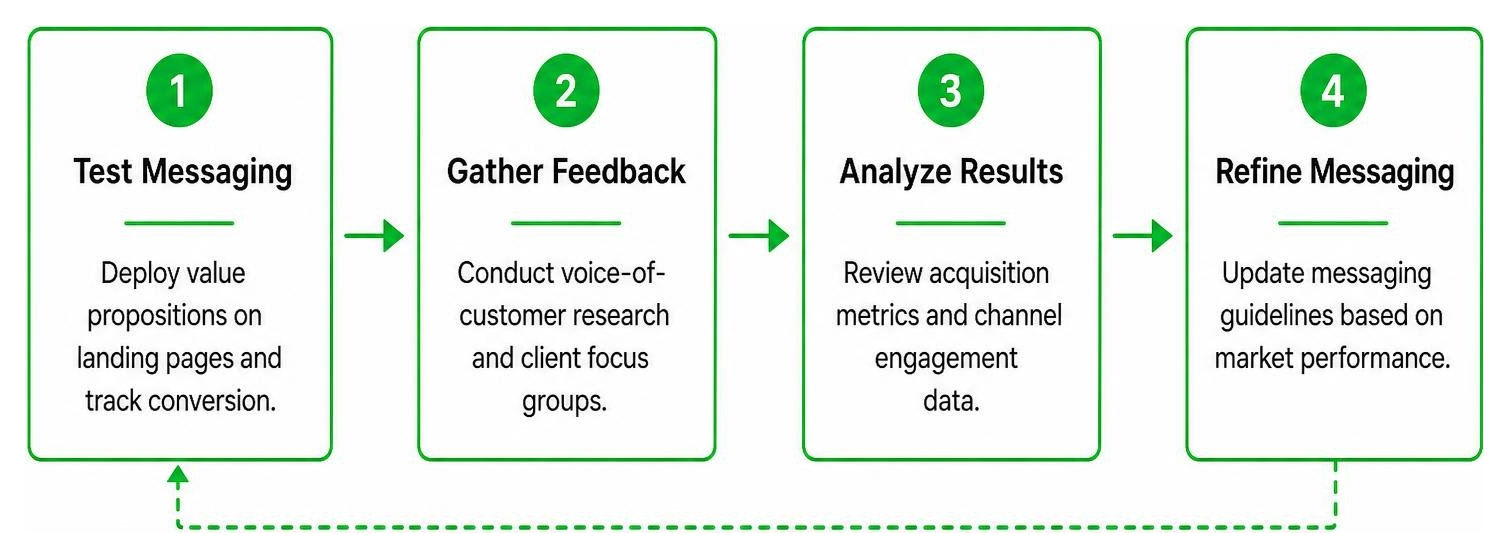
A structured iteration model begins by deploying target value propositions across dedicated landing page experiments to track conversion velocity. Organizations then conduct direct voice-of-customer research and client focus groups to gather qualitative feedback. Next, strategic leaders review quantitative client acquisition metrics and channel engagement data to evaluate resonance. Finally, marketing teams refine messaging guidelines based on empirical market performance.
Tracking audience engagement data allows organizations to optimize messaging over time. Systematically updating value propositions builds a dynamic narrative model that adapts to changing audience expectations, laying a strong foundation to increase brand recognition.
Common Messaging Pitfalls and How to Avoid Them
Organizations frequently encounter strategic pitfalls that weaken their market positioning. Delusional differentiation occurs when leadership invents differences that clients find irrelevant. Broad audience targeting poses a similar risk; trying to appeal to every market segment leads to generic messaging that fails to connect with anyone.
Unfulfilled promises present an even greater threat to market reputation. An exaggerated promise that fails during service delivery erodes client trust faster than poor marketing ever could. Every messaging pillar must stand on verifiable proof points. Furthermore, when adjusting core messaging, organizations must give clear advance notice to existing clients. Shifting identity without warning confuses loyal customers and damages client relationships. Avoiding these common traps protects long-term brand equity and strengthens your brand messaging strategy.
Frequently Asked Questions About Brand Messaging
How often should a business update its brand messaging strategy?
A baseline framework review should occur annually, while minor message updates happen alongside new product launches or strategic adjustments. Foundational brand strategy should remain stable, but external value statements must adapt as market conditions, client behaviors, and competitive environments change.
What is the most effective way to test new brand messaging?
The most reliable method combines quantitative digital split-testing with qualitative voice-of-customer interviews. Running targeted split-tests on digital campaigns measures direct engagement rates, while direct client research reveals the emotional drivers behind conversions.
How does brand messaging differ across industries?
While core principles like narrative clarity and audience empathy apply universally, operational delivery varies by sector. High-velocity technology platforms focus on speed and operational efficiency, whereas professional service organizations prioritize trust, capability, and long-term risk reduction. Customizing strategy to sector nuances is essential, whether developing tailored marketing strategies for nonprofit organizations or designing high-growth marketing strategies for software technology businesses.
Strategic Value Realization
Crafting an effective brand messaging strategy requires combining sales psychology with structured market analysis and clear cross-channel execution. When organizations align internal positioning with client values, communication becomes an engine for long-term growth.
At CC&A Strategic Media, we deliver data-driven strategies that help executive teams elevate market position, refine narrative frameworks, and achieve measurable expansion. Through CC&A Strategic Ops, we provide the dedicated coordination, leadership, and operational execution businesses need to turn strategic vision into revenue performance. Connect with me to transform your brand messaging strategy and position your organization for sustainable success.