The Business Case for Becoming the Go-To Voice in Your Industry
Thought leadership is the practice of building genuine authority in your field by consistently sharing original insights that change how people think, decide, and act.
In practice, this means being the trusted expert your audience turns to first because your ideas consistently prove your value. This approach requires specialized knowledge, a clear point of view, original research or frameworks, and the discipline to share them consistently. Ultimately, it delivers stronger brand credibility, shorter sales cycles, premium pricing power, and inbound opportunities that traditional marketing cannot manufacture. It is fundamentally different from publishing generic blog posts, repurposing obvious advice, or simply calling yourself an expert.
More than 70% of B2B buyers fully define their needs before they ever talk to a sales representative. By the time a prospect reaches out, they have already been forming opinions — about your industry, your category, and your competitors. The businesses that shape those opinions early are the ones that win.
That is the core promise of thought leadership. It is not a content tactic. It is a long-term business strategy that positions your brand as the obvious choice before the conversation even begins.
Yet most businesses get it wrong. They produce content that looks like thought leadership but lacks the depth, originality, and genuine perspective that actually moves decision-makers. According to research from Edelman and LinkedIn, 71% of decision-makers say less than half of the thought leadership they consume gives them any real insight. The bar is low — and that is actually good news for businesses willing to clear it.
The term itself has a complicated history. It first appeared in a 1990 prominent business publication, was later revived by marketers, and has since earned a fair share of eye-rolls for being overused and vague. Critics are not entirely wrong. Much of what gets labeled thought leadership is little more than dressed-up self-promotion. But that criticism points to an opportunity, not a reason to avoid it. Done with honesty, depth, and genuine value, thought leadership remains one of the most powerful growth levers available to any business.
I’m Stephen Taormino, Founder and CEO of CC&A Strategic Media, and over 25 years of leading a digital marketing agency I have seen how thought leadership transforms businesses — not just by raising visibility, but by fundamentally changing the quality of relationships, leads, and revenue a brand attracts. In the sections ahead, I will walk you through exactly how to build it.
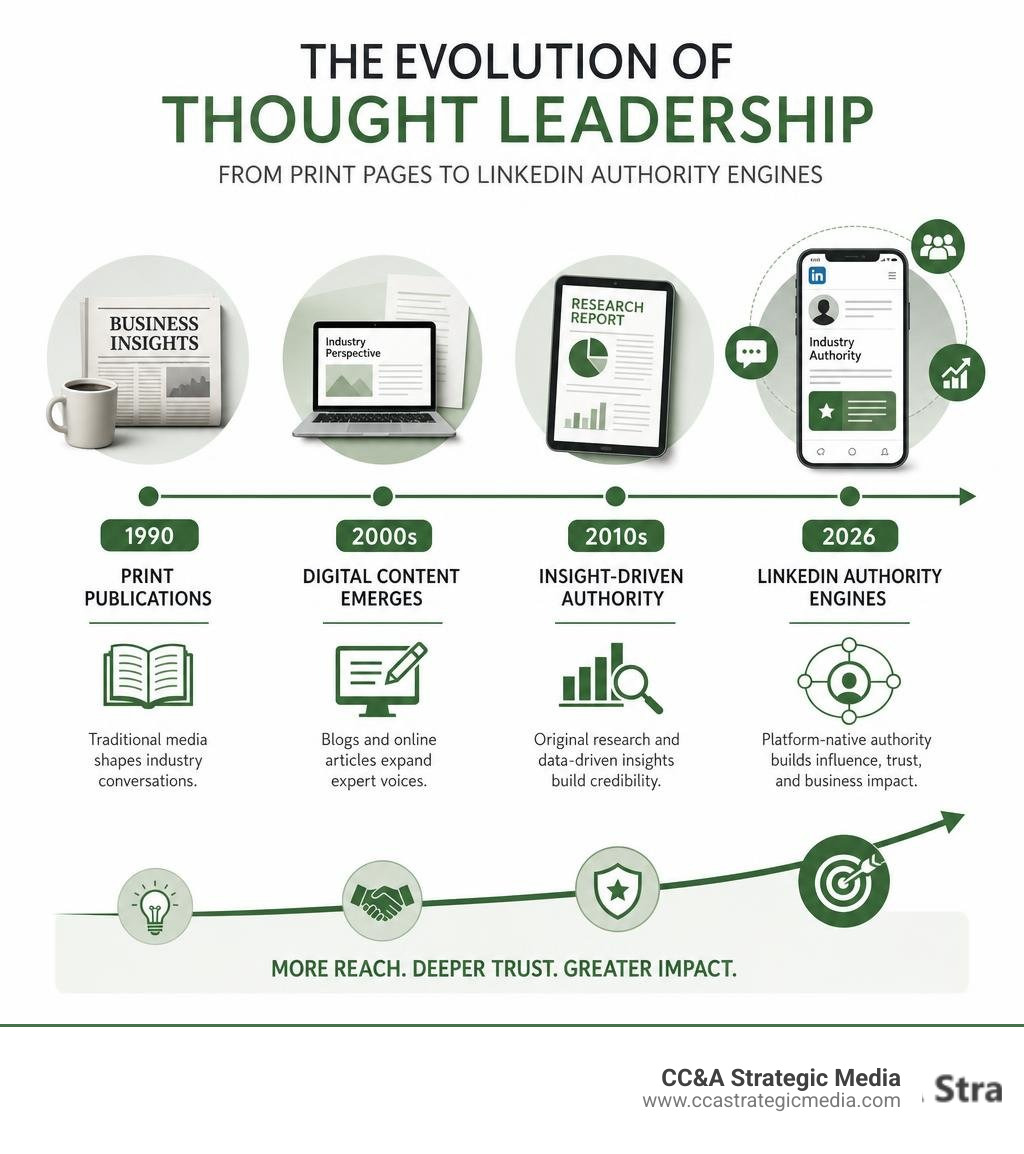
Defining Thought Leadership in the 2026 Business Landscape
To understand how to build real authority today, we must first establish a clear, modern definition of what we are creating. True thought leadership is not merely a collection of opinions or a series of promotional social media updates. According to foundational definitions established by leading professional marketing associations, which you can explore in detail through What is the Definition of Thought Leadership? , it is the expression of ideas that demonstrate deep, proven expertise in a specific field. It is about introducing convention-breaking ideas that address the biggest questions on your audience’s mind while simultaneously surfacing emerging issues that are not yet on their radar.
This perspective is echoed in professional networks, where the concept has evolved from simple content sharing into a highly strategic business function. As outlined by What is Thought Leadership? | LinkedIn , true industry authority means sparking meaningful customer conversations and shaping business decisions through engaging, original, and highly authentic content. It is the outcome of being a trusted, respected voice with a strong, defensible point of view.
When we look at the business landscape of June 2026, we see that the proliferation of artificial intelligence has made generic information cheap and incredibly abundant. In this environment, credibility is your only sustainable competitive advantage. True authority is not about being the loudest or the most frequent poster. It is about being the person or the organization that translates real-world expertise into memorable, repeatable frameworks that others can share, trust, and act upon.
The Difference Between Content Marketing and Thought Leadership
Many organizations mistakenly use the terms content marketing and thought leadership interchangeably, yet they serve fundamentally different purposes within a healthy business architecture. Traditional content marketing is designed to answer immediate, tactical questions. It is the educational foundation that guides prospects through the standard sales cycle, explaining how products work, comparing features, and addressing direct user inquiries. It is highly effective for capturing existing search demand and nurturing top-of-funnel leads.
In contrast, our approach to Thought Leadership Marketing focuses on shifting paradigms and establishing a distinct brand ethos. While content marketing answers the questions your audience is already asking, authority-driven content teaches them how to think about those questions in the first place. It is the difference between writing a guide on how to implement a software tool and publishing a framework that redefines how an entire industry manages its operational workflow. This higher-level approach builds deep, systemic trust and often leads to category creation, allowing your business to operate in a market of one.
Addressing the “Jargon” Criticism
We must address the elephant in the room: the phrase itself has frequently been dismissed as meaningless management speak. Satirical parodies, such as David Brooks’ famous column mocking the predictable lifecycle of self-proclaimed experts, and various media parodies of tech-conference style presentations, highlight how easily the concept can slide into empty business jargon. When any professional with a social media profile can claim the title, the currency of authority becomes diluted.
To overcome this criticism, we must treat authority as an earned recognition rather than a self-appointed crown. You cannot simply declare yourself an industry leader; your audience, your peers, and even your competitors must recognize you as one based on the consistent value of your insights. This requires moving away from superficial, agreeable content that merely validates current thinking. Instead, it demands a commitment to intellectual honesty, original research, and a willingness to take a stand on complex, sometimes controversial, industry issues.
The Strategic Value: Why Authority is Your Greatest Asset
In the modern B2B buyer journey, decision-makers are incredibly protective of their time and attention. They do not want to be sold to; they want to be guided. More than 70% of B2B buyers fully define their organizational needs before they ever engage with a sales representative, and almost half identify specific solutions before reaching out. Furthermore, 55% of decision-makers use thought-provoking content specifically to vet prospective vendors and organizations during their procurement processes.
This shift in buyer behavior means that if your brand is not actively shaping the conversation early in the decision cycle, you are effectively invisible. C-suite executives are hungry for high-quality insights, with 60% of them reporting that they read authoritative articles to help them make better, more informed business decisions. However, they are also highly critical of the content they find. A staggering 71% of decision-makers state that less than half of the thought-provoking content they consume actually provides valuable insights.
This gap between what decision-makers want and what the market currently provides represents a massive opportunity. Specifically, 81% of decision-makers want provocative insights that challenge their assumptions rather than validate their current thinking. By delivering deep, evidence-based perspectives, you can achieve true competitive differentiation. This authority translates directly into commercial power, allowing your firm to command premium pricing, accelerate sales cycles, and attract top-tier talent who want to work for the recognized leader in the field. To understand how to make this transition, we often guide clients through the principles of the Thought Leadership Marketing/Thought Leadership Flip 2/, which shifts your content from self-serving promotion to high-value industry guidance.
Measuring the ROI of Your Thought Leadership Strategy
Many business leaders hesitate to invest in authority-building because they believe the return on investment is too difficult to quantify. This is a misconception born from tracking the wrong metrics. While vanity metrics like page views and social media likes have their place, a sophisticated business growth system measures impact through deeper commercial indicators, such as influenced pipeline, inbound media requests, speaking invitations, and close rates.
The data supporting this strategic approach is compelling. Research shows that companies with recognized industry authorities enjoy 47% higher win rates during competitive bids. Additionally, B2B buyers are willing to pay up to 9% higher prices to work with companies that have established clear intellectual leadership.
Consider the real-world impact of targeted authority campaigns: when Mastercard utilized highly targeted professional campaigns to promote their leadership content, they achieved a 130% increase in company page followers, a 175% increase in click-through rates, and a 169% increase in engagement rates. By measuring how authoritative content influences the sales cycle, you can turn your expertise into a predictable engine for revenue growth.
Building Your Strategy: A Holistic Framework for Growth

Building a sustainable authority engine requires a disciplined, systematic approach rather than sporadic bursts of writing. As detailed in the comprehensive guide What Is Thought Leadership? Complete Guide for 2026 , establishing yourself as a go-to resource is a compounding process that requires a minimum of six to twelve months of consistent sharing to see initial traction, and eighteen to twenty-four months to fully establish category dominance.
To build this system, we use a structured four-step process that aligns with our holistic philosophy of business growth. First, we identify content gaps and conduct thorough competitor analysis to locate the “white space” in your industry — the critical topics that competitors are either ignoring or addressing superficially. Second, we establish an editorial calendar that balances timely trend analysis with evergreen, foundational concepts. Third, we develop signature frameworks that simplify complex ideas into memorable, visual models that your audience can easily understand and share. Finally, we implement a repeatable publishing engine that extracts raw expertise from your team and translates it into high-impact assets.
The Role of Original Research and Data Storytelling
The most effective way to stand out in a crowded digital landscape is to ground your opinions in proprietary data and original research. Decision-makers are highly skeptical of unsubstantiated claims; indeed, 80% of them explicitly state a preference for content that features third-party data and proprietary insights.
When you conduct original surveys, analyze internal data sets, or publish industry benchmarks, you create an incredibly valuable asset that cannot be easily replicated. This approach allows you to engage in first principles thinking — breaking complex industry challenges down to their basic truths rather than relying on conventional wisdom. By combining hard data with compelling storytelling, you can present counter-narratives that challenge industry norms while providing the evidence needed to back up your claims.
From Individual Expertise to Organizational Infrastructure
A common point of failure for many organizations is relying entirely on a single executive to be the sole voice of the brand. While executive presence is valuable, a truly resilient business architecture builds authority across the entire organization. Since 77% of decision-makers prefer consuming content from identifiable subject matter experts over senior executives, you must build a system that extracts and amplifies the knowledge of your frontline specialists.
We help organizations design scalable knowledge extraction engines. This process involves regular, structured sessions where we record interviews with your technical, operational, and legal experts, extract their unique insights, and translate them into polished, publishable assets. This structured approach allows busy professionals to participate in 30-day authority sprints, building their personal profiles and professional networks while driving massive, cumulative authority for the parent brand.
Content Formats and Distribution for Maximum Impact

Creating exceptional content is only half the battle; you must also ensure it reaches the right decision-makers at the precise moment they are seeking solutions. A modern digital content ecosystem must utilize a diverse mix of formats to accommodate different consumption preferences. Some decision-makers prefer deeply researched white papers and comprehensive ebooks, while others engage more readily with dynamic webinars and high-production podcasts.
Video has also become an indispensable tool for simplifying complex professional concepts. Research indicates that 96% of audiences have watched an explainer video to learn more about a product, service, or industry challenge. By packaging your signature frameworks into short, high-impact videos, you can significantly increase engagement.
However, organic reach alone is rarely sufficient in 2026. To maximize the impact of your assets, you must pair organic distribution with sophisticated paid promotion. Utilizing targeted professional campaigns, such as LinkedIn Ads, allows you to place your insights directly in front of key decision-makers at target accounts, often resulting in massive increases in click-through and engagement rates.
Selecting the Right Faces for Your Brand
When distributing your insights, the messenger is just as important as the message itself. Audiences do not build relationships with faceless logos; they connect with real people. This is why having an identifiable author with a distinct point of view is critical, with 67% of decision-makers preferring content that features a clear, personal perspective.
When selecting the internal experts to represent your brand, look for individuals who possess a natural blend of deep subject matter expertise and strong communication skills. These representatives must be willing to share personal narratives, participate in public speaking engagements, and actively engage in professional networking. By humanizing your brand through authentic, visible experts, you build the essential social proof that modern buyers require before establishing a business relationship.
Real-World Excellence: Traits and Examples of Industry Authorities
When we analyze the organizations and individuals who have successfully achieved category dominance, we find that they do not simply publish more content than their competitors. Instead, they exhibit a distinct set of characteristics that elevate their work above the noise. They are recognized Thought Leaders who understand how to connect deep industry expertise with human-centric communication.
True industry authorities demonstrate a unique combination of empathy, critical thinking, and decisive action. They do not shy away from complex, systemic challenges; instead, they run toward them, offering strategic simplification and clear paths forward. By studying these successful models, we can identify the specific operational traits required to build lasting authority in any professional sector.
Characteristics of a True Industry Authority
First, a true authority possesses a deep commitment to consistency. They do not publish only when they have a product to launch; they maintain a steady, predictable rhythm of sharing high-value insights year-round. This consistency builds expectation and trust with their audience.
Second, they possess exceptional teaching ability. They do not use overly complex jargon to make themselves appear smart; instead, they focus on making their audience smarter by breaking down complex concepts into actionable, easily understood advice.
Finally, they demonstrate intellectual honesty and active community engagement. They are willing to admit when industry trends shift, they openly learn from others, and they actively participate in the conversations sparked by their content, turning their publishing efforts into a dynamic, two-way dialogue.
Frequently Asked Questions about Industry Authority
How long does it take to see results from these efforts?
Building genuine authority is a compounding process that requires patience and discipline. While you may see short-term wins, such as increased social media engagement or individual media requests, within the first thirty to ninety days, a realistic timeframe for seeing substantial commercial results is six to twelve months of consistent publishing. To fully establish category dominance and see a significant, predictable lift in close rates and premium pricing power, organizations should plan for an eighteen to twenty-four month strategic horizon.
Can a business build authority without a high-profile CEO?
Absolutely. In fact, relying entirely on a single, high-profile executive can introduce significant key-person risk to your business architecture. Because modern decision-makers heavily favor insights from frontline subject matter experts, building a collaborative, multi-author system is often far more effective. By showcasing a diverse range of experts from your operational, technical, and legal teams, you demonstrate a deep, organizational capability that extends far beyond any single individual.
What is the biggest mistake companies make when starting out?
The most common point of failure is trying to speak to everyone about everything, resulting in highly diluted, generic content. When businesses do not clearly define their niche, they end up repeating obvious industry advice that fails to capture attention. Another critical mistake is producing content that is overly promotional or self-serving. If your thought-provoking articles are simply disguised sales pitches, decision-makers will quickly lose interest and seek out resources that offer genuine, uncompromised value.
Conclusion
In the highly competitive business landscape of 2026, building genuine industry authority is no longer an optional marketing tactic. It is a fundamental pillar of modern business architecture. By moving away from short-term, superficial tactics and committing to a systematic, holistic approach to content creation, you can position your firm as the obvious, trusted partner for decision-makers long before they ever contact your sales team.
At CC&A Strategic Media, we believe that sustainable business growth is achieved through the careful integration of sales and marketing psychology, advanced technology, and high-quality storytelling. We help organizations build repeatable authority engines that extract real-world expertise, shape it into memorable frameworks, and distribute it to drive true commercial success. If you are ready to rise above the noise and build a brand that commands respect and premium pricing, explore More info about building your authority and let us help you design your customized growth system.