Why Most Law Firms Stay Stuck — and How the Right Law Practice Expansion Strategies Change Everything
Law practice expansion strategies are the structured systems, decisions, and actions that move a firm from reactive survival to intentional, scalable growth.
If you’re evaluating how to grow your firm, here’s a quick overview of what actually works:
| Strategy | What It Does |
|---|---|
| Define your niche and ideal client | Focuses your marketing and attracts higher-margin work |
| Build a client intake system | Converts more leads without adding lawyer hours |
| Leverage AI and automation | Reduces admin burden and frees billable time |
| Implement alternative fee structures | Creates predictable revenue and client loyalty |
| Strengthen referral networks | Generates leads that convert 30% better than other sources |
| Track KPIs religiously | Reveals what’s working and where revenue is leaking |
| Hire and delegate strategically | Builds capacity before you’re overwhelmed |
| Invest in brand and digital presence | Positions your firm as the obvious choice in your market |
The legal market is evolving fast. In 2026, firms are dealing with sharper competition, more informed clients, and a growing technology gap between those who adapt and those who don’t. And yet, many firms are still running on outdated playbooks — reacting to growth instead of architecting it.
Here’s the uncomfortable reality: the average small law attorney spends less than 60% of their time actually practicing law. The rest gets absorbed by administrative tasks, inconsistent intake processes, and operational friction that quietly drains revenue.
Growth isn’t just about getting more clients. It’s about building a business that can handle more clients — without burning out the people running it.
The strongest firms aren’t simply good at marketing. They are disciplined in how every part of the business works together to create growth.
I’m Roxanne St. Marie — with nearly two decades of experience in legal marketing, intake systems, and revenue operations, I’ve helped law firms at every stage identify and execute the law practice expansion strategies that actually move the needle. In this guide, I’ll walk you through the full picture: from assessing your firm’s readiness to building the infrastructure, marketing systems, and financial discipline that sustainable growth demands.
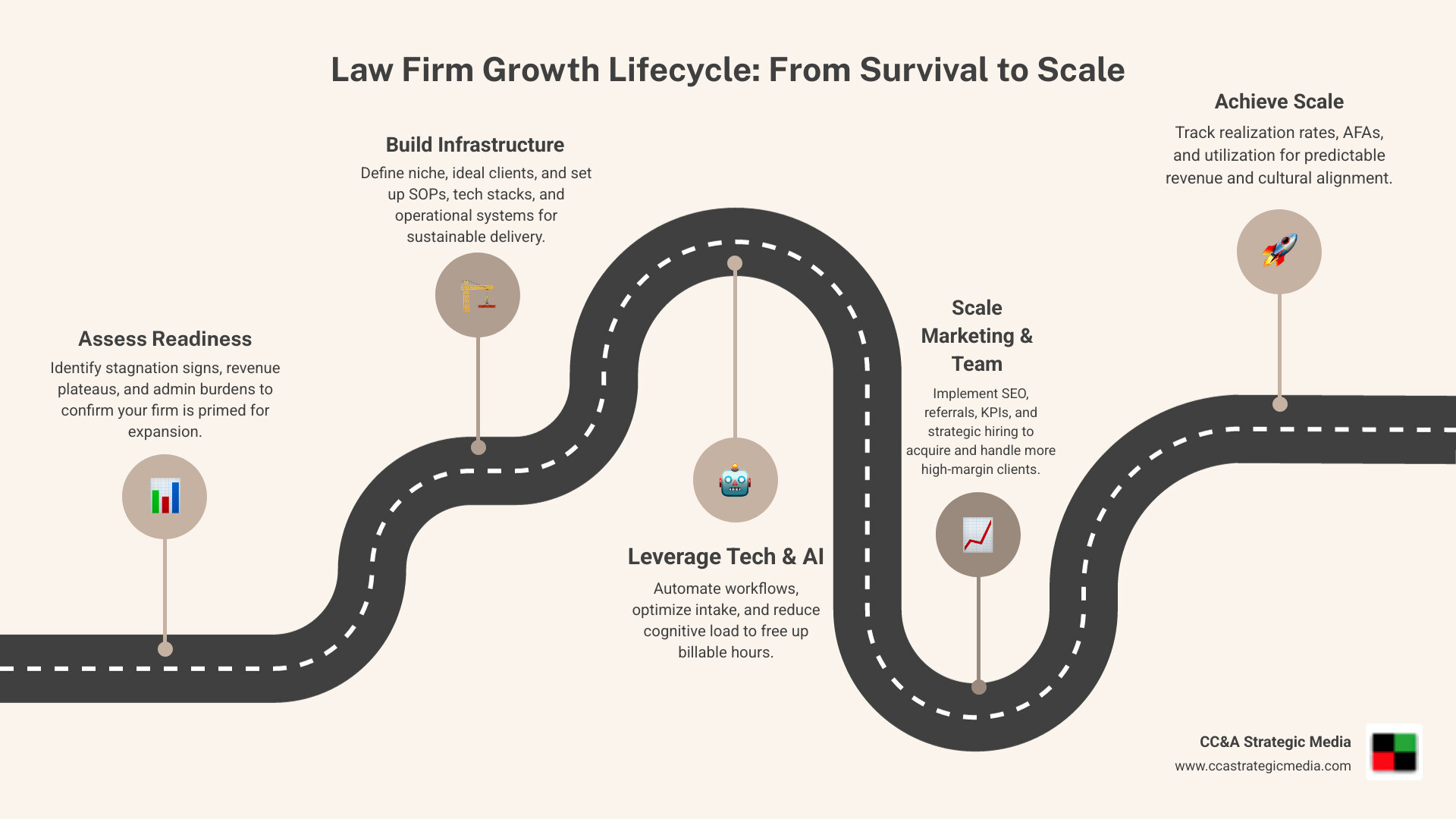
Relevant articles related to law practice expansion strategies:
Assessing Readiness: Is Your Firm Primed for Law Practice Expansion Strategies?
Before we dive into the “how,” we must address the “when.” Many firms attempt to scale on top of a fractured foundation, which only accelerates inefficiency. We call this the “plateau problem.” It occurs when a firm’s revenue is tied strictly to lawyer hours. Since there is a hard ceiling on how many hours you can work, your growth eventually stalls.
How do you know if you’re ready for law practice expansion strategies or if you’re simply struggling with stagnation? We look for specific red flags:
- The Responsiveness Gap: A 2024 study found that 67% of law firms failed to respond to a test email. If your leads are falling through the cracks, you don’t have a lead problem; you have a system problem.
- Administrative Overload: If you are spending more time scheduling calls and filling out forms than arguing cases, your firm is in “survival mode.”
- Revenue Plateaus: Your bank account looks the same month after month, despite you working harder.
Survival Mode vs. Building Mode
To move forward, we must shift our mindset. Here is how we compare the two states of a law firm:
| Feature | Survival Mode | Building Mode (Growth-Ready) |
|---|---|---|
| Daily Focus | Putting out fires and admin tasks | High-value legal work and strategy |
| Client Intake | Inconsistent and manual | Automated, structured, and fast |
| Technology | Viewed as a cost/burden | Viewed as a strategic multiplier |
| Staffing | Hiring only when desperate | Proactive capacity building |
| Marketing | “Random acts of marketing” | Data-driven acquisition funnels |
If you find yourself on the left side of this table, don’t worry. Most firms start there. The key is to recognize that “working harder” isn’t the solution—implementing better business strategy for lawyers is. As noted in Practical Strategies to Grow Your Law Firm Successfully, real growth starts by fixing how the firm runs, not by adding more to your plate.

Building the Infrastructure for Sustainable Growth
Sustainable growth requires two synchronized “engines”: the Business Development Engine (attracting and converting clients) and the Delivery Engine (providing high-quality legal services efficiently). If one engine is stronger than the other, the firm either starves for work or drowns in it.
To align these engines, we recommend a disciplined approach to setting SMART goals (Specific, Measurable, Achievable, Relevant, and Time-bound). For example, instead of saying “I want to grow,” a SMART goal would be: “Increase monthly revenue by 20% by December 2026 by automating intake and adding one specialized paralegal.”
Strategic SWOT Analysis for Law Firms
We often use a SWOT analysis to help firm leaders see the bigger picture of their current business architecture:
- Strengths: Specialized legal expertise, high client satisfaction, lean operational costs.
- Weaknesses: High administrative burden (spending <60% time on law), lack of documented SOPs, outdated technology.
- Opportunities: Generative AI adoption (which saw a 27% increase in usage by legal professionals in 2025), expanding into adjacent practice areas, implementing AFAs.
- Threats: Increased competition from “BigLaw” moving into boutique spaces, informed clients demanding more transparency, economic shifts affecting specific practice areas.
By identifying these areas, we can build a law firm succession plan and growth strategy that leverages your strengths while shoring up your infrastructure.
Defining Your Niche and Ideal Client for Law Practice Expansion Strategies
One of the most effective law practice expansion strategies is actually doing less. Trying to be everything to everyone is a recipe for mediocrity. The “riches are in the niches” because specialization allows you to standardize your workflows and charge premium rates for your unique expertise.
To define your ideal client, we look for “adjacency clusters.” These are practice areas that naturally flow into one another. For example:
- Estate Planning leads to probate and asset management.
- Entity Formation leads to ongoing compliance and contract work.
- Family Law often intersects with domestic violence or mediation services.
By focusing on these clusters, you can serve existing clients more deeply, which is significantly more cost-effective than acquiring new ones. In fact, increasing client retention by just 5% can boost profits by 25% or more. For more on this, explore How to Expand Practice Areas in Single-Practice Firms.
Leveraging Technology and AI as a Growth Multiplier
In April 2026, AI is no longer a “futuristic” concept; it is the fundamental infrastructure of the modern law firm. We view AI as a business infrastructure layer that allows firms to operate smarter, faster, and with more precision.
Statistics show that nearly 74% of hourly billable work—including document drafting, data analysis, and routine correspondence—can now be automated or augmented by AI. Firms that embrace this can cut overhead and focus their human talent on the high-level strategy that clients value most.
The 2026 Tech Stack for Growth
To scale effectively, your firm needs a unified “tech stack” that includes:
- Generative AI for Legal Research and Drafting: Standardizing AI use can reduce risk and unlock massive productivity.
- Automated Client Intake: Systems that respond instantly to inquiries, ensuring you never lose a lead to a competitor’s faster response time.
- Client Portals and Payment Solutions: Firms using these together consistently earn over 20% more revenue per lawyer each month.
- Workflow Management (CRM): Centralizing every interaction to ensure no task is missed.
However, with great power comes the need for governance. We advise firms to create a practical governance framework for AI use, documenting human oversight and ensuring data confidentiality. As noted in How to Grow a Law Firm: Proven Strategies for Sustainable Client and Revenue Expansion, transparency regarding AI has become a client expectation.
Operational Excellence through Law Practice Expansion Strategies
Operational excellence is becoming synonymous with legal excellence. If your processes are messy, your legal work will eventually suffer as you scale. We focus on creating Standard Operating Procedures (SOPs) for every repeatable task.
Consider document assembly: automating the creation of standard contracts or filings can reduce drafting time by as much as 82%. This doesn’t just save time; it ensures consistency and reduces the risk of human error.
Another critical component is the “Client Journey.” We map out every touchpoint, from the first Google search to the final invoice. Using a professional answering service can ensure that every potential client reaches a live person, significantly improving your conversion rates.
Strategic Marketing and Client Acquisition Systems
Marketing is not an expense; it is an investment in your firm’s future. The most successful law practice expansion strategies rely on a multi-channel approach that positions you as the authority in your niche.
1. Search Engine Optimization (SEO)
SEO is divided into two parts: technical SEO (making sure your site is discoverable) and content SEO (ranking for specific legal questions). By publishing helpful, plain-language content—like “What to expect in a high-conflict divorce”—you build trust before the client even calls you.
2. Referral Networks
Referral leads convert 30% better than any other source. We help firms build structured referral programs with complementary professionals like accountants, realtors, and financial advisors.
3. Paid Advertising and Social Media
While SEO takes time, paid ads (like Google LSA or Facebook Ads) can generate leads immediately. For example, a targeted Facebook strategy can put your firm in front of specific demographics, such as small business owners in a particular region.
4. Brand Authority
Your brand is the complete perception of your firm’s values and reliability. In a saturated market, a well-defined brand is your primary differentiator. Whether you’re a business law firm or a family practice, your online presence must reflect professional excellence.
Financial Management and Scaling the Team
You cannot manage what you do not measure. To scale, you must move beyond looking at your bank balance and start tracking Key Performance Indicators (KPIs).
Essential KPIs for Growth
- Utilization Rate: The percentage of an 8-hour day spent on billable work (the average is currently around 38%).
- Realization Rate: The percentage of billable work that actually makes it onto an invoice (average is around 83%).
- Collection Rate: The percentage of invoiced work that is actually paid.
- Revenue per Lawyer: A clear indicator of individual and firm-wide efficiency.
Alternative Fee Arrangements (AFAs)
The billable hour often penalizes efficiency. In 2026, 84% of law firms offer some form of AFA, such as flat fees, subscription models, or contingency fees. These models provide cost certainty for the client and predictable revenue for the firm.
Scaling the Team
When should you hire? The biggest mistake is waiting until you are drowning. We recommend hiring “to your gaps.” Often, the first hire should be a non-billable administrative assistant or a virtual legal assistant. These roles free up the attorney’s time to focus on billable work, which invariably generates enough revenue to cover the new hire’s salary and more.
As you grow, partnership agreements become vital to ensure all leaders are aligned on the firm’s vision and compensation structure.
Frequently Asked Questions about Law Firm Growth
What are the biggest pitfalls to avoid during expansion?
The most common mistake is trying to scale everything at once—new staff, new systems, and new locations simultaneously. This creates chaos. We recommend a “stabilize before you scale” approach. Another pitfall is neglecting risk management and governance; as you grow, your exposure increases, making robust partnership agreements and compliance protocols essential.
When is the right time to hire non-billable staff?
If you are turning away work or if your “billable hours” are being eaten by “admin hours,” it’s time. A proactive hire—someone who can handle intake, billing, and scheduling—allows the firm to take on more cases without burnout. If you wait until you’re desperate, you’ll likely make a poor hiring decision.
How does AI impact firm profitability in 2026?
AI impacts profitability by reducing the “cognitive load” on routine tasks. By automating 74% of hourly tasks, firms can either lower their prices to be more competitive or maintain their prices while significantly increasing their profit margins. Furthermore, AI-driven data interpretation allows firms to diagnose why a KPI is drifting off-target before it becomes a financial crisis.
Conclusion: Architecting Your Firm’s Future
Expanding a law practice is a multi-dimensional challenge that requires moving beyond the “practitioner” mindset to that of a strategic business owner. The firms that will dominate the next decade are not simply adopting AI tools or spending more on ads; they are redesigning how their businesses operate from the ground up.
At CC&A Strategic Media, we believe in a holistic approach to growth. We combine the art of branding with the science of big data and the efficiency of advanced technology to help you build a firm that is not just larger, but stronger and more resilient.
Sustainable growth comes from alignment across the business—from your intake process to your final invoice. By implementing these law practice expansion strategies, you are not just chasing the next case; you are building a legacy.
Ready to move from survival mode to building mode? Learn more about our holistic marketing and growth strategies and let’s architect the future of your practice together.