Core Marketing Best Practices for Sustainable Growth
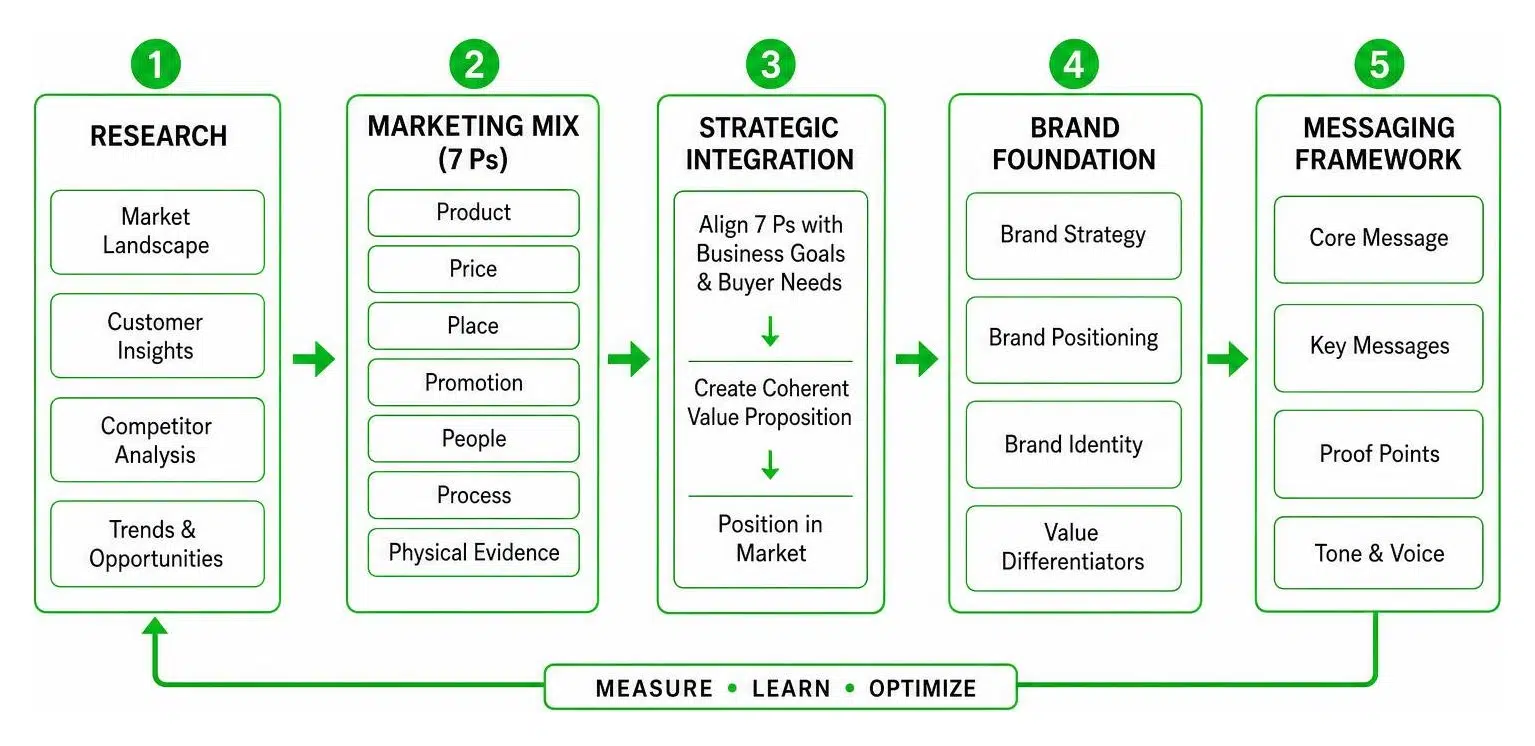
Sustainable commercial growth requires moving beyond disconnected, reactionary tactics. When I work with corporate leadership teams, business owners, and professional services executives, I emphasize that long-term authority is built through disciplined strategy rather than ad-hoc promotion. The traditional 4 Ps model—Product, Price, Place, and Promotion—has naturally expanded into the 7 Ps framework to encompass People, Process, and Physical Evidence. In modern digital ecosystems, these foundational pillars directly inform brand strategy, brand positioning, brand messaging, and overall brand identity to ensure a company captures market share while preserving its core value proposition.
Establishing high-impact marketing requires setting three to five SMART objectives that directly tie into top-line organizational growth. Rather than aiming for vague visibility, successful leaders target specific benchmarks, such as increasing qualified pipeline revenue by twenty-five percent year-over-year or improving customer retention rates across key client demographics. Achieving these targets starts with rigorous market research to understand evolving buyer expectations, competitive threats, and structural market shifts.
A comprehensive marketing mix aligns both traditional and digital operational frameworks into a unified commercial strategy. Traditional channels like direct engagement, high-touch events, and strategic print collateral foster tangible brand authority and local trust. Digital frameworks leverage search engines, programmatic media, dynamic content distribution, and interactive touchpoints to scale brand awareness rapidly. Balancing both environments allows mid-market organizations and commercial entities to optimize customer touchpoints while maintaining price elasticity and operational efficiency.
Strategic Foundation and Goal Alignment
Every high-performing campaign rests on a clearly articulated audience architecture. I recommend building detailed buyer personas that document precise buyer demographics, professional pain points, behavioral motivations, and channel preferences. Understanding exactly who you are speaking to ensures your narrative strikes an emotional cord while offering practical problem-solving utility. You can explore our detailed process on How to Create Buyer Personas to discover how audience research transforms abstract demographics into actionable strategic assets.
Proper budget allocation ensures creative ideas are backed by sufficient operational runway. Modern enterprises generally invest between five and fifteen percent of gross revenue into promotional growth, while high-growth entities or launching organizations may commit a significantly higher proportion to establish market presence. To evaluate your financial commitments and optimize spending across channels, read our step-by-step guide on How to Develop a Business Marketing Budget.
To establish true strategic clarity, organizations must conduct a rigorous SWOT analysis that evaluates internal Strengths and Weaknesses alongside external Opportunities and Threats. By analyzing strengths such as proprietary technology or specialized service delivery against internal weaknesses like resource bottlenecks, companies protect their operational stability. Simultaneously, mapping market opportunities against competitive threats allows brand leaders to sharpen their unique value proposition, build distinctive brand messaging, and maintain long-term competitive differentiation.
When organization-wide execution feels fragmented, operational alignment becomes the primary bottleneck to sustainable growth. This is where CC&A Strategic Media’s proprietary framework, Strategic Ops, serves as an operational foundation offering fractional leadership, dedicated marketing coordination, and full-stack agency execution. By bridging high-level strategic vision with daily tactical deployment, Strategic Ops empowers executive teams, growth-minded companies, and generic law firms to scale marketing operations without overextending internal staff.
Balancing AI Automation and Human Strategy
Artificial intelligence has transformed digital marketing operations, but automated tools cannot replace authentic creative vision. While generative AI platforms streamline baseline drafting, data aggregation, and workflow management, thirty-five percent of marketing executives highlight that generative systems are fundamentally altering content discovery. To navigate this shifting landscape effectively, explore the official AI Marketing Strategy Guide for 2026 – Think with Google to see how algorithmic models reshape digital user journeys.
Maintaining a strong human touch remains essential for protecting brand equity. AI outputs often drift toward generic middle ground, which makes creative direction, clear brand storytelling, and executive oversight more important. I often emphasize that AI should work as an operational accelerator, not a replacement for strategic leadership. Marketers who rely on unedited automated content risk weakening their brand voice and losing audience trust.
The optimal approach combines internal workflow automation with high-level human curation. Machine learning models excel at processing large data sets, identifying search patterns, and optimizing campaign management mechanics. Human strategists, however, must guide emotional resonance, ethical compliance, subject matter authority, and overarching business objectives. This hybrid balance allows organizations to scale production volume while keeping brand messaging sharp, authentic, and compelling.
Content Strategy and Brand Trust Systems
Content creation in 2026 is defined by extreme market saturation. With over six hundred million blogs active globally, seventy million new blog posts published on WordPress every month, and five hundred hours of video uploaded to YouTube every minute, standing out requires exceptional quality. Building brand authority demands a shift away from self-serving promotional copy toward comprehensive answer systems that solve real buyer problems and establish long-term trust.
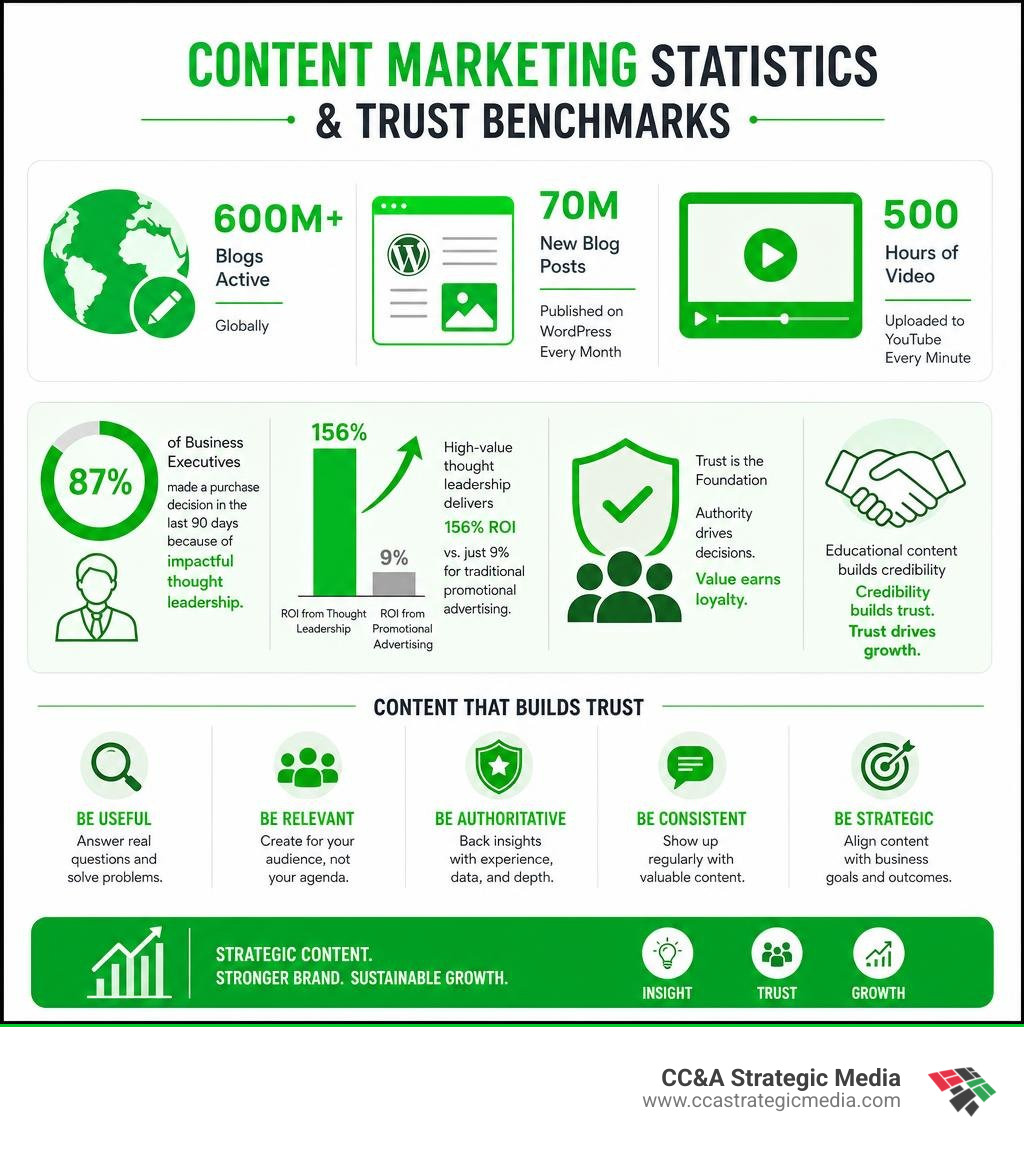
Thought leadership has emerged as the single most potent driver of executive decision-making. Research indicates that eighty-seven percent of business executives made a purchase decision in the last ninety days directly because of impactful thought leadership. Furthermore, high-value thought leadership generates an average ROI of one hundred fifty-six percent compared to just nine percent for traditional promotional advertising, making strategic content creation a cornerstone of modern corporate expansion.
Content Marketing Best Practices for Building Brand Authority
Creating authoritative content requires shifting from fragmented publishing to a structured strategy backed by specialized execution. Working with a dedicated Content Marketing Company helps organizations align educational messaging with business outcomes. Sustainable visibility relies on solid search engine fundamentals; learning the Best Strategies for Organic SEO ensures your core assets rank prominently for high-intent search queries.
A key rule for content efficiency is the 80/20 distribution framework, which dictates that marketing teams should spend twenty percent of their time creating top-tier assets and eighty percent of their effort promoting, repurposing, and distributing them across multi-channel environments. Rather than constantly producing new content from scratch, high-performing marketing teams convert comprehensive white papers into executive summaries, video insights, social graphics, and newsletter feature articles.
Maintaining consistent publishing standards requires a strict content governance framework. Governance outlines content approval workflows, brand style standards, subject matter expert involvement, and legal compliance guidelines across all channels. Additionally, periodic asset pruning is necessary to remove, update, or consolidate outdated web pages. Pruning underperforming legacy content eliminates keyword cannibalization, optimizes site architecture, and improves overall organic domain authority.
Interactive and Experiential Content Engagement
Passive content reading is increasingly giving way to active digital participation. Experiential content—such as dynamic calculators, interactive benchmark assessments, and immersive digital demos—dramatically increases user retention. While seventy-eight percent of marketers agree that experiential content significantly boosts repeat engagement, only thirty-three percent actively incorporate interactive elements into their online touchpoints, presenting a major competitive advantage for early adopters.
Preparing for modern content discovery also requires optimizing for voice search queries and immersive technologies. Voice search reliance demands conversational language patterns, structured schema markup, and long-tail question targeting to secure featured answer snippets. Simultaneously, augmented reality and virtual try-on environments offer direct experiential proof, enabling buyers to evaluate products or visualize service outcomes in real time before making a purchase.
User-generated content and authentic peer validation remain unmatched tools for building credibility. Ninety-two percent of consumers trust peer recommendations and user experiences far more than corporate advertising. Incorporating authentic customer testimonials, user-submitted video reviews, and executive case studies into digital journeys reassures prospective buyers, reduces purchase friction, and solidifies initial brand positioning.
Omnichannel Execution and Data-Driven Analytics
Modern buyers do not follow linear paths; they interact across an average of ten point two distinct digital and physical touchpoints before completing a transaction. Relying on too few channels severely restricts business growth, with thirty-three percent of marketers reporting that channel limitations actively hamper their commercial success. Achieving true market coverage requires a seamless omnichannel strategy where messaging, branding, and customer experience remain aligned across every digital interaction.
Integrating owned, earned, and paid media environments creates a self-reinforcing brand ecosystem. Owned media—such as proprietary web platforms, email subscriber databases, and resource hubs—provides total control over the brand narrative. Paid media accelerates reach and captures active commercial intent, while earned media provides third-party validation through media coverage, public relations, and social mentions.
Omnichannel Marketing Best Practices and Channel Integration
Executing a unified channel presence requires sophisticated technical coordination and strategic cross-channel planning. Organizations utilizing full-scope Digital Marketing Services ensure their brand positioning, visual identity, and messaging remain harmonized whether a customer visits a landing page, opens an email newsletter, or views a video advertisement.
Social media channels serve as vital interaction points for brand awareness, engagement, and customer feedback. Partnering with an expert Social Media Marketing Firm allows companies to tailor platform-specific narratives while maintaining a coherent master brand story. Consistent multi-channel touchpoints build top-of-mind awareness and reinforce trust at every stage of the buyer journey.
Seamless channel integration relies on continuous cross-departmental alignment between sales, marketing, and client operations. When messaging on paid social ads perfectly mirrors the information provided in inbound sales collateral and post-sale onboarding materials, prospective clients experience zero friction. This structural harmony strengthens overall brand identity and increases conversion momentum across complex buying groups.
Unified Analytics and Performance Measurement
Data analytics is the engine that transforms tactical marketing into a predictable revenue driver. Despite its importance, thirty-four percent of marketers report limited visibility into funnel attribution as one of their primary operational challenges. Overcoming this visibility gap requires consolidating platform metrics into central analytics dashboards that track exact customer journeys from first touch to closed contract.
Accurate financial measurement depends on calculating Customer Acquisition Cost alongside Customer Lifetime Value. To maintain healthy commercial margins, organizations should target a Minimum Lifetime Value to Customer Acquisition Cost ratio of three-to-one or four-to-one across primary client channels. Establishing these clear financial benchmarks ensures marketing expenditures directly support top-line profitability.
Modern conversion attribution must account for complex multi-touch buyer paths rather than relying solely on first-click or last-click models. Multi-touch attribution distributes conversion credit across early research touchpoints, middle-funnel consideration assets, and final sales interactions. This complete perspective prevents teams from underfunding top-of-funnel brand awareness initiatives that subtly drive downstream revenue growth.
Personalization and Customer Retention Frameworks
Generic mass marketing is increasingly ineffective in modern commercial markets. To capture attention and drive conversions, brands must deliver personalized communication tailored to the specific needs, industry contexts, and behavioral signals of individual buyers. Combining detailed customer segmentation with automated lifecycle workflows allows businesses to scale high-touch experiences efficiently.

Personalization extends far beyond inserting a contact’s first name into an email header. Authentic dynamic personalization adapts landing page messaging, content recommendations, and promotional offers based on a visitor’s industry, previous interaction history, and clear buying intent signals. Delivering tailored experiences accelerates conversion velocity and demonstrates deep respect for the buyer’s time.
Tailored Customer Messaging and Segmentation
Expanding target market coverage while preserving engagement quality requires structured audience segmentation. As companies grow, they must evaluate new demographic segments and adjacent verticals carefully. You can review proven expansion models by exploring our guide on How to Expand Your Target Audience to diversify your client base safely.
Dynamic personalization relies on behavioral tracking and customer journey mapping. By identifying where a prospective client stands within the decision-making cycle—whether they are identifying an operational problem, evaluating alternative solutions, or verifying vendor credentials—companies can serve content assets tailored to those precise concerns. This alignment lowers bounce rates and significantly improves conversion efficiency.
Tailoring brand messaging for specific vertical markets reinforces market authority and trust. When generic law firms, B2B software enterprises, or professional services consultancies craft industry-specific case studies and bespoke messaging, prospective buyers recognize immediate relevance. This specialized positioning allows organizations to defend premium pricing and shorten sales cycles.
Automation for Retention and Loyalty
Customer acquisition without robust customer retention creates an unsustainable growth treadmill. Post-sale engagement is critical for maximizing long-term profitability, yet while ninety-seven percent of executives view thought leadership as essential across the complete customer lifecycle, only forty-three percent extend these assets post-sale. Deploying advanced Marketing Automation systems ensures existing clients receive continuous value and proactive communication.
Implementing strategic retention programs prevents customer churn and surfaces expansion opportunities. For an in-depth strategy on leveraging automated communication to strengthen ongoing client relationships, read our detailed operational playbook on How to Keep Customers Using Marketing Automation.
Email marketing remains one of the most profitable channels for sustaining client relationships, generating an impressive thirty-eight-dollar return for every single dollar invested. Automated email onboarding sequences, quarterly check-ins, educational product updates, and personalized recommendations keep your brand embedded in the client’s daily workflow. Maintaining consistent post-sale engagement builds long-term advocacy, encourages peer referrals, and unlocks cross-sell revenue opportunities.
Frequently Asked Questions About Marketing Best Practices
How do businesses integrate AI into marketing without losing authenticity?
Integrating artificial intelligence successfully requires treating automated platforms as analytical and operational assistants rather than creative decision-makers. AI systems excel at parsing large data sets, generating initial content outlines, organizing keyword research, and automating routine administrative tasks. However, every public-facing output must undergo rigorous human editorial review, brand voice alignment, and strategic refinement. Protecting authenticity demands that senior human leaders maintain complete control over creative direction, brand storytelling, emotional resonance, and ethical compliance. Establishing explicit content governance frameworks prevents robotic, low-value material from eroding hard-earned brand equity.
What are the key components of an effective 2026 marketing plan?
A robust marketing plan begins with three to five clearly defined SMART objectives that align directly with overall corporate revenue goals. Next, it incorporates deep market research and customer persona mapping to identify exact target audience pain points and decision criteria. The strategy must deploy a balanced 7 Ps framework alongside a comprehensive SWOT analysis to evaluate internal strengths against market threats. Additionally, an effective plan integrates an omnichannel content execution strategy across owned, earned, and paid media channels, backed by clear budget allocations and automated workflows. Finally, it establishes unified data analytics and conversion tracking to evaluate campaign performance in real time.
How do you measure marketing ROI across multi-channel campaigns?
Measuring return on investment across multi-channel ecosystems requires moving beyond single-touch attribution models that misrepresent complex buyer journeys. Organizations must implement unified analytics frameworks that collect data across CRM systems, web analytics platforms, ad networks, and email automation suites. By tracking key metrics such as Customer Acquisition Cost, Customer Lifetime Value, lead velocity, and pipeline attribution, leaders gain complete visibility into revenue drivers. Calculating total marketing spend against net revenue generated across multi-touch attribution models reveals which channels build top-of-funnel brand awareness and which drive bottom-of-funnel conversions, ensuring capital is deployed efficiently.
Conclusion

Mastering modern marketing best practices requires a balanced, systematic approach that bridges high-level strategic positioning with operational execution. In an era where AI tools continue to lower the barrier for generic content creation, sustainable business growth belongs to organizations that prioritize authentic brand authority, data-informed clarity, seamless omnichannel integration, and deep customer trust.
Building a resilient commercial strategy demands continuous adaptation, structural alignment, and constant performance measurement. By establishing clear SMART goals, refining your core brand messaging, leveraging unified analytics, and deploying operational frameworks like CC&A Strategic Media’s Strategic Ops, your organization can successfully navigate competitive market dynamics and drive predictable long-term revenue.
If you are ready to elevate your commercial marketing operations, align your internal teams, and build a high-impact growth strategy tailored to your business goals, I invite you to connect with me! Together, we can translate complex marketing challenges into clear, actionable steps that strengthen your brand identity and deliver true business growth. You can learn more about my background and reach out directly by visiting my author page to Connect with Reagan Collins.