Why Most Law Firms Get Burned by Marketing Agencies (And How to Avoid It)
Law firm marketing services are the strategies, tools, and agency partnerships that help law firms attract new clients, build authority, and grow revenue online.
Here are the most common services top legal marketing agencies offer in 2026:
| Service | What It Does |
|---|---|
| SEO | Ranks your firm on Google for searches like “personal injury lawyer” |
| PPC / Google Ads | Drives immediate paid traffic from high-intent searches |
| Website Design | Converts visitors into leads with fast, mobile-friendly pages |
| Content Marketing | Builds trust and authority through blogs, FAQs, and practice area pages |
| Local SEO | Gets your firm into Google’s map results and targeted searches |
| Reputation Management | Generates and monitors client reviews across platforms |
| Social Media Marketing | Builds brand awareness and community on Facebook, LinkedIn, and more |
| AI / GEO Optimization | Makes your firm visible in ChatGPT, Gemini, and AI-driven search results |
The legal industry is one of the most competitive marketing environments on the internet. Prospective clients turn to Google roughly 90% of the time when searching for legal help. And yet, only 47% of law firms have a formal annual marketing budget, according to industry legal technology survey reports.
That gap is expensive.
Many firms that do invest in marketing end up overpaying for underwhelming results — locked into contracts, losing ownership of their own websites, or working with agencies that serve their direct competitors at the same time.
The strongest law firms are not simply good at marketing. They are disciplined in how every part of the business works together to create growth. Choosing the wrong agency doesn’t just waste money. It costs you cases.
I’m Roxanne St. Marie, Marketing Director at CC&A Strategic Media, and my nearly two decades of hands-on experience — from law firm front desks to executive leadership in law firm marketing services — give me a ground-level view of what actually drives client growth inside a firm. In the sections below, I’ll walk you through exactly what to look for, what to avoid, and which agencies are worth your trust in 2026.
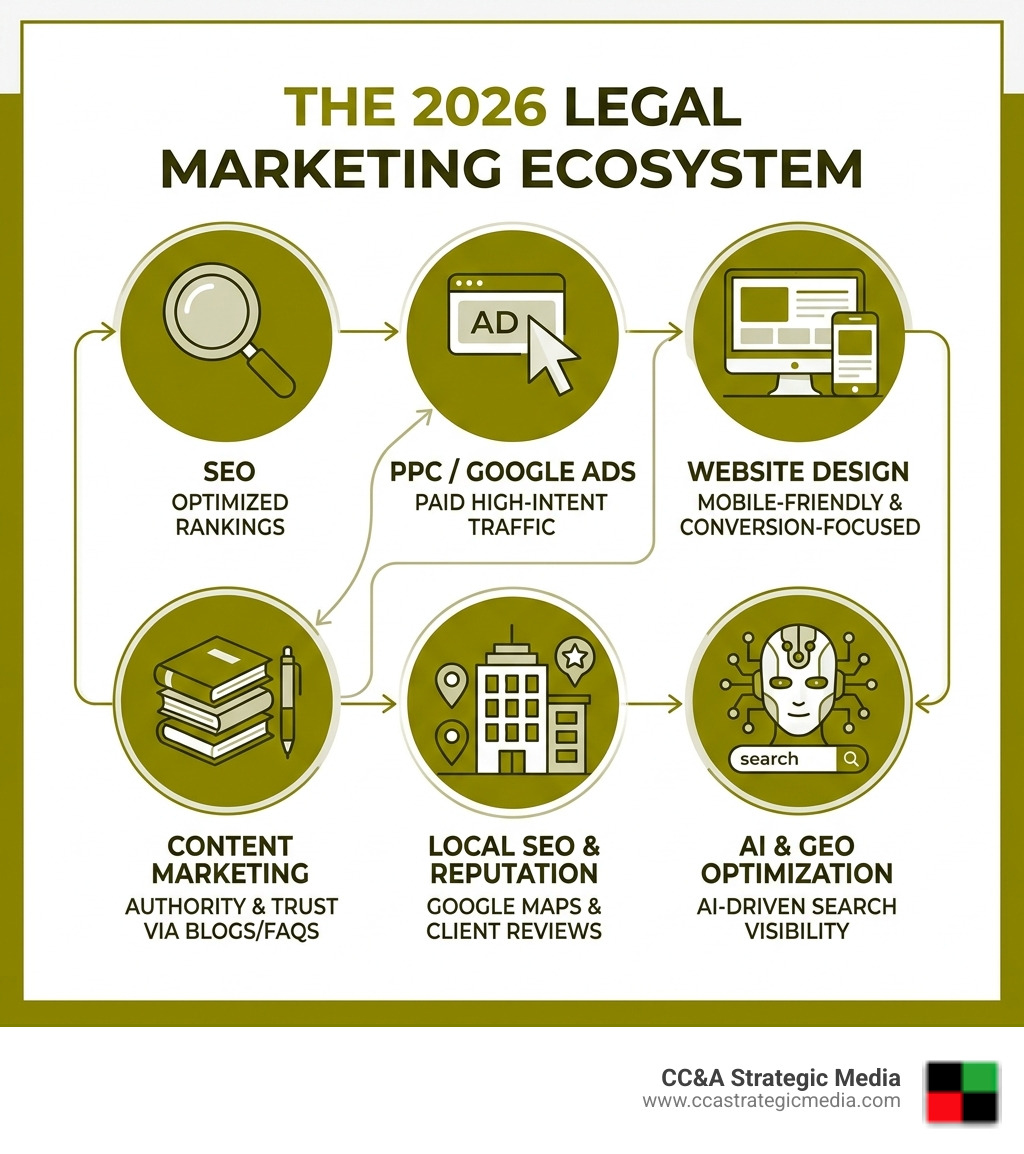
Law firm marketing services vocabulary:
Defining High-Impact Law Firm Marketing Services

When we talk about high-impact law firm marketing services, we aren’t just talking about “getting more clicks.” In 2026, marketing is no longer a tactical add-on; it is a core business infrastructure layer. If your marketing isn’t integrated with your intake process, your caseload, and your firm’s overall growth strategy, you are essentially throwing spaghetti at a very expensive wall.
The goal of modern marketing services is three-fold: client acquisition, brand authority, and sustainable revenue growth. For a firm to truly dominate its market, it must move beyond generic advertising. This requires a deep dive into Digital Marketing Strategies for Business Law Firms or specialized Digital Marketing Strategies for Family Law Firms, depending on your practice area.
High-impact services focus on the “buyer’s journey.” For example, a person looking for a divorce attorney has a very different emotional and psychological state than a CEO looking for a merger and acquisitions specialist. Your marketing partner must understand these nuances to create a system that doesn’t just drive traffic, but converts that traffic into signed retainers.
Core Components of Law Firm Marketing Services
To build a resilient firm, you need a balanced “marketing diet.” Relying on just one channel is a recipe for disaster if an algorithm changes. Here are the core components that should make up your strategy:
- Search Engine Optimization (SEO): This is the long game. It involves optimizing your website structure and content so that search engines recognize you as the authority in your field. While it takes time to see results, it offers the highest long-term ROI.
- Pay-Per-Click (PPC): Think of this as the “faucet.” You can turn it on for immediate leads. Top agencies focus on “buyer intent” keywords rather than “information” keywords to ensure you aren’t paying for clicks from people who are just browsing.
- Content Strategy: Content is the bridge between a stranger and a client. It includes blogs, whitepapers, and FAQs that answer the specific questions your prospects are asking. For instance, Personal Injury Law Marketing relies heavily on educational content that calms a victim’s fears while demonstrating the firm’s win record.
- Reputation Management: In 2026, 66% of people expect a response from an attorney within a day, and many hire within hours. Online reviews are your digital currency. Agencies today use automated systems to help firms generate, monitor, and respond to reviews, ensuring your “social proof” is ironclad.
Emerging Trends in Law Firm Marketing Services
The legal marketing landscape in 2026 is being radically reshaped by technology. We are moving away from traditional search and toward “Answer Engines.”
- Generative Engine Optimization (GEO): As more people use ChatGPT, Gemini, and Claude to find legal advice, firms must optimize their content to be the “source of truth” these AI models cite.
- AI Integration: AI isn’t just for writing blogs. It’s being used to analyze big data to predict which demographics are most likely to need specific legal services, allowing for hyper-targeted advertising.
- Video Content: Short-form video on platforms like YouTube and LinkedIn has become a primary way for attorneys to build trust. It allows potential clients to “meet” you before they ever pick up the phone.
- Answer Engine Optimization (AEO): This focuses on structured data and “People Also Ask” sections on Google, ensuring your firm provides the direct answer to specific legal queries.
For those looking to leverage social platforms, The Legal Guide to Dominating Facebook Advertising and Getting Clients provides a roadmap for using these tools to find clients where they spend their leisure time.
Strategic Criteria for Selecting Top-Tier Agencies
Choosing a marketing partner is one of the most critical leadership decisions you will make. You shouldn’t just look at a portfolio; you need to perform a full SWOT analysis (Strengths, Weaknesses, Opportunities, Threats) on the potential partnership.
According to industry legal technology survey reports, many firms struggle because they don’t treat marketing with the same strategic rigor as their legal cases. When evaluating law firm marketing services, we recommend looking for these specific criteria:
- Exclusivity Guarantees: Does the agency work with your direct competitor? If they are trying to rank two personal injury firms for the same keyword in the same market, one of you is going to lose. Look for agencies that offer “exclusive market territories.”
- Ethical Compliance: Legal marketing is governed by strict Bar Association rules. Your agency must understand the nuances of “solicitation” versus “advertising” and ensure all content meets ethical standards to protect your license.
- Specialization: A generalist agency that markets for plumbers and dentists won’t understand the complexities of the legal industry. You need a partner who understands the “sales and marketing psychology” unique to legal consumers.
- Transparency: You should have 24/7 access to a dashboard that shows exactly where your money is going. If an agency is “black-boxing” their results or hiding their metrics, that’s a major red flag.
The strongest firms understand that The Complete Guide to Business Strategy for Lawyers isn’t just about law; it’s about how marketing, operations, and leadership align to create a dominant market position.
Operational Alignment and Ownership of Marketing Assets
One of the biggest “robberies” in the marketing world happens when a firm decides to leave an agency and discovers they don’t actually own their website, their domain, or their data. We call this “hostage marketing.”
To avoid this, you must ensure that your firm maintains full ownership of all marketing assets. This includes the CMS (Content Management System), the Google Ads account, and all original content created.
Agency vs. In-house: Which is Right for You?
| Feature | Marketing Agency | In-house Team |
|---|---|---|
| Cost | Fixed monthly fee; often lower than multiple salaries | High (Salaries, benefits, software, taxes) |
| Expertise | Deep, specialized team (SEO, PPC, Design, AI) | Limited to the skills of 1-2 hires |
| Speed | Fast implementation; systems already in place | Slower; requires training and management |
| Perspective | Fresh, data-driven insights from multiple firms | Deeply familiar with firm culture but can be siloed |
| Scalability | Can scale up or down instantly | Difficult to scale without new hires |
For most small to mid-sized firms, an agency provides a better ROI because you get access to a “fractional CMO” and a team of specialists for the cost of one junior marketing coordinator. However, as firms grow, they often find success in a hybrid model: an in-house person to handle internal communications and a specialized agency to drive the high-tech law firm marketing services.
Data transparency is the heartbeat of this relationship. According to the Clio Legal Trends Report, firms that use data-driven decision-making grow significantly faster than those that rely on “gut feeling.” You should be tracking every dollar from the initial click to the final settlement.
Furthermore, operational efficiency is key to scaling. For example, Why Your Law Firm Needs a Professional Answering Service to Scale highlights how marketing only works if you have the infrastructure to catch the leads it generates. If your marketing is working but your phones aren’t being answered, you’re just burning money.
Frequently Asked Questions about Legal Marketing
How much should a firm budget for marketing in 2026?
The “prevailing wisdom” suggests that law firms should spend between 2% and 12% of their gross revenue on marketing. However, this is highly dependent on your goals. If you are in a maintenance phase, 2-5% might suffice. If you are looking for aggressive, “market dominance” growth in a competitive field like personal injury, you may need to lean closer to that 12% mark.
Marketing is an investment in your firm’s future, not a commodity. A savvy agency will help you maximize your ROI so that every dollar spent generates a predictable multiple in revenue.
Should we prioritize SEO or PPC for immediate growth?
If you need leads today, PPC (Pay-Per-Click) is your best friend. It provides immediate visibility at the top of search results. However, it is also expensive and the leads stop the moment you stop paying.
SEO is the foundation. It builds long-term authority and “organic” traffic that you don’t have to pay for on a per-click basis. In a perfect world, you use PPC to bridge the gap while your SEO is maturing. The goal is to eventually reach a state of “omnipresence” where you appear in both the paid and organic sections of the search results.
How does AI impact search visibility for legal queries?
AI is fundamentally changing how people search. With the rise of Generative Engine Optimization (GEO), search engines are now providing direct answers to legal questions rather than just a list of links.
To remain visible, your firm’s content must be structured in a way that AI models can easily digest and cite. This means focusing on high-quality, JD-vetted content that answers complex legal questions with precision. Firms that ignore AI optimization in 2026 will find themselves invisible to a significant portion of the market.
Conclusion
Hiring a marketing partner shouldn’t feel like a gamble. When you approach law firm marketing services as a strategic business infrastructure rather than a series of disconnected tactics, you position your firm for true, sustainable growth.
At CC&A Strategic Media, we believe in a holistic approach. We don’t just look at clicks; we look at the sales and marketing psychology that drives human behavior. We combine advanced technology with the “art and science” of branding to ensure your firm isn’t just seen, but is respected and chosen.
Whether you are looking to dominate a specific market or expand your practice more broadly, the key is alignment. Your marketing must reflect your values, your operations must support your growth, and your leadership must be committed to the long-term vision.
If you are ready to take the next step in your firm’s evolution, exploring Business Law Marketing can provide the strategic depth needed to turn your firm into a market leader. Don’t settle for being another “account” at a massive agency. Demand a partner who is as committed to your firm’s growth as you are. Case closed.