Historical Origins and Evolution of Strategic Communications
When I look back at my experience building integrated strategies for growing companies, I am constantly reminded that public relations is fundamentally about human psychology and social trust. While the formal profession took shape in the early twentieth century, the core mechanics of strategic communication have been used for thousands of years to align leaders with their communities.
Long before modern media existed, ancient civilizations relied on structured public messaging to maintain order, rally support, and share essential information. Archeologists have uncovered ancient clay tablets that provided agricultural advice to farmers, effectively functioning as early informational public relations assets. In ancient history, philosophers like Plato and Aristotle analyzed the art of rhetoric in governance, examining how speech and logical structure shape community opinion. Early leaders refined these ideas even further. Julius Caesar published detailed accounts of his military accomplishments to demonstrate his fitness to rule, leveraging clear narrative framing to influence public perception.
As mass production and global industry expanded during the late nineteenth century, public relations transformed into a dedicated discipline. The founding of the Publicity Bureau in 1900 is widely acknowledged as the birth of the formal agency structure. Pioneer Ivy Lee transformed the industry by championing transparency and accurate disclosures, moving away from theatrical publicity. Shortly after, Edward Bernays introduced social science and psychological theory to the practice, viewing strategic communication as a way to understand human desires and guide social behavior.
The formal definition of public relations has continued to evolve alongside changing cultural expectations. In 1982, major professional communication organizations defined the field by stating that public relations helps an organization and its publics adapt mutually to each other. Decades later, industry leaders recognized that communication had shifted from top-down messaging to continuous public engagement. In a modern crowdsourced initiative, PRSA updated its official statement, declaring that public relations is a strategic communication process that builds mutually beneficial relationships between organizations and their publics. You can trace this deeper history in the History of public relations overview and explore the voting data behind the revised industry standard at A Modern Definition of Public Relations – PRsay.
Historical Milestones and Interesting Facts About Public Relations Evolution
Understanding the historical progression of strategic communication helps leaders evaluate their current market positioning. Throughout my career, I have observed that companies achieve the strongest brand positioning when they move past viewing PR as mere publicity and embrace two-way symmetrical communication.

When industry leaders voted on the modern definition of PR, the word choices highlighted a fundamental shift in business operations. Professionals deliberately selected the word process instead of management function to avoid connotations of top-down corporate control. They also chose the plural term publics rather than stakeholders, recognizing that organizations interact with diverse groups beyond just shareholders and customers. Interestingly, a majority of voters opted to leave the word ethics out of the core concise definition, choosing instead to maintain ethical mandates within separate codes of professional conduct. For a detailed breakdown of these historical shifts, explore Chapter 2: Origins and Evolution of PR – Public Relations: From Strategy to Action.
To help executive teams evaluate their communication framework, applying a simple SWOT analysis to historical PR models offers valuable clarity.
Strengths of modern PR lie in its emphasis on mutually beneficial dialogue, building long-term brand equity and trust.
Weaknesses emerge when organizations treat PR as a decorative overlay rather than a core strategic discipline, leading to inconsistent messaging.
Opportunities abound in using digital data, social engagement, and precise messaging to build direct relationships with audiences without relying exclusively on gatekeepers.
Threats persist when fast-moving public conversations catch companies unprepared, leaving them vulnerable to rapid reputational loss during a crisis.
Early Antecedents and Surprising Figures in Communications History
The colorful history of public relations includes fascinating figures who shaped early publicity tactics. In the nineteenth century, showman P.T. Barnum demonstrated the raw power of media attention through theatrical press agentry. He frequently wrote letters to newspaper editors using pseudonyms, declaring his own exhibits to be hoaxes simply to ignite public debate and boost ticket sales. While Barnum popularized the famous phrase that there is no such thing as bad publicity, modern professional communication has evolved toward long-term trust and strategic reputation management.
During World War I, governments mobilized systematic communications on a massive scale. A key national communications committee recruited approximately 75,000 volunteer speakers, known as Four Minute Men, who delivered concise updates on war efforts at local community gatherings. This initiative demonstrated how structured, coordinated messaging could quickly align public opinion across an entire nation.
Corporate communications also gained momentum as industrial enterprise expanded. The term public relations first appeared in print in the 1897 Year Book of Railway Literature. During this era, major railway enterprises raised tens of millions of dollars while navigating public scrutiny through deliberate media outreach. Following a tragic train derailment, Ivy Lee authored what is widely recognized as the first modern press release, inviting journalists directly to the scene to provide accurate information and establish transparent media relations.
Core Disciplines and Interesting Facts About Public Relations Operations
Modern public relations encompasses a wide range of specialized disciplines designed to protect, build, and amplify brand value. A comprehensive strategy integrates media relations, corporate communications, investor relations, internal engagement, and brand journalism into a cohesive operational system.
At CC&A Strategic Media, we take a holistic approach that connects marketing psychology, advanced analytics, and strategic execution. Through our dedicated operational framework called Strategic Ops, we provide fractional leadership, dedicated coordination, and full-stack execution to help companies manage these core PR functions smoothly. Organizations can explore our full capabilities through our Public Relations Services.
Distinction Between Public Relations, Advertising, and Journalism
Executives often ask me to clarify how public relations differs from paid advertising and independent journalism. While all three shape the public information ecosystem, their controls, financial models, and strategic goals are distinctly different.
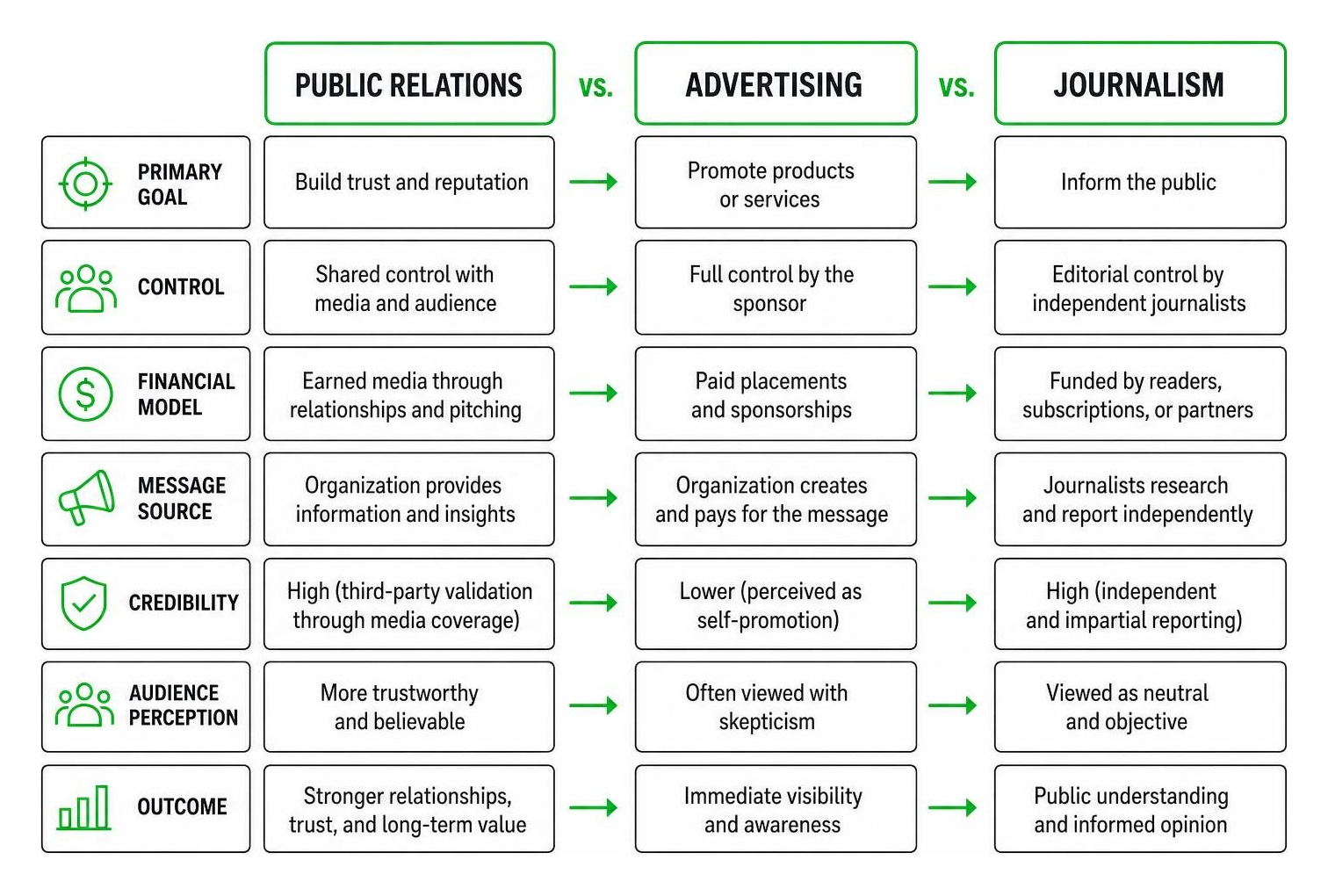
Advertising relies on paid space. A company purchases ad placements, giving them complete authority over the message, design, and schedule. However, modern consumers are increasingly skeptical of direct sales pitches.
Public relations focuses on earned media and strategic relationships. PR professionals pitch stories, insights, and data to journalists, editors, and broad audiences. Because the resulting coverage is filtered through independent editorial oversight, earned media carries far greater credibility and social proof.
Journalism operates independently to report news, analyze trends, and inform the public. Journalists seek verified facts, neutral reporting, and compelling stories. PR specialists support journalists by providing accurate research, expert commentary, and timely data.
Career Requirements, Duties, and Salary Metrics
Public relations specialists serve as essential conduits between organizations and the public. Their daily responsibilities include drafting press releases, pitching media outlets, managing executive communications, writing speeches, monitoring public sentiment, and navigating crisis events. In public sector settings, professionals serving in these roles are frequently designated as press secretaries.

Entering the field typically requires a bachelor’s degree in public relations, communications, journalism, or business. Professional success depends on strong writing abilities, strategic agility, and deep media operations knowledge.
Government labor statistics report that the median annual wage for public relations specialists was $69,780 in May 2024. Compensation varies significantly across sectors, with government agencies and specialized advertising or PR firms offering higher median earnings than non-profit organizations. Overall employment for public relations specialists is projected to grow five percent from 2024 to 2034, reflecting the ongoing corporate demand for strategic reputation management in a media environment.
Strategic Execution, Ethics, and Modern Digital Trends
The public relations landscape is undergoing a massive digital evolution. Today, data analytics, automated monitoring, and artificial intelligence work alongside traditional media outreach to help brands shape public perception with incredible speed and precision.
Industries worldwide continue to expand their communication investments, with the global PR market projected to reach $144 billion by 2028. This growth is driven by a simple reality: 92% of consumers trust earned media over traditional advertisements. Furthermore, 68% of journalists report relying directly on PR professionals for research, trend analysis, and verified data. Navigating this environment requires understanding the latest data trends, which you can review in the 20+ Public Relations Statistics: 2026 Verified Report and see applied in our guide on how Social Proof Builds Brands.
Modern Digital Trends and Interesting Facts About Public Relations Execution
Digital transformation has fundamentally reshaped how public relations campaigns are created and evaluated. Generative AI adoption among communications professionals expanded rapidly from 33% to 64% in a single year, enabling teams to streamline media research, content creation, and data analysis.

Media pitching dynamics have also evolved. Journalists receive overwhelming volumes of pitches daily, leading 90% of PR professionals to rely on personalized, one-to-one email outreach. Pitch length is critical: two-thirds of journalists prefer concise pitches under 200 words. Timing matters as well, with pitches sent on Thursdays yielding optimal open rates. Incorporating images, infographics, and video into releases increases engagement up to six times over plain text.
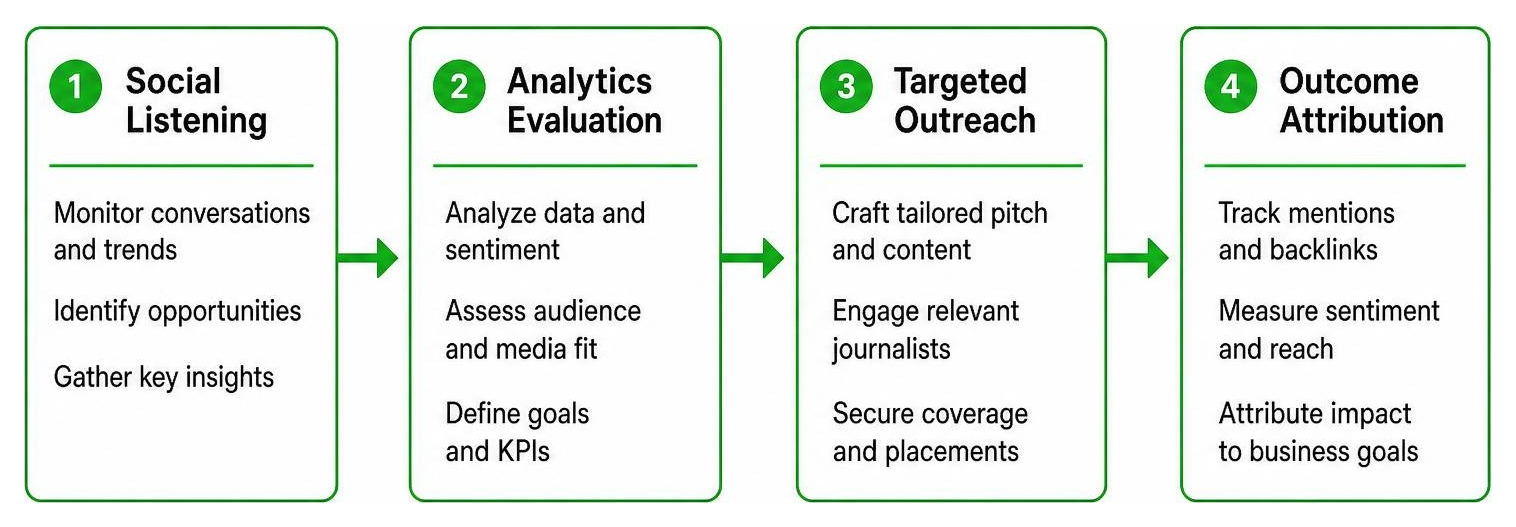
Modern digital PR performance tracking has shifted away from vanity metrics like media impressions toward true business outcomes. Advanced teams use UTM attribution links, media mentions, sentiment analysis, and Generative Engine Optimization to evaluate campaign effectiveness. To learn more about modern reputation strategy, visit our resource on What is Reputation Marketing and explore our insights on optimizing Social Media Engagement.
Crisis Management, Ethics, and Reputation Protection
Crisis management is one of the most critical aspects of modern strategic communication. The historic 1982 Tylenol product-tampering response remains a classic benchmark for crisis recovery. By taking immediate responsibility, issuing rapid recalls, launching nationwide hotlines, and pioneering tamper-evident packaging, leadership successfully restored consumer trust.
In contrast, delayed responses, opaque messaging, or spin tactics can turn a minor issue into a major corporate crisis. Research shows that 43% of executive leaders view misinformation as their single largest operational crisis risk. Organizations that issue transparent, accurate statements within a 24-hour window recover public trust significantly faster than those that hesitate.
Maintaining high ethical standards is essential for long-term credibility. Practices like spin—distorting facts to present an overly favorable narrative—or reputation laundering destroy stakeholder trust over time. Modern codes of conduct established by major PR associations emphasize advocacy, honesty, expertise, and fairness. Discover how proactive communication protects organizations by reviewing our strategy guide on Winning the Court of Public Opinion and evaluating services offered by a specialized Reputation Management Firm.
Frequently Asked Questions About Public Relations
What is the single most surprising historical fact about public relations?
Perhaps the most surprising fact is that public relations techniques far predate modern technology or corporate media. From ancient agricultural tablets to Julius Caesar’s military memoirs, civilizations have used structured strategic communication for thousands of years. Additionally, Edward Bernays, one of the primary architects of modern PR, applied psychological insights directly from his uncle, psychoanalyst Sigmund Freud, to influence consumer behavior and societal trends.
How does earned media in public relations compare to paid advertising?
Earned media consists of organic news coverage, executive commentary, and editorial features secured through third-party interest rather than direct media purchases. Because an independent journalist or publication vets the information before sharing it, earned media delivers substantially higher trust, social proof, and credibility than traditional paid advertising placements.
What are the primary education and skill requirements for a public relations career?
A public relations career typically begins with a bachelor’s degree in public relations, journalism, communications, or business management. Essential professional skills include exceptional writing ability, media pitching expertise, audience research, strategic thinking, crisis communication planning, and proficiency with digital media analytics tools.
Strategic Alignment and Brand Resilience
Public relations is not a standalone tactical exercise; it is an essential operational discipline that supports brand identity, organizational trust, and enterprise growth. Throughout my career leading CC&A Strategic Media, I have seen how connecting digital data, behavioral psychology, and transparent communication helps leadership teams protect and expand their brand equity.
By integrating strategic PR into your overarching business model, you build an enduring foundation that withstands market shifts, protects your market reputation, and fosters authentic trust with your core audiences. If you are ready to elevate your strategic communications and protect your corporate reputation, Explore strategic insights from Reagan Collins or connect with me to build a holistic strategy tailored to your growth goals.