Why Client Intake Is a Law Firm Growth System
To improve client intake at a law firm, build one clear workflow: respond quickly, capture only the facts needed to screen the matter, run a documented conflict check, schedule the consultation, and send a clear engagement letter for e-signature. Connect each step to your practice management system so staff do not retype information or lose track of follow-ups.
A strong intake process does more than save administrative time. It shapes a prospective client’s first impression, helps attorneys focus on qualified matters, and shows firm leaders where leads stall or convert. Keep forms short, mobile-friendly, and easy to complete. Then pair automation with a real person who can listen, answer questions, and explain what happens next.
I am Roxanne St. Marie, and I have spent nearly two decades building intake, marketing, client-growth, and CRM systems for legal organizations. My work with client intake law firm operations connects first-contact experience, data, technology, and leadership decisions to support measurable growth.

Basic client intake law firm vocabulary includes legal intake automation and legal intake services.
Core Stages of an Effective Client Intake Law Firm Workflow
When law firm leaders evaluate operational bottlenecks, they frequently discover that revenue leaks occur before an attorney ever examines a case file. A modern law firm client intake engine is not merely an administrative checklist; it is an integrated client lifecycle system that qualifies matters, safeguards ethical compliance, and delivers a frictionless onboarding journey.
Lawyers spend an average of less than three hours per day on billable work, which represents a thirty-seven percent utilization rate across a standard workday. The remaining hours are routinely consumed by administrative friction, manual data entry, and unorganized prospective client communications. By mastering how to improve efficiency, a legal practice eliminates redundant touchpoints and accelerates the transition from initial prospect contact to retained client.
From a high-level strategic management perspective, evaluating your intake operations through a structured SWOT framework clarifies where your organization currently stands and where immediate operational leverage exists.
Firms possess internal strengths when deploying centralized customer relationship management platforms, rapid multi-channel response protocols, and scripted intake workflows. Operational weaknesses emerge through disjointed recordkeeping, delayed outreach, ambiguous fee disclosures, and overburdened staff juggling intake alongside unrelated clerical tasks. External opportunities present themselves via dynamic intake forms, conversational artificial intelligence screening, and automated calendar booking. Conversely, severe external threats involve heightened lead acquisition costs, competitive firms capturing fast-moving prospects within minutes, and catastrophic malpractice exposure originating from incomplete conflict screenings or missed filing deadlines.
Lead Capture and Pre-Screening Strategies
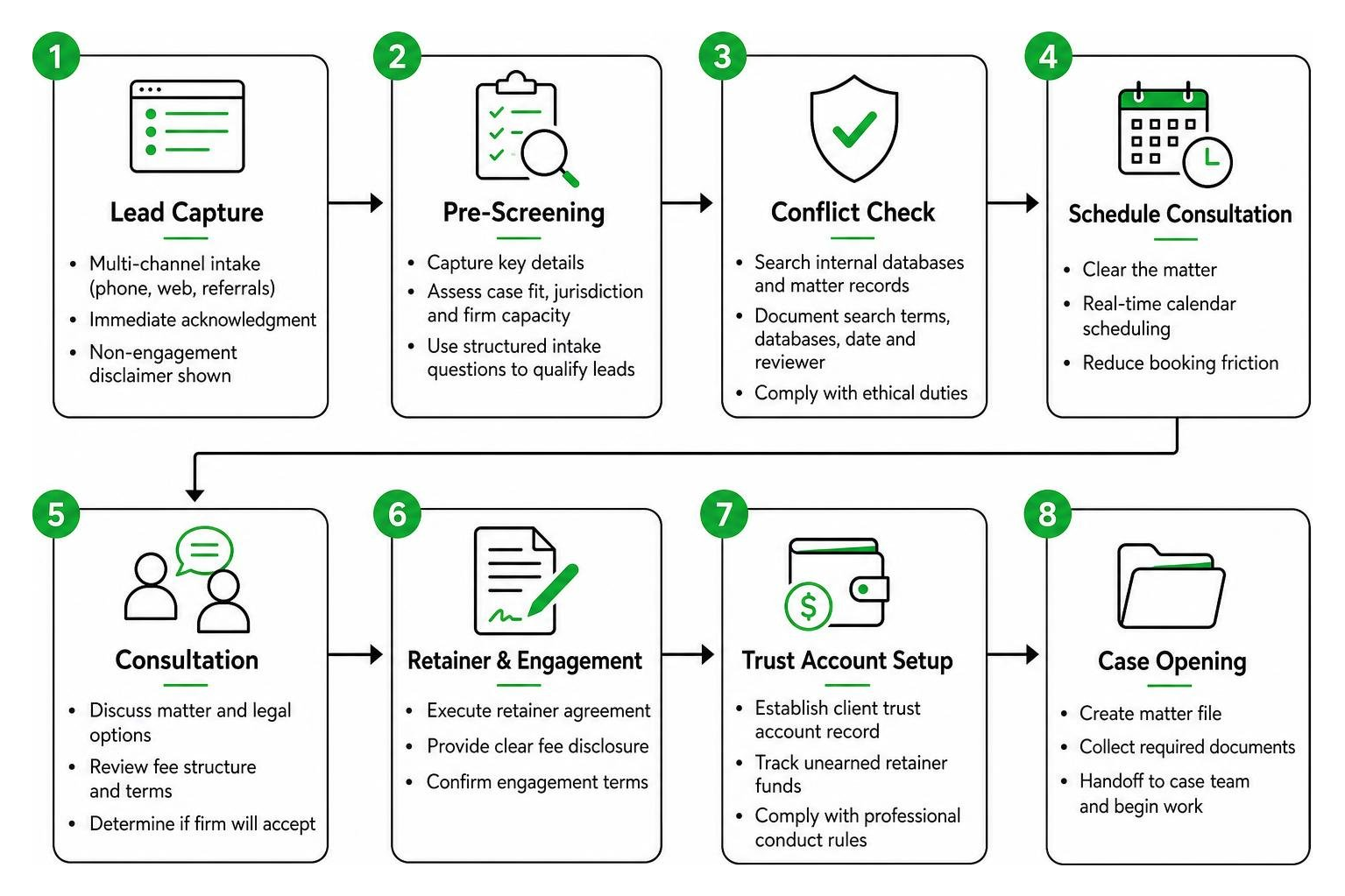
The initial moments following a prospective client’s inquiry determine whether that individual retains your firm or contacts a competitor. In competitive legal markets, a single missed inbound call or a delayed form response can easily cost a firm thousands of dollars in lost business. Establishing high-velocity lead capture protocols ensures that every phone call, website submission, and referral is acknowledged immediately.
During the pre-screening phase, your team must capture fundamental identifying details while evaluating whether the matter aligns with your firm’s substantive capabilities, jurisdiction, and capacity. Incorporating structured legal intake support allows firms to deploy structured questionnaires that filter out unqualified inquiries before senior attorneys invest non-billable hours. Crucially, all initial intake capture interfaces must contain clear, prominent non-engagement disclaimers stating that submitting information or participating in an initial screening call does not establish an attorney-client relationship.
Conflict Checking and Ethical Compliance Under Model Rules
Ethical compliance represents the most legally sensitive component of the intake architecture. Under American Bar Association Model Rule 1.18, legal professionals owe distinct duties of confidentiality to prospective clients, even when no formal legal representation materializes. Gathering excessive, sensitive factual disclosures before confirming that adverse parties are clear can disqualify an entire legal team from representing an existing client in a related matter.
Firms must implement a standardized conflict-of-interest search protocol across all internal databases and historical matter management records prior to conducting detailed factual consultations. Reviewing the foundational steps outlined in this guide to intake process structure highlights why every intake record must explicitly document the search terms used, the specific databases checked, the date of review, and the identity of the reviewing staff member. This disciplined approach insulates the practice against ethical complaints and catastrophic disqualification disputes.
Consultation Scheduling and Retainer Execution
Once a matter clears the initial conflict search and passes substantive viability criteria, your intake workflow must guide the prospect directly into consultation scheduling and retainer execution without administrative delay. Friction during consultation booking remains a primary driver of prospect drop-off.

Modern intake systems leverage two-way calendar synchronization, allowing screened prospects to select consultation times that fit real-time attorney availability. During the consultation, transparent discussions regarding fee structures, payment terms, and retainer handling lay the foundation for a healthy professional relationship. If the firm accepts the matter, the intake software must immediately generate a customized engagement letter, while simultaneously establishing the required trust account records to track unearned retainers in strict compliance with professional conduct rules.
Upgrading to Modern and Automated Legal Intake Systems
Solo law firms adopting modern digital intake tools report fifty-three percent higher revenue and a forty-eight percent increase in client leads, while small firms experience twenty-eight percent higher revenue and six percent more leads. Transitioning away from fragmented spreadsheets, paper intake pads, and disconnected email threads is an operational necessity for firms seeking sustainable growth.
Automating routine data collection restores billable capacity. In fact, twenty percent of legal professionals report saving at least six hours monthly simply by adopting modern lead tracking and automated intake tools. Evaluating various platforms using an objective legal intake automation tool comparison empowers firm leadership to select solutions that unify front-office marketing with back-office case management.
Dynamic Forms and Practice Management Integration for a Client Intake Law Firm
Traditional static document packets create immense friction for prospective clients. Research indicates that ninety percent of companies lose potential clients during digital onboarding because information collection is cumbersome, with users commonly abandoning digital onboarding flows after fourteen minutes. Every superfluous field added to an intake questionnaire can decrease user completion rates by up to ten percent.
Dynamic intake forms solve this challenge by utilizing conditional logic to display only questions that are relevant based on prior responses. Insights from this professional intake form guide demonstrate that mobile-friendly forms featuring no-account-required upload links dramatically reduce completion friction.
When these dynamic intake forms integrate directly with your central practice management software, contact records and matter files populate automatically. This seamless data exchange eliminates duplicate data entry, reduces human transposition errors, and ensures that critical deadlines identified during initial intake are automatically logged into the firm’s redundant master calendaring system.
Automated Retainers and Electronic Signatures
The gap between deciding to retain a firm and physically executing an agreement represents a severe conversion vulnerability. Requiring prospective clients to print, sign, scan, or mail hard-copy fee agreements introduces days of unnecessary friction, during which client motivation wanes or competing firms intervene.
Integrating secure electronic signature technology within your automated intake workflow allows prospects to review clear fee structures and execute legally binding retainer agreements in seconds from any mobile device. Coupling e-signatures with secure digital payment processing platforms enables firms to collect upfront retainer deposits instantly, accelerating client onboarding from days into mere minutes.
Staffing Your Intake Desk: In-House vs. Virtual Intake Specialists
A sophisticated digital intake software stack requires capable human orchestration. Prospective clients contacting a law firm are frequently navigating high-stress life events or complex commercial disputes, requiring empathetic, highly professional human interaction alongside digital efficiency.
Firm leaders face a strategic choice when structuring their intake personnel: maintaining dedicated in-house intake professionals or partnering with specialized virtual legal intake services.
In-house intake specialists provide immediate on-site oversight and direct control over firm culture, though they typically operate strictly during standard business hours and carry substantial fixed overhead costs, including salaries, benefits, and physical workspace. Scaling an internal team also requires prolonged hiring cycles and continuous internal coaching. In contrast, specialized virtual legal intake services offer continuous round-the-clock coverage with flexible, scalable pricing models, enabling firms to handle sudden marketing surges efficiently using external professionals already trained in legal terminology and intake workflows.
First Impressions and Dedicated Intake Roles
Attorneys often assume they should personally field initial prospect inquiries. However, having senior legal counsel manage raw inbound inquiries is neither cost-effective nor operationally sound. Intake specialists serve as dedicated brand ambassadors, triaging inbound leads, answering non-legal procedural questions, and ensuring prompt follow-up.
Intake specialists must possess active listening capabilities, emotional intelligence, and disciplined adherence to firm qualification scripts. When marketing campaigns generate high inquiry volumes, implementing practical techniques to market your firm sustainably ensures your front-office team maintains consistent conversion standards without burning out administrative staff.
Evaluating Virtual Answering Services and Scalability
Inquiries do not cease when your physical office closes for the evening. Prospective clients seeking immediate assistance routinely contact competing firms if their initial call rolls to an unmonitored voicemail box.

Deploying a dedicated legal answering service provides round-the-clock responsiveness, capturing leads outside regular business hours. Exploring why your organization should scale with a professional answering service reveals how virtual intake teams bridge the gap between marketing spend and retained revenue, capturing after-hours opportunities and directly embedding intake data into your practice management workflow.
Measuring Performance and Eliminating Onboarding Drop-Off
More than half of surveyed legal professionals acknowledge that tracking and managing leads remains an ongoing challenge within their organizations. Law firms frequently invest substantial capital into digital advertising and search engine visibility, yet fail to measure the precise conversion metrics governing their intake funnels.
Aligning your intake metrics with a broader law firm marketing and growth strategy transforms prospective client acquisition from a speculative expense into a predictable, scalable business driver.
Key Performance Metrics for a Modern Client Intake Law Firm
To diagnose operational inefficiencies and maximize lead conversion, legal administrators must systematically track core quantitative indicators across the entire intake continuum:
Speed to lead measures the exact number of minutes elapsed between an initial prospect inquiry and your team’s first substantive contact attempt.
Intake completion rate tracks the percentage of prospective clients who successfully complete your dynamic digital intake forms without abandoning the session.
Consultation show rate monitors the proportion of scheduled consultations that actually take place versus cancellations and no-shows.
Conversion rate calculates the ultimate percentage of qualified leads that execute retainer agreements and pay required initial deposits.
Cost per retained client divides total marketing and intake operational expenditures by the actual number of signed, paying clients acquired over a specific time horizon.
Consistently monitoring these figures reveals which marketing channels yield the highest-value matters, helping you build a robust referral system and fill your docket with premier client engagements.
Common Intake Mistakes and How to Prevent Them
One of the most damaging mistakes a firm can make is slow response latency. Research proves that contacting a prospect within minutes dramatically increases retention probability compared to waiting several hours. Establishing automated confirmation text messages and immediate phone outreach protocols eliminates this drop-off risk.
Another widespread vulnerability is the use of overly complex, multi-page intake forms prior to initial consultations. Forcing prospects to complete exhaustive questionnaires before establishing professional rapport triggers severe form fatigue and high exit rates. Instead, divide intake into a lean pre-screening phase followed by a post-retention document collection phase.
Finally, failing to send formal non-engagement letters when declining representation creates severe malpractice exposure. Whenever a firm chooses not to represent an inquiry, staff must immediately issue a written non-engagement notice confirming that no attorney-client relationship exists and advising the individual of imminent statute-of-limitations deadlines.
Frequently Asked Questions About Law Firm Client Intake
How does ABA Model Rule 1.18 govern prospective client intake?
American Bar Association Model Rule 1.18 establishes that an attorney owes duties of confidentiality to anyone who discusses the possibility of forming a client-lawyer relationship, even if no representation ensues. Law firms must limit initial intake data collection to only what is strictly necessary to perform conflict checks and evaluate case viability. Gathering extensive confidential disclosures from a prospective client without proper screening can legally disqualify the firm from representing opposing parties in related proceedings.
Why do prospective clients abandon digital legal intake forms?
Prospective clients primarily abandon online intake forms due to excessive form length, complex legal jargon, mandatory account creation barriers, and poor mobile device formatting. When forms take longer than fifteen minutes to complete or demand sensitive documentation before establishing trust, abandonment rates increase dramatically. Utilizing mobile-optimized dynamic forms with conditional logic ensures that prospects encounter only necessary, digestible questions.
What is the expected return on investment when modernizing legal intake?
Modernizing intake operations delivers immediate return on investment by recovering non-billable attorney hours, decreasing lead acquisition waste, and increasing client conversion rates. Firms that implement automated workflows, rapid-response systems, and electronic retainers frequently see significant increases in retained case volume without increasing their baseline advertising budgets.
Conclusion
Building a high-performing client intake law firm workflow requires aligning empathetic client communication, ethical compliance protocols, and modern automation software into a cohesive operational engine. When you eliminate friction across data capture, conflict screening, consultation booking, and retainer execution, you create an exceptional first impression that consistently converts prospective inquiries into loyal clients.
At CC&A Strategic Media, we take a holistic approach to sustainable business growth, connecting marketing psychology, advanced operational infrastructure, and technology adoption to help law firm leaders build resilient, highly profitable practices. If you are ready to modernize your intake workflows and elevate your firm’s conversion architecture, I invite you to connect with me to explore our Strategic Ops approach and begin transforming your firm’s growth trajectory. To establish a rigorous operational foundation for your front-office team, explore our comprehensive guide on mastering legal intake training and elevate your client experience today.