
A comprehensive training curriculum for legal intake specialists establishes the foundation for sustainable firm expansion. Throughout my career leading growth initiatives, I have observed that high-performing intake operations rest on four non-negotiable pillars: empathetic communication, legal terminology comprehension, CRM software proficiency, and meticulous data management accuracy. When team members understand how these elements interlock, every call becomes a seamless experience for the prospective client.
Building this framework requires strategic balance. The intake process must capture essential information while prioritizing caller comfort and emotional reassurance. You can read more about operational optimization in The Complete Guide to Improving Law Firm Efficiency.
Conducting a strategic SWOT analysis highlights why thorough training matters across all four pillars. Regarding strengths, structured training creates reliable conversion rates, clear data entry standards, and immediate caller trust. For weaknesses, fragmented onboarding leads to high employee turnover, incomplete prospect records, and lost case opportunities. In terms of opportunities, integrating advanced software tools streamlines data collection, allowing specialists to focus on human connection. Finally, regarding threats, regulatory missteps, inaccurate data tracking, or unprofessional call handling can harm firm reputation and trigger legal compliance issues.
To evaluate where your operational infrastructure stands, review the core capabilities below.
| Training Focus Area | Operational Objective | Key Performance Indicator | Strategic Business Impact |
|---|---|---|---|
| Empathetic Communication | Build instant rapport and de-escalate anxiety | First-call satisfaction score | Higher consultation schedule rates |
| Financial Fit Guidance | Discuss payment expectations, options, and next steps clearly | Qualified consultation rate | Better client alignment and fewer drop-offs |
| Legal Aid Referral Awareness | Identify callers who may need low-cost, nonprofit, or legal aid resources | Appropriate referral completion rate | Preserves trust when the firm is not the right fit |
| Legal Terminology | Accurately categorize client inquiries | Data entry error rate | Reduced attorney review time |
| CRM Proficiency | Maintain accurate, real-time prospect records | System logging compliance | Eliminates lead leakage across handoffs |
| Data Integrity | Protect client privacy and prevent conflicts | Compliance audit score | Mitigates ethical and operational risk |
Essential Skills Differentiating Specialists from Phone Answerers
The gap between a generic phone answerer and a skilled intake specialist directly impacts firm performance. Industry benchmarks reveal that basic call operators convert prospective leads at around 5%, whereas trained intake specialists routinely achieve conversion rates of 14% or higher. This dramatic difference stems from intentional skill development rather than rigid adherence to a script.
A phone answerer focuses on completing a checklist, often treating the caller as an administrative task. A legal intake specialist adopts a problem-solving mindset. Specialists practice active listening, maintain professional phone etiquette, and offer genuine reassurance to individuals navigating stressful life events. By focusing on the caller’s immediate needs, specialists transform a routine inquiry into a strong professional relationship.
Why Traditional Scripts Fail in Legal Intake Training
Many law firms rely on rigid scripts, expecting standard scripts to guarantee consistency. However, script-based training frequently creates compliance rather than true competence. When callers present unique circumstances or emotional distress, a script-bound representative often stumbles, sounding cold or robotic.
Traditional scripts fail because they cannot adapt to subtle shifts in caller tone, manage unexpected objections, or build authentic trust. High-converting intake training replaces rigid scripts with dynamic conversation frameworks. These frameworks guide representatives on call objectives, essential milestones, and effective responses while giving them the flexibility to respond naturally to each caller.
Developing Conversion-Driven Skills Beyond Basic Phone Handling

Converting legal inquiries requires continuous skill refinement. Intake professionals must quickly evaluate case details, ask targeted questions, establish appropriate urgency, and guide the caller confidently toward next steps. You can explore additional insights on improving client touchpoints in 5 Ways to Create a “Wow” Moment in Intake Training.
To achieve consistent results across your team, focus on developing key conversation capabilities across several operational areas. Dynamic case recognition allows specialists to recognize key matter indicators quickly to ensure proper routing and prioritization. Strategic questioning involves using open-ended inquiries to collect vital facts without overwhelming the prospective client. Creating ethical urgency requires explaining necessary administrative or legal timelines so callers understand why taking prompt action matters. Finally, confident closing focuses on offering clear, professional guidance on next steps rather than asking passive permissions.
Systematically Training Empathy and Creating “Wow” Moments
Empathy is a deliberate operational capability that can be taught and measured. We train intake representatives to use tone mirroring, adjusting their pacing and demeanor to match the caller’s emotional state. This approach calms anxious callers and establishes rapid alignment.
A key component of this approach is the 3-Step Clarity Script. First, specialists acknowledge and validate the caller’s situation with genuine care. Second, they explain the upcoming process in simple, transparent terms. Third, they confirm and check that the caller feels comfortable and understands the details.
Following this framework, specialists execute a Certainty Close. By summarizing key details, outlining concrete timelines, and delivering explicit reassurance, intake representatives turn stressful inquiries into reassuring experiences.
Balancing Personalization with Operational Efficiency
High-performing intake departments balance warm, personalized communication with streamlined call management. Efficiency should never mean rushing a caller through a form. Instead, true efficiency relies on modern operational software that simplifies administrative tasks.
When intake tools link directly with firm management software, representatives can reference previous touchpoints, access web forms, and personalize conversations immediately. Accurate documentation ensures prospective clients never have to repeat their story during attorney handoffs. This seamless coordination reflects the core methodology behind CC&A Strategic Media’s Strategic Ops service. Strategic Ops provides an operational foundation featuring fractional leadership, dedicated marketing coordination, and full-stack execution to streamline business functions.
Optimizing Follow-Up Speed and Purposeful Communication
In modern legal marketing, response speed strongly influences conversion success. Research indicates that contacting a lead within five minutes yields significantly higher engagement than waiting thirty minutes or longer. Speed alone, however, is not enough; outreach must always carry clear value.
A practical follow-up routine includes multi-channel touchpoints tailored to caller preferences. Sending a personalized text message or email confirmation within 30 minutes of initial contact reinforces professionalism and secures prospective client commitment. Automated CRM reminders prevent leads from dropping off, ensuring consistent communication. To explore scalable call handling options, review Why Your Law Firm Needs a Professional Answering Service to Scale.
Designing a Structured 90-Day Onboarding Framework
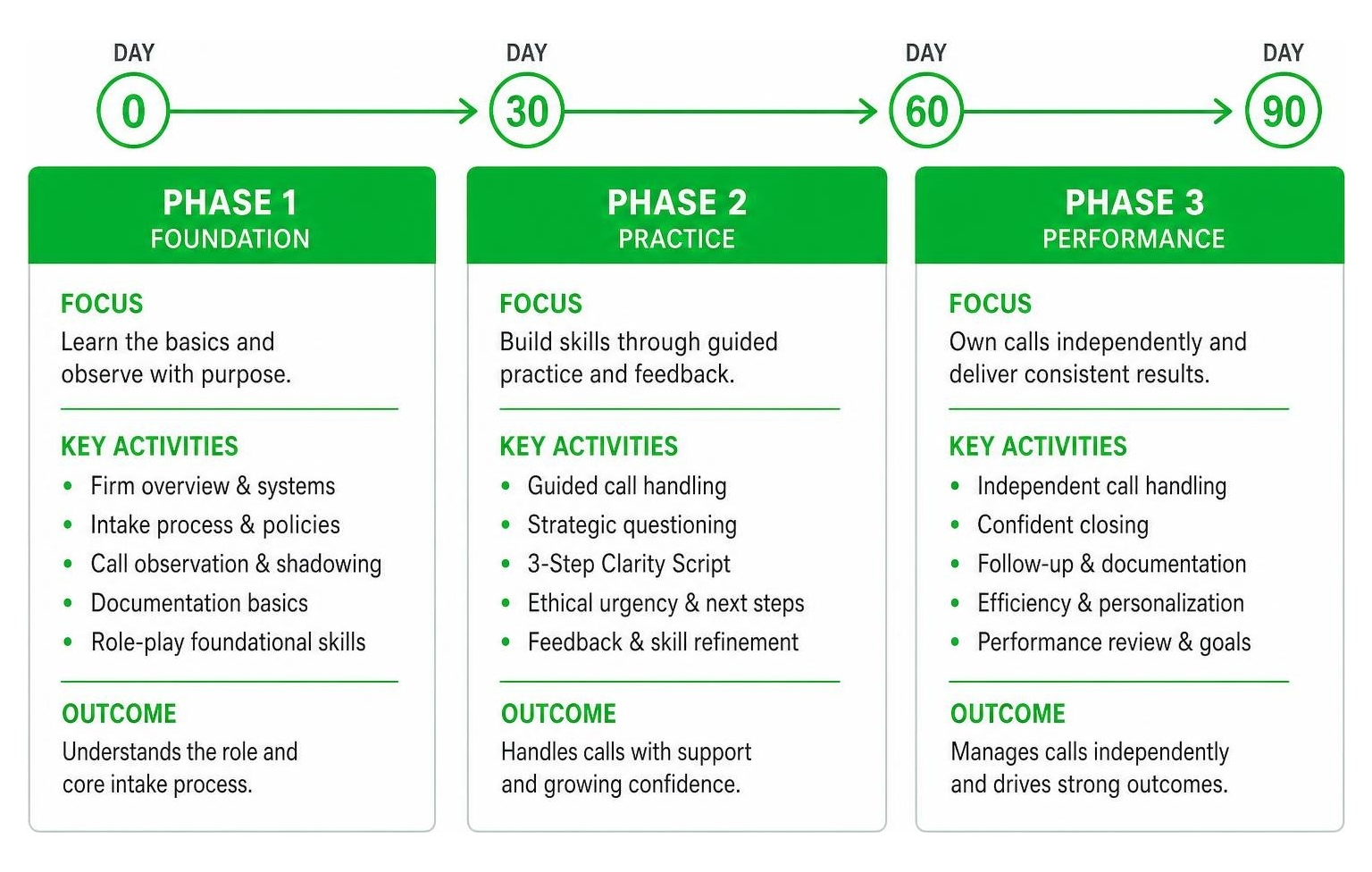
Onboarding new intake personnel requires a structured roadmap that builds confidence and skill over time. Rather than rushing new hires onto live calls after a few days of peer shadowing, forward-thinking firms implement a phased 90-day onboarding program. For a broader perspective on sustainable firm expansion, read The Ultimate Guide to Law Firm Marketing and Growth.
Building a 90-Day Legal Intake Training Framework
A 90-day development framework breaks learning into clear, manageable stages across four distinct phases. During Weeks 1–2, known as the Observation Phase, new hires study practice area fundamentals, shadow experienced specialists, review call recordings, and master software tools. During Weeks 3–4, the Supervised Practice Phase, trainees conduct simulated calls, participate in role-playing exercises, and take live calls under direct supervision. During Weeks 5–8, the Independent Execution Phase, representatives manage calls independently while receiving weekly targeted coaching and call scoring. Finally, during Weeks 9–12, the Performance Benchmark Phase, specialists handle full call loads, target key conversion benchmarks, and refine advanced de-escalation skills.
Continuous Coaching, Call Audits, and Key Performance Indicators
Training does not end at the 90-day mark. Long-term performance relies on consistent call reviews, structured performance tracking, and actionable feedback loops.
Managers should regularly audit a random sample of recorded calls using standard scoring rubrics. Many firms use CallRail, one of the most widely used call tracking and call audit platforms, to review phone etiquette, active listening, data accuracy, empathy, and closing clarity. Monthly coaching sessions help teams celebrate wins, fix skill gaps, and steadily improve call quality.
Ethics, Compliance, and AI Governance in Client Intake

Client intake carries significant ethical responsibility. Because legal duties can arise before a formal representation agreement is signed, intake teams must operate within clear ethical boundaries. Mismanaging initial calls can create unintended conflicts of interest or result in the unauthorized practice of law. Detailed compliance guidelines are available in Client Intake Under the Rules of Professional Conduct.
Managing Model Rule 1.18 and Prospective Client Information
Under American Bar Association Model Rule 1.18, a attorney owes ethical duties to a prospective client who discusses the possibility of forming a client-attorney relationship. Even if no retention occurs, confidential information shared during an intake call can create disqualifying conflicts for the firm in future matters.
To mitigate this operational risk, intake specialists must follow clear screening protocols. First, specialists perform immediate preliminary conflict checks before collecting detailed factual information. Second, they limit initial data collection to essential qualifying details until potential conflicts are cleared. Third, they inform callers early in the conversation that sharing unrequested confidential details before conflict clearance could impact representation. Fourth, specialists document all prospective client interactions in a secure database to preserve complete audit trails.
AI Supervision and Data Privacy Standards
As law firms deploy artificial intelligence chatbots and automated call screening systems, ethical supervision becomes paramount. ABA Model Rule 5.3 requires attorneys to exercise direct supervisory authority over non-lawyer assistants and third-party technology tools.
Firms using AI tools during intake must conduct thorough vendor due diligence, implement rigorous data protection controls, and verify that automated systems comply with consumer privacy requirements. Automated platforms must never offer legal opinions or make unauthorized representations regarding case outcomes.
Modern Training Methodologies: Beyond Scripted Conversations
Moving beyond traditional scripts requires dynamic training approaches that build genuine conversational skill. Modern legal intake training uses active learning techniques, including scenario simulations, real-time call shadowing, and data-driven feedback.
Effective training relies on consistent practice across varied situations. Interactive role-playing allows specialists to simulate difficult call scenarios and refine response flexibility. Peer review workshops offer group call analysis sessions that encourage collaborative learning and skill sharing. Metric-driven coaching aligns feedback with concrete conversion data to keep skill development focused on real outcomes.
De-Escalating Emotional Callers and Building Instant Rapport
Callers reaching out to a law firm are often dealing with significant personal stress. Intake specialists must be equipped to handle heightened emotions, maintain calm control, and offer supportive guidance.
De-escalation begins with calm authority. Specialists allow distressed callers to share their concerns without interruption, using gentle verbal affirmations to show understanding. Once the caller feels heard, the specialist guides the conversation back to structured evaluation using soothing tone transitions and clear, practical questions.
Implementing Call Audits and Continuous Feedback Loops
Continuous operational improvement requires ongoing call auditing, feedback, and accurate tracking. Tools like CallRail can help firms connect calls to marketing sources, review recordings, spot missed opportunities, and coach intake teams with real examples. This makes it easier to identify trends, address performance drops, and highlight exemplary interactions across the team. To explore additional strategies for organizational alignment, read Stop Winging It: A Strategic Roadmap for Law Firm Growth.
Frequently Asked Questions about Legal Intake Training
What is the average cost and timeframe to train a legal intake specialist?
The average direct cost to train an intake staff member ranges around $1,200 to $2,000 in direct instructional resources and supervisory time. Developing a high-converting specialist typically takes a structured 90-day onboarding period. While basic phone handling can be mastered within two weeks, achieving strong conversion performance requires continuous coaching, regular call reviews, and ongoing role-playing over three full months.
How can law firms measure the success of an intake training program?
Intake training success is evaluated using both quantitative and qualitative key performance indicators. Core quantitative metrics include lead-to-consultation conversion rate, average call answer speed, follow-up response times, and system data logging accuracy. Qualitative measures focus on call audit quality scores, empathy ratings, de-escalation effectiveness, and prospective client feedback.
How do intake specialists avoid giving legal advice during calls?
Intake specialists avoid the unauthorized practice of law by setting clear conversational boundaries early in the call. Specialists use structured mini-agendas, explicitly stating that their role is to gather information for attorney review and explain firm processes. When callers request specific legal opinions, specialists use polite deflections, reassuring the caller that an attorney will address their legal questions once complete information is gathered.
Elevating Your Firm’s Intake Operations
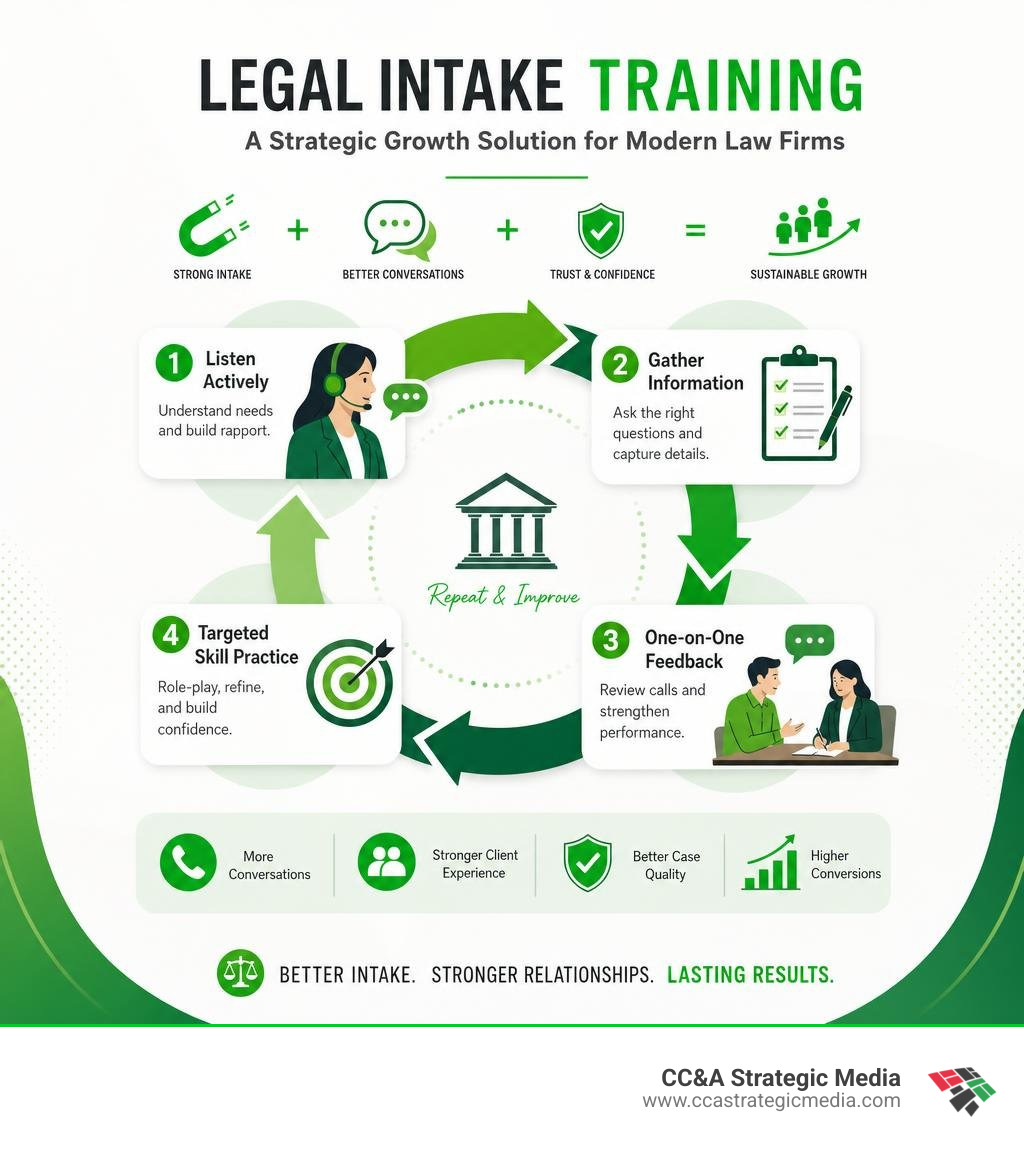
A high-converting intake operation bridges marketing investment and long-term firm expansion. By treating intake as a core operational capability—supported by empathetic communication, structured 90-day onboarding, continuous call audits, and strong compliance safeguards—your firm ensures every prospective client experience reflects your organizational values.
At CC&A Strategic Media, we take a holistic approach to growth, combining sales psychology, operational strategy, and technology integration. Through our Strategic Ops platform, we help firms establish efficient intake workflows, connect marketing data, and build sustainable client pipelines.
If you are ready to strengthen your intake process and increase your marketing ROI, connect with me, Roxanne St. Marie, to discuss custom intake strategies tailored to your firm’s goals.