Why Most Law Firms Stay Stuck Without an Attorney Business Development Plan
A strong attorney business development plan is a written roadmap that defines how a lawyer or law firm will attract clients, build relationships, generate revenue, and grow over time. It is not a marketing campaign. It is the strategic architecture behind every growth decision your firm makes.
Here is what a solid plan covers at a glance:
| Component | What It Does |
|---|---|
| Goals & KPIs | Defines measurable targets like revenue, new clients, and referrals |
| Ideal Client Profile | Clarifies who you serve and why they choose you |
| Market & Competitor Analysis | Identifies opportunities and threats in your space |
| Business Development Tactics | Outlines networking, content, speaking, and referral strategies |
| Financial Projections | Maps revenue targets to fee structures and case volume |
| Tracking & Review Cycle | Keeps the plan alive with quarterly check-ins |
Most lawyers are exceptional at their craft. But exceptional legal skills are table stakes. The firms that grow consistently are not the ones with the most talented attorneys. They are the ones with a deliberate system for building relationships, staying visible, and converting opportunities into clients.
The challenge is real. Billable hour pressure, client deadlines, and internal meetings leave little room for strategic thinking. Business development gets pushed to the back burner until the pipeline runs dry. Then it becomes urgent — and urgency rarely produces good strategy.
As the adage goes: if you don’t plan your career, someone else will plan it for you.
The good news is that an effective attorney business development plan does not need to be a 50-page document. It needs to be specific, honest, and revisited regularly. Even a focused one-page roadmap outperforms no roadmap at all.
I’m Roxanne St. Marie, and over nearly two decades leading marketing, intake, and client growth operations inside law firms — from high-profile practices to scaling boutique firms — I have seen how a structured attorney business development plan separates firms that grow intentionally from those that simply stay busy. In this guide, I will walk you through exactly how to build one.
Basic attorney business development plan terms:
Defining the Attorney Business Development Plan: Strategy vs. Tactics
In my experience as a strategic advisor, I often see firm leaders conflate “business development” with “sales.” While they are related, an attorney business development plan is much broader. It is the architectural blueprint for your firm’s future. If sales is the act of building the house, business development is the design process that ensures the house is built on the right land, for the right price, and for the right inhabitants.
A successful business development plan for lawyers focuses on identifying long-term value. It isn’t just about winning a single case; it’s about opening a new revenue stream or cultivating a referral source that will yield ten cases a year for the next decade. For those focused on business law marketing, this means looking beyond transactional work toward becoming a “trusted advisor” who is integrated into the client’s business lifecycle.
The Distinction Between Marketing and Business Development
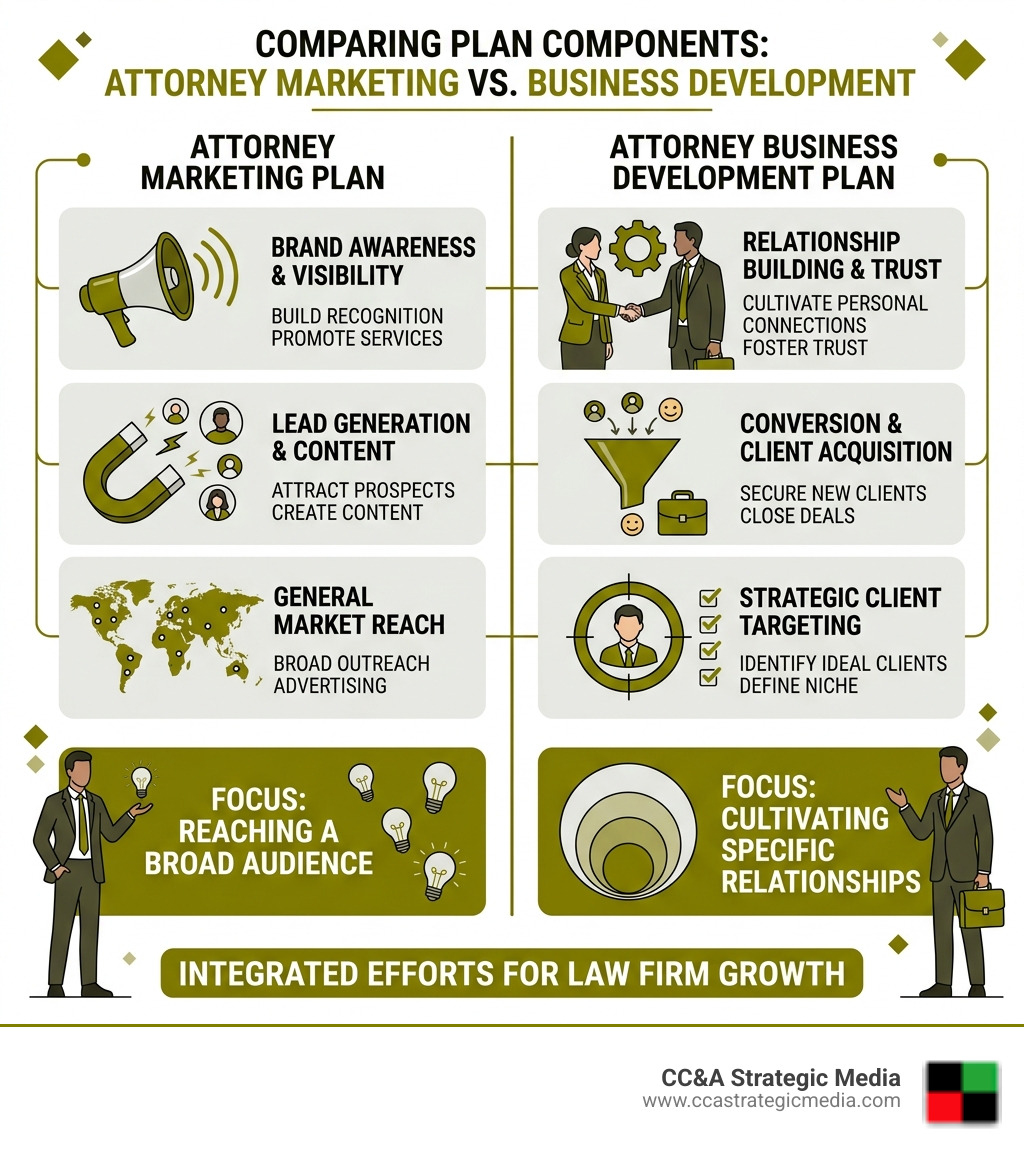
To grow a firm in 2026, you must understand where marketing ends and business development begins. Marketing is generally “top-of-funnel.” It’s about brand awareness, digital marketing strategies for business law firms, and generating leads through broad visibility.
Business development, however, is about relationship intelligence. It is the “hand-to-hand combat” of growth. While marketing might get a prospect to your website, business development is the strategic follow-up, the lunch meeting, and the long-term nurturing that turns a lead into a client. When these two functions are aligned, your firm operates with a level of precision that competitors simply cannot match.
Why Every Career Stage Requires a Roadmap
Whether you are an associate, a partner, or a solo practitioner, your growth needs a system.
- Associates: You are building your infrastructure. You need a plan to transition from being a “generic generalist” to a specialist with a visible niche.
- Partners: Your focus is on maintaining a “book of business.” You need a plan to cross-sell services and ensure your existing clients are fully served by other practice areas in the firm.
- Solo Practitioners: A plan is your survival tool. With limited resources, you cannot afford to waste time on low-value activities.
- Succession Planning: For senior partners, a business development plan is critical for law firm succession planning. You must plan how to transition your relationships to the next generation to preserve the firm’s value.
The Architecture of Growth: Core Components of a Personal Business Plan
The most effective plans I have implemented share a common structure. They move from the abstract (vision) to the concrete (financials). When you develop a strong business development plan, you are essentially writing a manual for your own success.
Every plan should start with an Executive Summary. This isn’t just fluff; it’s a concise statement of what you intend to achieve and why. Following this, a clear Mission Statement defines your purpose. Are you the most aggressive litigator for tech startups, or the most empathetic guide for families in crisis? This clarity informs every other decision.
Setting Measurable Goals for Your Attorney Business Development Plan
Hope is not a strategy. We advocate for SMART goals: Specific, Measurable, Achievable, Relevant, and Time-bound.
- Ineffective Goal: “I want to bring in more business.”
- SMART Goal: “I will sign five new corporate clients with a minimum matter value of $50,000 by December 31, 2026.”
By using SEO services and data tracking, you can monitor Key Performance Indicators (KPIs) like pipeline value and lead conversion rates. This data allows you to see exactly where your growth is coming from and where it is stalling.
Financial Considerations and Revenue Projections
A business development plan must be rooted in financial reality. We look at the “math of growth.” For example, if your revenue goal is $125,000 and your average case value is $3,000, you need to close roughly 42 cases a year—or about 3 to 4 per month.
Understanding these numbers helps you determine your fee structures and startup budgets. If you are entering a new partnership, these projections are essential for drafting law firm partnership agreements. You need to know how much revenue you are expected to generate and what resources (staffing, technology, marketing spend) are required to get there.
Market Intelligence and the Strategic SWOT Analysis
The legal market in 2026 is hyper-competitive. You cannot grow in a vacuum. You must understand your target market and where you fit within it.

Identifying Your Niche and Ideal Client Persona
One of the biggest mistakes I see is attorneys trying to be “everything to everyone.” In a crowded market, the specialist wins. You need to create buyer personas that go beyond demographics. What are their psychographics? What keeps them up at night? What are the “triggers” that make them realize they need a lawyer?
Developing a Unique Selling Proposition (USP) is about answering one question: “Why should I hire you instead of the firm down the street?” If your answer is “we provide great service,” you haven’t found your USP yet. Everyone says they provide great service. Your USP should be a specific, undeniable advantage you offer.
Conducting a Competitive SWOT Analysis
A SWOT analysis (Strengths, Weaknesses, Opportunities, Threats) is a foundational tool for any business architect.
- Strengths: What do you do better than anyone else? (e.g., deep industry knowledge, high-profile wins).
- Weaknesses: Where are you vulnerable? (e.g., lack of automated follow-up, aging client base).
- Opportunities: Where is the market moving? (e.g., new regulations, emerging technologies like AI).
- Threats: What external factors could hurt you? (e.g., aggressive new competitors, economic downturns).
Integrating this with reputation marketing allows you to leverage your strengths to mitigate market threats.
Executing Your Attorney Business Development Plan: From Roadmap to Reality
A plan on a shelf is useless. The magic happens in the execution. We often see a “gap” between strategy and daily action. To bridge this, business development must become a daily habit, not a sporadic burst of activity when the phone stops ringing. Turning plans into reality requires discipline and a commitment to the “long game.”
Practical Tactics for Your Attorney Business Development Plan
Consistency is the “drip, drip, drip” that leads to a flood of business.
- Thought Leadership: Don’t just write for other lawyers. Write for your clients. Repurpose a ten-page white paper into five short LinkedIn posts and a webinar.
- Referral Engines: Build relationships with “contemporaries” (accountants, bankers, other lawyers) who serve the same clients but offer different services.
- Networking: Move beyond traditional bar association events. Go where your clients are—trade shows, industry boards, or even community gatherings.
- Brand Recognition: Focus on increasing brand recognition by being the “go-to” source for media quotes in your niche.
Leveraging Technology and Online Presence
In 2026, your “online presence” is often your first impression. 81% of buyers do their own research before ever reaching out to a firm. This makes digital marketing for family law or personal injury firms non-negotiable.
Your technology stack should support your strategy. A robust CRM (Client Relationship Management) system is the “brain” of your business development efforts. It tracks every interaction, ensures no lead is forgotten, and provides the data you need to measure ROI. AI is no longer a luxury; it is a business infrastructure layer that allows firms to automate routine tasks, leaving more time for high-value relationship building.
Measuring Success and Adjusting the Growth System
The final piece of the architecture is the feedback loop. You must treat your attorney business development plan as a living document. I recommend a quarterly review cycle where you look at your KPIs and adjust your tactics based on what the data is telling you.
Are you getting leads but not converting them? The problem might be your intake process. Is your website traffic high but your bounce rate even higher? You may need to revisit how to get reviews on Google Business to build trust.
Common Pitfalls and How to Avoid Them
Even the best-designed systems can fail if they aren’t maintained.
- Lack of Focus: Trying to pursue too many niches at once.
- Sporadic Activity: Doing “marketing” only when you are slow.
- Neglecting Current Clients: 72% of a firm’s revenue typically comes from existing customers. Don’t forget to cross-sell.
- Poor Follow-up: Most opportunities are lost because an attorney didn’t follow up after the first meeting. This is why a professional answering service or automated CRM workflows are so vital—they ensure you never miss a beat.
Frequently Asked Questions about Attorney Business Development Plans
How much time should I spend on business development weekly?
Start with at least one to two hours of focused, “non-billable” time per week. As you build momentum, aim for 10-15% of your total time. The key is consistency—thirty minutes every day is better than five hours once a month.
What is the most effective way to generate referrals in 2026?
The most effective way is to provide exceptional value to your current clients and then systematically ask for reviews and referrals. Additionally, building a network of “complementary professionals” who trust your expertise is a proven way to generate high-quality leads.
Can a solo practitioner compete with large firm business plans?
Absolutely. In fact, solo practitioners often have an advantage because they can be more agile and specialized. By focusing on a narrow niche and leveraging modern technology, a solo attorney can build a presence that rivals much larger firms.
Conclusion
At CC&A Strategic Media, we believe that sustainable growth is not the result of a single “lucky” case or a flashy ad campaign. It is the result of a holistic growth system that aligns your marketing, your operations, and your leadership mindset.
Building an attorney business development plan is the first step in redesigning how your firm operates. It moves you from a reactive state—chasing whatever work comes through the door—to a proactive state where you are the architect of your own success.
If you are ready to stop winging it and start building a firm that grows with precision, we invite you to explore our marketing services. Let’s build something that lasts.