Introduction
Performance marketing is a results-driven digital advertising strategy where businesses only pay when a specific, measurable action occurs, such as a click, lead form submission, video view, or sale. Unlike traditional advertising focused solely on estimated reach or awareness, performance marketing links every media dollar directly to verified user conversions and return on ad spend.
How Performance Marketing Turns Spend Into Measurable Growth
Performance marketing is a way to run advertising with clear, trackable goals. Instead of treating every ad as an awareness expense, you set the action that matters most, such as a click, qualified lead, sale, or booked consultation, then measure what it took to produce that result. Start by choosing one business goal, setting a target cost and return, tracking conversions accurately, and testing the channels and messages that bring in the most valuable customers.
It is not just about buying clicks. Strong performance marketing connects audience research, creative, landing pages, follow-up, and sales data. That lets businesses see which efforts create revenue, not simply activity.
For business owners, the value is accountability. You can improve campaigns based on evidence, shift budget away from weak results, and use customer lifetime value to decide what a new lead or customer is truly worth. Brand marketing still matters, but performance marketing gives you a practical system for tying marketing work to outcomes.
As a marketing manager at CC&A Strategic Media, I help organizations connect SEO, paid media, and branding to measurable business growth. In this guide, I’ll explain how performance marketing works, why data matters, and how businesses can build a more effective, measurable approach to customer acquisition.
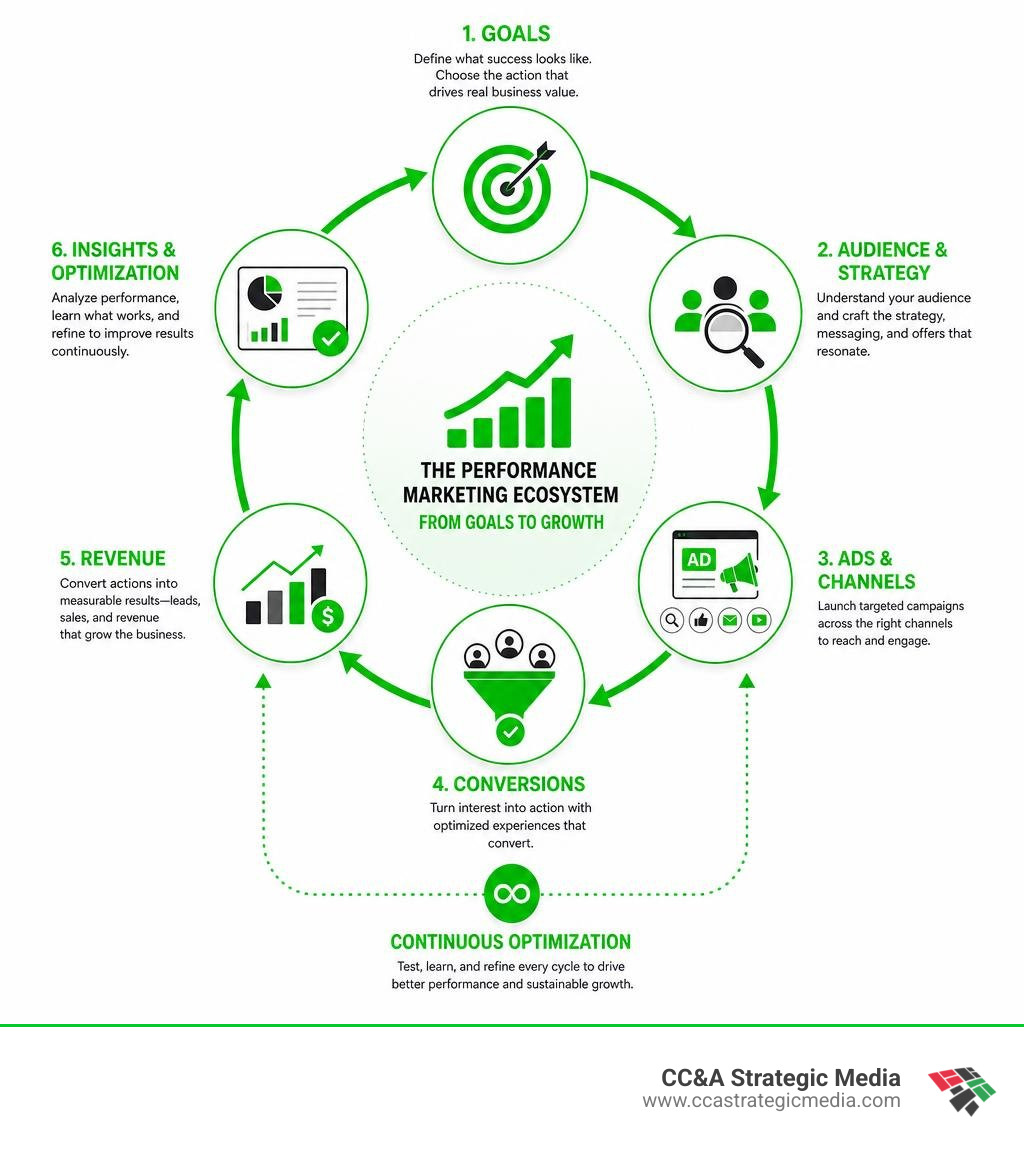
Key terms for performance marketing include marketing best practices and brand messaging strategy.
Understanding Performance Marketing and Its Core Mechanics
At its foundation, performance marketing operates on a pay-for-performance model. Instead of paying upfront fees for estimated exposure, you compensate ad platforms or publishing partners primarily when a designated, measurable user outcome takes place. This arrangement fundamentally alters financial risk, transferring a significant portion of uncertainty away from your marketing budget and placing the emphasis on verified delivery.
A helpful way to visualize this ecosystem is to think of performance advertising as the tactical vehicle, while performance marketing is the entire road network and traffic control system. The ad unit itself might capture an immediate click, but the broader discipline integrates audience data, channel governance, conversion rate optimization, and lifetime value modeling into a full-funnel strategy.
| Core Dimension | Performance Marketing | Brand Marketing |
|---|---|---|
| Primary Objective | Immediate, measurable user actions (clicks, leads, sales) | Long-term brand equity, sentiment, and awareness |
| Primary Pricing Metric | Action-based (CPC, CPL, CPA, CPS) | Impression-based (CPM) |
| Optimization Focus | Conversion paths, landing pages, direct ROI/ROAS | Reach, recall, messaging resonance, and frequency |
| Risk Distribution | Low upfront risk; payment tied to verified results | Higher upfront commitment with delayed attribution |
| Measurement Timeline | Real-time to short-term closed-loop data | Medium to long-term longitudinal studies and lift |
Performance Marketing vs. Brand Marketing
Understanding the operational boundaries between direct-response initiatives and brand equity campaigns prevents misallocated budgets. Brand marketing focuses on shaping market perception, fostering trust, and establishing emotional resonance over extended cycles. These campaigns are traditionally purchased on an impression basis, prioritizing broad market reach and message frequency.
In contrast, performance initiatives prioritize direct response. Every dollar deployed targets a specific stage of the sales pipeline, with direct metrics like customer acquisition cost (CAC) serving as the benchmark of success. However, high-performing organizations do not view these approaches as opposing forces. A trusted identity built by an experienced Brand Marketing Company dramatically lowers downstream acquisition costs by increasing organic trust and ad click-through rates.
Performance Marketing vs. Affiliate Marketing
A common misconception in digital advertising is conflating affiliate programs with the entirety of performance marketing. Affiliate marketing is actually a specific subset under the broader performance umbrella. In an affiliate model, third-party publishers promote products and earn a commission solely on resulting sales or completed registrations.
Comprehensive performance marketing encompasses an expansive spectrum of owned, paid, and syndicated channels—including search engines, programmatic media, paid social, and connected television—that an organization can manage entirely in-house or through specialized agencies. As highlighted in industry analyses like Performance marketing – What it is, how to measure, and channels., strategic oversight requires unified governance across both direct channel spending and publisher-driven partnerships to maintain consistent brand integrity and accurate attribution.
Primary Pricing Structures and Financial Models
Selecting the appropriate commercial model directly dictates your cash flow efficiency and budget protection. Modern digital advertising allows organizations to tailor payment terms to their operational risk tolerance and sales cycle velocity. Leveraging dedicated PPC Services ensures these pricing models align with real commercial targets rather than vanity metrics.
Cost-Per-Click and Impression Dynamics
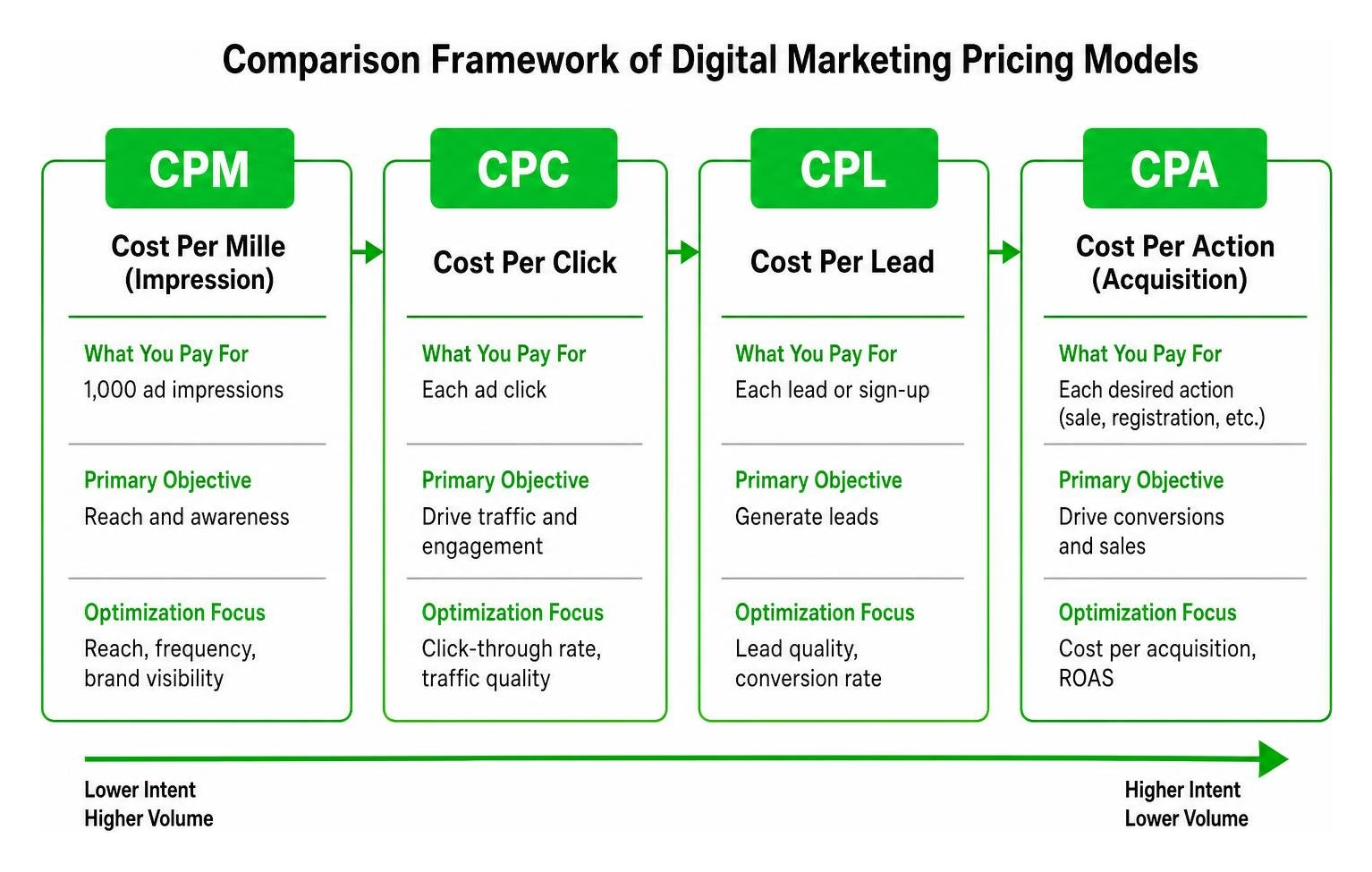
Cost-Per-Click (CPC) remains a standard pricing mechanic for intent-driven channels. Advertisers bid within real-time automated auctions, paying only when a user actively clicks on an ad unit. This dynamic offers fine-grained budget control, enabling businesses to adjust bids based on device, time of day, geographic intent, and keyword competitiveness.
Historically, digital auction competition has expanded steadily. Search dynamics established decades ago—where rising keyword valuations shifted budgets from passive impression buying to action-driven models—continue to shape today’s landscape. Senior marketing leaders recognized early on that shifting budgets toward measurable action models yields superior financial control. Effective PPC Management continuously balances impression share against conversion efficiency to ensure keyword bidding remains profitable.
Action and Acquisition Pricing Models
For deeper pipeline protection, action-oriented pricing structures tie expenditure directly to lower-funnel milestones.
Under Cost-Per-Lead (CPL), the advertiser pays when an interested prospect submits verified contact information via a web form, interactive tool, or gated resource. CPL campaigns are advertiser-centric, offering high control over lead qualification criteria and subsequent nurture sequences.
With Cost-Per-Acquisition (CPA) and Cost-Per-Sale (CPS), payment triggers only after a complete financial transaction or paid customer conversion occurs. This model represents high risk mitigation for direct-response e-commerce and transactional sales environments.
For Cost-Per-Mille (CPM), charging per one thousand impressions is optimal for top-of-funnel reach or programmatic retargeting where high frequency is required to influence multi-channel decision-makers.
Essential Performance Channels and Modern Execution
Modern performance campaigns do not operate in single-channel silos. Executing an omnichannel distribution architecture captures prospects at every stage of consideration while preserving clean attribution. Integrating multi-channel execution through comprehensive Digital Marketing Services ensures unified messaging across every customer touchpoint.

High-Intent Search and Social Media Channels
Search Engine Marketing (SEM) captures active intent at the exact moment a buyer seeks a specific solution. Paid search captures immediate bottom-of-funnel demand, while long-term discoverability is reinforced through expert SEO Services that capture organic search share without ongoing per-click media fees.
Simultaneously, paid social platforms provide unmatched behavioral, interest-based, and demographic segmentation. Leveraging targeted Social Media Services allows brands to engage decision-makers inside native feeds, delivering customized value propositions, case studies, and interactive formats directly into their daily professional and personal browsing environments.
Emerging Touchpoints: CTV and Retail Media Networks
The performance landscape has expanded far beyond traditional web banners and search engine result pages. Two rapidly growing channels have transformed modern media strategies.
Connected TV (CTV), once viewed strictly as a brand-awareness vehicle, now acts as a full-funnel performance engine. By matching household IP addresses and connected device identifiers, advertisers deliver precision television ads to defined audiences and track cross-device view-through conversions on secondary devices such as laptops, tablets, and smartphones. High-impact creative produced via professional Video Production Services drives direct digital action from the living room screen.
Retail Media Networks (RMNs) leverage rich first-party purchase history to offer closed-loop attribution. Advertisers place sponsored listings and display units directly at the digital point of sale, matching ad exposure directly to verified offline and online transactions.
Next-Generation Automation, AI, and B2B Application
Generative AI and machine learning have shifted day-to-day campaign management from manual bidding adjustments to strategic data governance. Implementing sophisticated Marketing Automation systems allows marketing teams to deploy dynamic personalization at scale, serving individualized ad variations, headlines, and landing page layouts based on real-time user intent signals.

Algorithmic Campaign Optimization and Autonomous Bidding
Modern advertising engines leverage algorithmic bidding to optimize performance across multi-channel inventories simultaneously. Machine learning models evaluate thousands of contextual and behavioral audience signals in milliseconds to forecast conversion probabilities and adjust bid values accordingly.
Platforms such as Performance Max | Microsoft Advertising demonstrate this unified approach, using artificial intelligence to dynamically assemble creative assets, identify conversion pathways, and serve ads across search, display, native, and conversational AI interfaces from a centralized objective framework.
High-Value B2B Lead Generation Frameworks
For B2B organizations and professional service firms, performance marketing serves as an engine for predictable pipeline generation. The professional ecosystem represents an immense landscape, with platforms like LinkedIn housing over 1 billion professional users worldwide.
To turn this audience into tangible commercial value, businesses deploy sophisticated multi-touch nurture architectures. Precision executive targeting segments audiences by exact job functions, company sizes, industry verticals, and seniority levels to prevent wasted ad spend. Gated educational assets deploy native lead-generation forms offering high-value whitepapers, research reports, or diagnostic tools to capture verified business contact data with minimal friction. Strategic inbound alignment through partnering with an experienced Inbound Marketing Company ensures captured leads seamlessly transition into automated email sequences, CRM scoring models, and direct sales consultations.
Within CC&A Strategic Media, our CC&A Strategic Ops framework provides the operational foundation required for this execution—combining fractional leadership, dedicated marketing coordination, and full-stack agency delivery to align performance campaigns directly with revenue objectives.
Campaign Measurement and ROI Optimization Framework
Accurate measurement separates high-yield performance campaigns from undisciplined ad spending. To optimize campaigns effectively, organizations must analyze metrics across every level of the conversion funnel, supported by strategic Consulting to interpret complex data patterns.
Top-of-Funnel and Conversion Metrics
Monitoring early-stage health indicators ensures ad creatives and targeting models remain efficient before pipeline bottlenecks occur.
Click-Through Rate (CTR) measures creative relevance and audience alignment, where a dropping CTR indicates ad fatigue or declining audience interest. Conversion Rate (CVR) tracks the percentage of users who complete a desired action after clicking, where low conversion rates typically point toward landing page friction, misaligned messaging, or slow site load speeds. Cost-Per-Lead (CPL) and Cost-Per-Acquisition (CPA) serve as baseline financial efficiency metrics calculating the direct media spend required to generate a prospect or completed transaction.
Long-Term Value and Multi-Touch Attribution
Evaluating performance purely through short-term ROAS (Return on Ad Spend) can limit sustainable business growth. Long-term profitability requires measuring Customer Lifetime Value (LTV or CLV) against Customer Acquisition Cost (CAC). When you know the lifetime value of an acquired account, you can set aggressive, mathematically sound target CPA thresholds that outbid competitors while maintaining profitability.
Furthermore, privacy shifts and browser changes require robust first-party data strategies. Relying solely on last-touch attribution obscures the early touchpoints that initiated customer interest. Modern performance frameworks deploy data-driven, multi-touch attribution and media mix modeling to evaluate how awareness, nurture, and closing touchpoints work together across the entire buying journey.
Frequently Asked Questions About Performance Advertising
What is the primary benefit of pay-for-performance advertising?
The fundamental advantage is financial risk reduction and commercial transparency. Because ad expenditures are directly tied to verified user outcomes (such as clicks, leads, downloads, or purchases), businesses eliminate speculative advertising costs and maintain clear accountability across every marketing dollar invested.
How do B2B organizations measure campaign success?
B2B organizations measure success by tracking pipeline velocity, marketing-qualified leads (MQLs), sales-accepted opportunities, and overall Customer Acquisition Cost (CAC) relative to contract value. Rather than focusing solely on initial form fills, high-performing B2B campaigns measure revenue attribution across extended sales cycles.
What is the difference between CPA and CPL models?
A Cost-Per-Lead (CPL) model charges the advertiser when a prospect submits their contact information, leaving subsequent qualification, nurturing, and closing to the advertiser’s sales team. A Cost-Per-Acquisition (CPA) model triggers payment only when a complete, revenue-generating transaction or account registration is finalized.
Conclusion
Performance marketing is not a collection of isolated tactical tricks; it is an accountable, data-driven methodology that turns marketing spend into a predictable revenue generator. By combining clear financial pricing models, multi-channel distribution, AI-assisted optimization, and disciplined lifetime value measurement, your organization can build a sustainable customer acquisition engine that adapts to market shifts.
If you are ready to evaluate your current advertising efficiency, align your sales pipeline with modern performance architectures, and build an accountable framework for sustainable growth, connect with me, Reagan Collins, to explore how our team can support your long-term business goals.