Why Law Firm Growth Strategies Determine Who Thrives — and Who Stalls
Law firm growth strategies are the deliberate systems, marketing approaches, and operational decisions that allow firms to scale their client base, revenue, and team — without sacrificing quality or burning out their people.
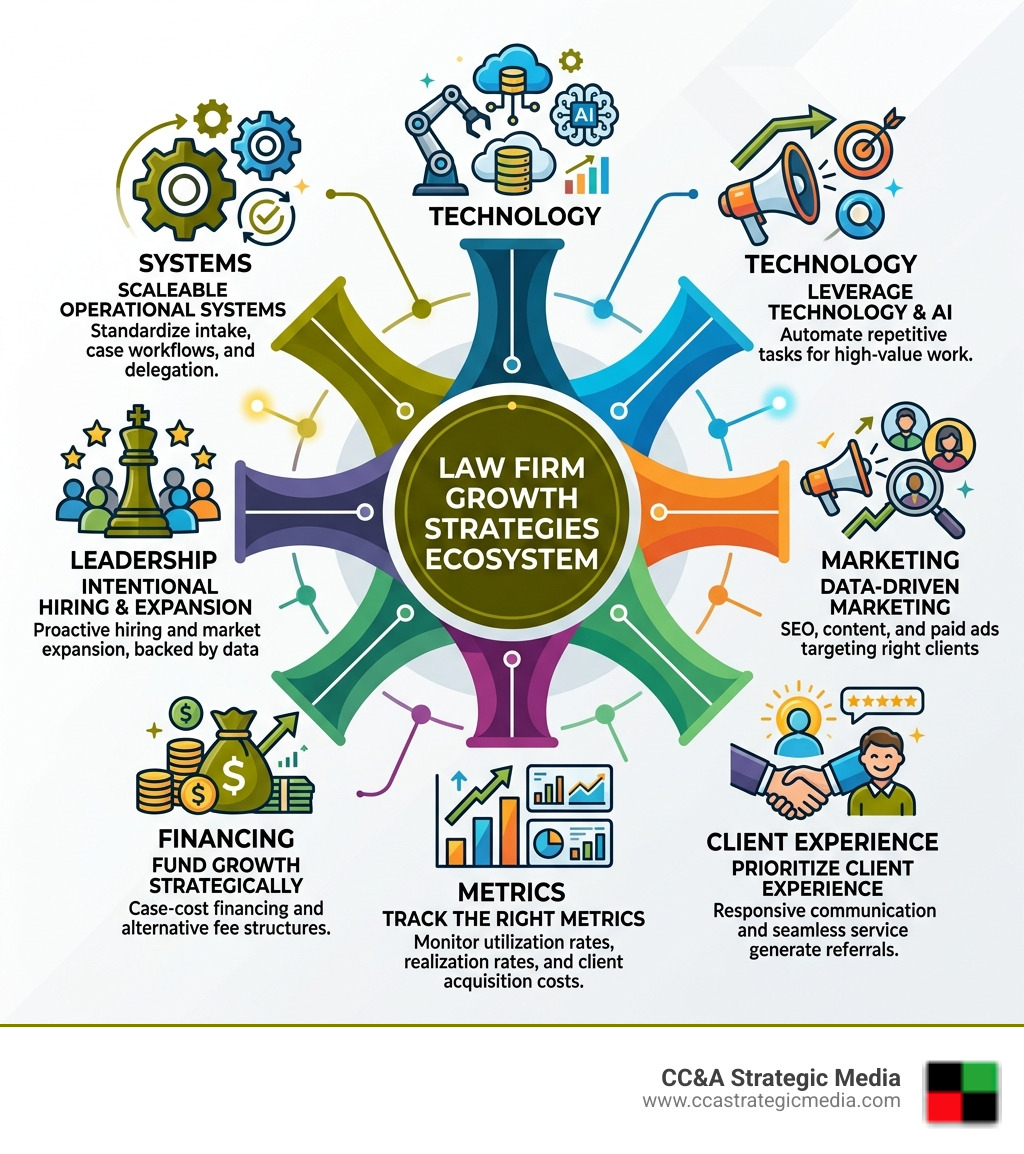
If you want the short version, here are the core strategies that move the needle:
- Build scalable operational systems — standardize intake, case workflows, and delegation before growth hits
- Leverage technology and AI — automate repetitive tasks and free your team for high-value work
- Invest in data-driven marketing — SEO, content, and paid ads that target the right clients
- Prioritize client experience — responsive communication and seamless service generate referrals
- Track the right metrics — utilization rates, realization rates, and client acquisition costs tell you where to invest
- Fund growth strategically — explore case-cost financing and alternative fee structures to stay liquid
- Hire and expand intentionally — proactive hiring and market expansion, backed by data, not guesswork
The hard truth? Most firms don’t fail because their lawyers aren’t good enough. They fail because the business side of the firm — intake, systems, marketing, and leadership — hasn’t kept pace with ambition.
The legal market is shifting fast. As of April 2026, 79% of legal professionals now use AI — up from just 19% in 2023. Firms making strategic investments in technology and marketing are seeing 21% higher profitability than those that don’t. Meanwhile, over 50% of law firms still ignore client inquiries entirely — a staggering competitive gap for firms willing to show up differently.
Growth isn’t just about winning cases. The strongest firms are disciplined in how every part of the business works together to create sustainable momentum.
I’m Roxanne St. Marie — I’ve spent nearly two decades inside law firms and legal marketing agencies building intake systems, CRM strategies, digital marketing strategies and growth operations that turn ambitious firms into scalable businesses, and law firm growth strategies have been at the center of that work. As Marketing Director at CC&A Strategic Media, I’ll walk you through exactly what works — and what doesn’t — so you can build a firm that grows with intention, not by accident.
Law firm growth strategies vocab to learn:
Building a Scalable Operational Foundation for Law Firm Growth Strategies
Sustainable expansion is impossible without a rock-solid foundation. Many firms attempt to layer aggressive marketing on top of broken processes, only to find that more leads lead to more chaos. As we look at the landscape in 2026, the firms that dominate are those that treat their practice as a business architecture rather than just a legal service.

Building this foundation requires a clear-eyed business strategy for lawyers that prioritizes capacity management. We often recommend starting with a SWOT analysis (Strengths, Weaknesses, Opportunities, Threats). By identifying where your internal “pipes” are leaking—whether it’s slow intake or disorganized document management—you can ensure your firm is positioned for a 21% increase in profitability.
Breaking the Feast-or-Famine Cycle with Predictable Systems
The “feast-or-famine” cycle is the silent killer of small and mid-sized firms. You work hard to get cases, become too busy to market, and then find yourself with an empty pipeline once those cases close. To break this, you must implement standardized operating procedures (SOPs).
Research shows that tasks like information gathering and data analysis account for up to 74% of hourly billable work. When these tasks are manual, they create bottlenecks. By creating templates for law firm partnership agreements and automating recurring workflows, you reclaim time for the high-level strategic work that actually drives growth.
Overcoming Common Barriers to Law Firm Growth Strategies
Growth barriers are often administrative in nature. Overload leads to human error, which is responsible for 26% of data breaches in the legal industry. Inconsistent procedures and non-compliant handling of Protected Health Information (PHI) aren’t just inefficient; they are liabilities.
The goal is to transition from a “hero-based” model, where the founding partner does everything, to a “systems-based” model. This means delegating non-core tasks so that the legal talent can focus on the law, not the logistics.
Leveraging Technology and AI as a Business Infrastructure Layer
In 2026, AI is no longer a futuristic concept; it is a core business infrastructure layer. With a 79% adoption rate among legal professionals, the question is no longer if you should use it, but how effectively you are integrating it into your law firm growth strategies.
Firms that ignore these technological trends face a dual risk: they become too slow to compete on price and more vulnerable to IT failures, which currently account for 23% of data breaches.
Automating Administrative Tasks and Medical Record Retrieval
One of the most significant operational drains, particularly for personal injury and medical malpractice firms, is medical record retrieval. Outsourcing this to specialized services is a strategic move that transforms a bottleneck into a competitive advantage.
Modern retrieval systems offer:
- OCR Searchability: Instantly find keywords across thousands of pages.
- Secure Portals: Maintain HIPAA compliance without the friction of manual filing.
- Real-time Tracking: Eliminate the need for staff to “check-in” on status updates.
When you automate these administrative burdens, you effectively increase your firm’s case capacity without adding to your headcount.
Enhancing Client Experience through Digital Portals and Responsiveness
The statistics on law firm responsiveness are, frankly, embarrassing. 67% of law firms fail to respond to test emails, and over 50% ignore inquiries entirely. This is a massive opportunity for growth-minded leaders.
By implementing client portals and professional answering services, you ensure that no lead is left behind. A seamless digital experience doesn’t just make you look modern; it builds the trust necessary to turn a prospect into a client.
Data-Driven Marketing and Client Acquisition Systems
Marketing is not an expense; it is an investment in your firm’s future. However, “spray and pray” advertising is a relic of the past. Today, we use big data and sales psychology to build acquisition systems that are measurable and scalable.
Whether you are looking for personal injury law marketing, business law marketing, or family law marketing, the principles remain the same: you must be where your clients are searching.
Dominating Social Media and Paid Advertising
Social media, particularly Facebook and LinkedIn, offers unparalleled targeting capabilities. You can reach individuals based on specific life events or professional roles that correlate with your practice areas.
Mastering Facebook advertising for lawyers requires a blend of high-quality brand identity and direct-response lead generation. It’s about building a “digital handshake” that introduces your firm’s value proposition before the first phone call even happens.
Cultivating Referrals through Exceptional Service
While digital marketing is powerful, referrals remain the gold standard. Referral leads convert 30% better than cold leads because they come with pre-built trust.
We recommend implementing formal referral systems and tracking your Net Promoter Score (NPS). By consistently asking for feedback and acting on it, you turn your current client base into your most effective marketing department.
Financial Management and Funding for Sustainable Expansion
You cannot grow what you do not measure. Sustainable law firm growth strategies require a deep understanding of your firm’s financial health. This goes beyond just looking at the bank balance; it involves tracking key performance indicators (KPIs) that predict future revenue.
| Traditional Bank Loans | Case-Cost Financing |
|---|---|
| Often requires personal guarantees | Based on case inventory value |
| Fixed monthly repayments | Repayment often tied to case resolution |
| Can limit liquidity for operations | Specifically designed to free up capital |
| Interest is a firm expense | Costs can often be passed to the client |
Strategic funding, such as case-cost financing, allows firms to take on high-value cases without straining their daily cash flow. This is particularly vital for personal injury law marketing and family law marketing where the time-to-settlement can be lengthy.
Tracking Metrics that Drive Sustainable Law Firm Growth Strategies
To achieve a 21% increase in profitability, you must monitor:
- Utilization Rate: How much of your team’s time is spent on billable work?
- Realization Rate: Of the work billed, how much is actually collected?
- Client Acquisition Cost (CAC): How much are you spending to get one new client?
- Revenue per Lawyer: A key metric for assessing the efficiency of your human capital.
Defining Your Unique Value Proposition and Brand Identity
In a crowded market, your Unique Value Proposition (UVP) is your shield. Why should a client choose you over the firm down the street? Your brand identity should communicate your UVP at every touchpoint. This isn’t just about a logo; it’s about the “holistic approach” we take at CC&A Strategic Media—combining art, science, and sales psychology to show meaningful business growth.
Strategic Leadership: Hiring, Culture, and Market Expansion
As a firm grows, the role of the founding partners must shift from “lead attorney” to “Chief Executive Officer.” This transition is often the hardest part of any law firm growth strategies plan. It requires a focus on leadership development and succession planning.
When and How to Scale Your Human Capital
Proactive hiring is essential. If you wait until you are drowning in work to hire, you will likely make a “panic hire” that doesn’t fit your culture. Use organizational charts to identify exactly where the gaps are—is it a junior associate, a paralegal, or perhaps a fractional business development professional?
Clear role clarity and a strong team culture ensure that as you scale, the quality of your work remains high. Delegation is a skill that must be practiced; it is the only way to increase your firm’s “ceiling.”
Expanding into New Practice Areas and Markets
Growth often involves looking beyond your current borders. This could mean diversifying into emerging practice areas like data privacy or expanding into new markets through mergers and acquisitions (M&A).
Before expanding, perform a capability analysis. Do you have the internal expertise to handle new types of cases? If not, buying a smaller firm or hiring a lateral partner with that expertise might be the faster route to growth.
Frequently Asked Questions about Law Firm Growth Strategies
What are the most effective law firm growth strategies for sustainable expansion?
The most effective strategies involve a multi-pronged approach: integrating AI to handle administrative burdens, building robust operational systems to prevent bottlenecks, using data-driven marketing to ensure a steady lead flow, and securing strategic financing to maintain liquidity during expansion.
How can technology and workflow automation increase a firm’s capacity?
By automating the 74% of billable tasks that are currently manual (like data entry and record retrieval), you allow your existing staff to handle a much higher case volume. This increases your “revenue per lawyer” without necessarily increasing your overhead.
What role does client service play in business development?
Client service is the engine of referrals. Since referral leads convert 30% better than other sources, providing a responsive, empathetic, and transparent experience is one of the most cost-effective business development moves you can make.
Conclusion
At CC&A Strategic Media, we believe that law firm growth strategies should be as sophisticated as the legal work you perform. Growth is not a happy accident; it is the result of aligning your leadership mindset with advanced technology and proven sales psychology.
The firms that will dominate the next decade are those that stop viewing marketing as a “tactic” and start viewing it as a core business system. Whether you are looking to refine your custom marketing strategies or completely redesign your firm’s business architecture, the time to start is now.
Sustainable growth comes from alignment across the business. By focusing on systems, people, and data, you can build a firm that doesn’t just survive the changes of 2026—it leads them.