How Legal Intake Automation Helps Law Firms Convert More Inquiries
Legal intake automation helps your firm respond faster, collect the right details, screen for fit, schedule consultations, and move qualified prospects toward a signed agreement without relying on manual follow-up. Start by mapping every way leads contact you, sending each inquiry into one shared system, and automating the first response, screening questions, reminders, and handoff to your team.
This matters because delays cost firms real opportunities. Nearly 80% of prospective clients expect a response within 24 hours, but 64% of firms do not meet that expectation. A well-built intake process does more than save staff time. It creates a consistent first impression, reduces missed inquiries, and gives firm leaders clear data on what is converting.
I am Roxanne St. Marie, and I have spent nearly two decades working in legal marketing, intake, client growth, CRM systems, and operations leadership. In this guide, I will show you how to approach legal intake automation as a practical growth system that supports your team and your clients from the first contact.
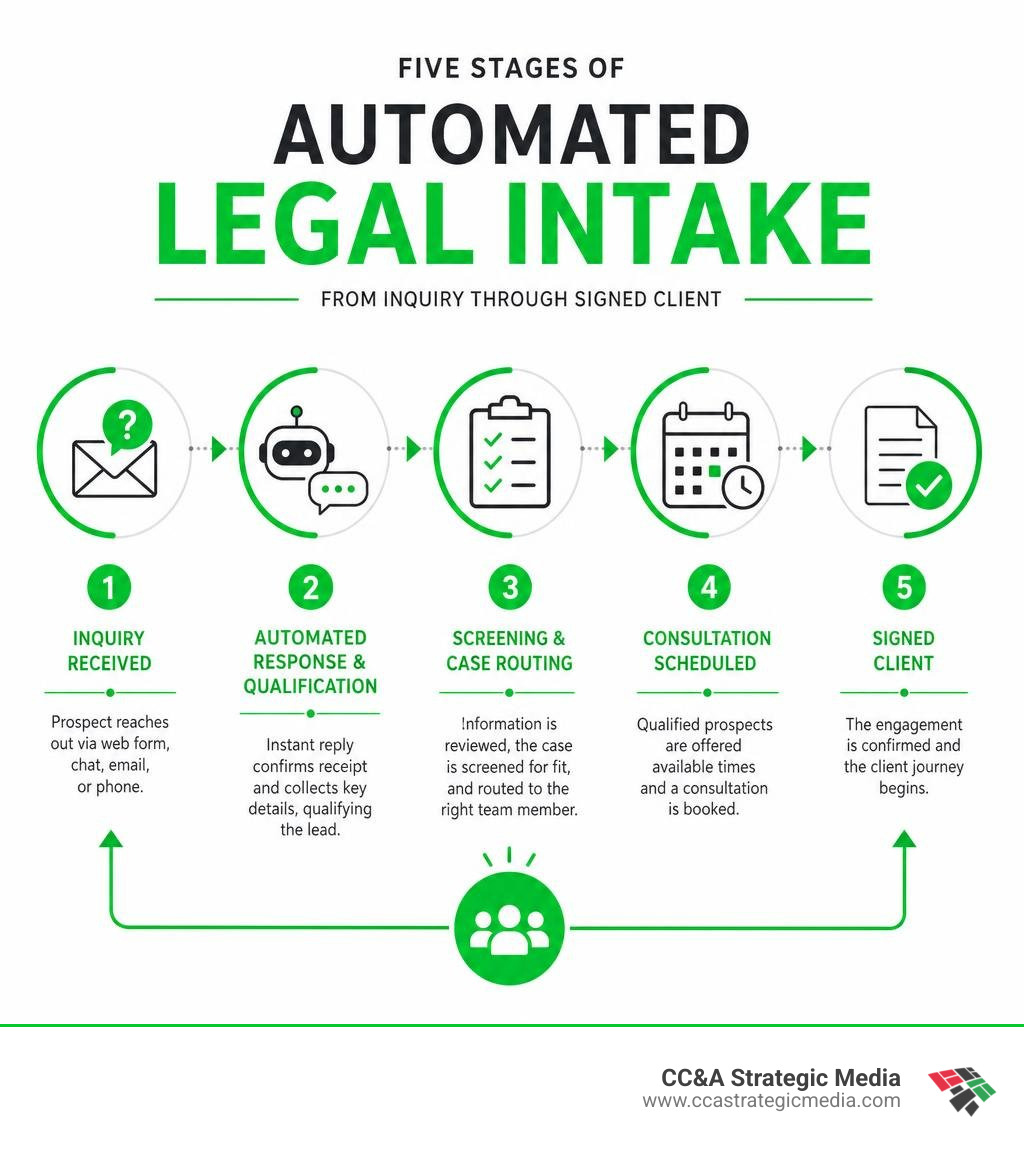
The Strategic Imperative of Legal Intake Automation for Modern Firms
When prospective clients reach out to a law firm, they are almost always facing an urgent, stressful situation. They are not casually browsing; they are seeking immediate clarity and reassurance. In modern legal operations, the firm that responds first with clear, compassionate communication is usually the firm that earns the client’s trust.
Achieving rapid speed to engagement is not just a customer service goal—it is the foundational metric of modern legal acquisition economics. Research consistently shows that 26% of law firms never respond to an online inquiry at all, and only 25% respond within five minutes. Yet, responding within that initial five-minute window lifts prospective client conversion by roughly 400%. When firms let inquiries sit in unmonitored inboxes, client acquisition costs soar because expensive marketing dollars generate leads that simply evaporate due to latency.
Exploring The Complete Guide to Improving Law Firm Efficiency highlights how operational delays directly undermine business profitability. Modernizing your intake is the fastest way to turn marketing investments into retained revenue without overburdening your staff.
Overcoming Operational Friction and Lost Inquiries
Traditional intake workflows are plagued by administrative friction. An inquiry arrives via a web form, an administrative assistant manually copies the details into a spreadsheet, an attorney attempts a phone call hours later, and the game of phone tag begins.
This manual process leads directly to inquiry drop-off and severe administrative fatigue. The industry average intake conversion rate hovers near 14% of inquiries becoming retained clients, meaning the typical firm loses more than five out of every six potential matters. Implementing systematic legal intake automation captures high-intent prospects before they look elsewhere, eliminating tedious data re-entry and letting your staff focus on high-value client interactions.
Conversational Triage Versus Outdated Static Forms
For decades, firms relied on static web forms featuring dozens of rigid dropdowns. Expecting an anxious individual to navigate complex legal categories is counterproductive. Every bad lead can look fine on an oversimplified form, while promising matters get lost because the form fails to ask the essential next question.
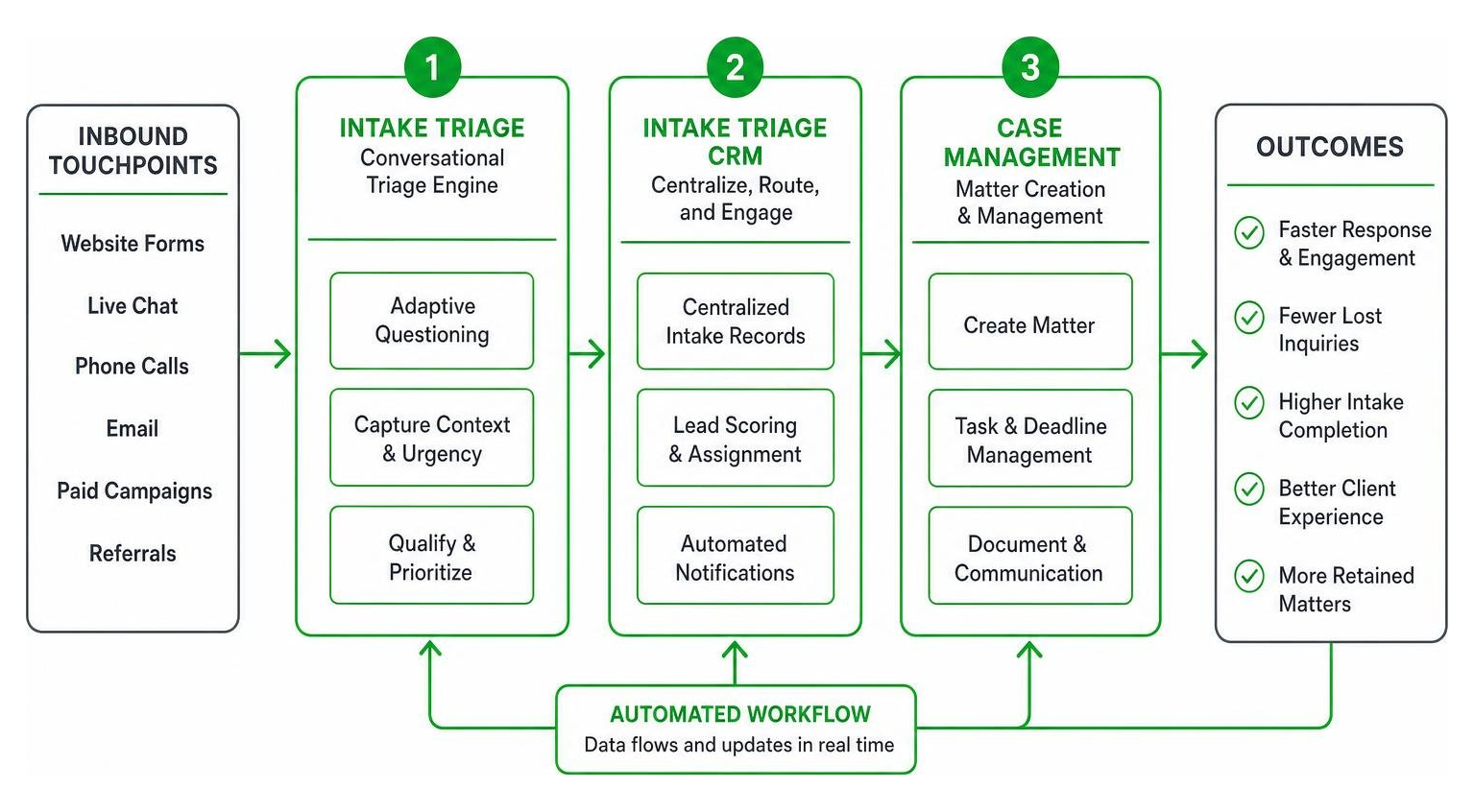
Modern conversational triage completely changes this dynamic through adaptive questioning. Whether powered by dynamic interactive flows or responsive conversational AI intake, modern systems capture the prospect’s narrative in their own words while dynamically probing for critical facts. They preserve context by capturing nuanced details, timelines, and urgency rather than forcing answers into generic text boxes. They also use dynamic branching to ask relevant follow-up questions in real time based on previous answers, while clarifying the prospect’s narrative so attorneys receive a structured brief rather than an unorganized transcript.
When law firms transition from static forms to conversational triage engines, lead completion rates often surge past 85%, turning confusing initial touchpoints into seamless, reassuring conversations.
Blueprint for Intake Workflow Modernization
Modernizing your intake workflow does not require rebuilding your entire firm overnight. It requires structured process re-engineering and deliberate workflow orchestration.
Understanding How AI is Quietly Revolutionizing Legal Marketing Performance reveals how data-driven automation empowers legal teams to streamline client acquisition. Below is my actionable blueprint to implement intake automation smoothly.
Map Every Inbound Touchpoint and Client Pathway
Begin by creating a unified legal front door. Prospective clients find your firm through diverse channels: direct website visits, paid digital campaigns, referral links, phone calls, live chat widgets, and direct emails.
Map out each inbound touchpoint to ensure all pathways converge into a single centralized repository. When every inquiry feeds into one automated funnel, no lead falls through operational cracks, and your team maintains a single source of truth for all incoming matters.
Configure Dynamic Triage and Real-Time Screening
Once leads enter the central pathway, your system must evaluate matter fit instantly. Configure triage algorithms that score leads against your firm’s ideal client profile. The system should use conditional logic to check fundamental criteria such as jurisdiction, timeline constraints, and matter scope. It should also flag high-urgency matters for immediate attorney notification while politely routing non-qualifying inquiries to trusted referral partners. As prospects provide information, the platform should synthesize client inputs into a clean, concise matter summary that gives your legal team instant context before they ever pick up the phone.
Unify CRM and Practice Management Architecture
Intake automation delivers maximum value when it communicates bidirectionally with your core operational systems. Siloed software creates duplicate work and introduces transcription errors.
Integrate your intake front end with your legal CRM and practice management software using native API connectors and automated webhooks. When an inquiry is screened and approved, the system should automatically create the contact card, populate custom matter fields, and generate internal onboarding tasks without manual intervention.
Streamline Retainers with Embedded Signatures and Payments
The traditional onboarding phase—sending a retainer via email, waiting for a printed signature, and issuing a separate invoice—introduces massive drop-off risk.
Consolidate these steps into a unified, mobile-first onboarding link. Deliver your customized fee agreement with integrated electronic signature fields alongside secure digital payment processing. By letting prospective clients review, sign, and fund their retainer in a single three-minute mobile session, firms eliminate days of administrative delay and secure client commitments instantly.
Optimize Conversion with Advanced Performance Metrics
Intake modernization is an ongoing management discipline, not a one-time setup. Regularly evaluate your pipeline analytics to uncover bottlenecks. Track intake source performance to understand which channels generate the highest-value retained clients, monitor stage-by-stage cycle times to measure how quickly inquiries move from initial screening to signed retainers, and audit drop-off points within your dynamic intake questionnaires to refine question clarity and reduce user friction.
Reviewing The Ultimate Guide to Law Firm Marketing and Growth provides broader context on aligning intake analytics with firm-wide expansion strategies.
Governance and Risk Management for Modern Practices
Adopting automated intake systems requires a rigorous approach to governance, client confidentiality, and ethical oversight.

Firms that combine automated digital intake with human touchpoints—as discussed in Why Your Law Firm Needs a Professional Answering Service to Scale—create a balanced client experience backed by strong operational guardrails.
Architectural Best Practices for Legal Intake Automation
As your firm scales, your automated infrastructure must maintain enterprise-grade reliability and security. Ensure all client-submitted narratives, uploaded records, and communication logs are encrypted both in transit through TLS and at rest. Implement role-based permissions so administrative staff, intake specialists, and senior partners access only the information relevant to their operational duties. Minimize the number of third-party plugins handling sensitive client information to maintain a clean, auditable security perimeter.
Ethical Compliance and Conflict Checks in Legal Intake Automation
Automated intake must adhere strictly to legal professional standards and ethical mandates. Configure your intake system to query your existing matter database during the initial screening stage so your firm can check prospective parties, opposing counsel, and affiliated entities before generating agreements. Automated chatbots and conversational interfaces should also identify themselves clearly as automated assistants, managing expectations and ensuring prospective clients know they are engaging with an automated intake tool. In compliance with supervisory oversight obligations and ethical standards recognized by organizations like the American Bar Association, automated workflows must maintain complete audit logs, and supervising attorneys should review all triage decisions, declination notices, and engagement letters.
Frequently Asked Questions About Automated Client Intake
How does automated intake improve overall conversion rates?
Automated intake eliminates response latency by engaging prospective clients the moment they reach out, 24 hours a day. Because responding within five minutes can produce a 400% conversion lift, removing manual delays ensures your firm connects with high-intent individuals before they contact competitors. Furthermore, adaptive qualification filters out non-viable inquiries, allowing your team to focus their energy entirely on retaining qualified matters.
What systems must integrate with automated intake software?
To build an efficient end-to-end workflow, your intake software should integrate with your legal CRM, case management system, digital calendaring tools, and secure payment processors. Bidirectional data synchronization ensures that matter details, contact records, and consultation schedules transfer automatically across your firm’s operational stack without duplicate data entry.
How does intake automation maintain regulatory compliance?
Intake automation platforms maintain compliance through enterprise data encryption, detailed system audit trails, and strict role-based access permissions. Additionally, integrating automated conflict-of-interest checks during early screening prevents inadvertent ethical violations, while transparent disclosures ensure prospects understand the automated nature of the preliminary qualification process.
Conclusion
Transforming your client intake workflow from a fragmented, manual burden into an automated growth engine is one of the highest-leverage investments a law firm leader can make. By providing instantaneous responses, adaptive screening, and unified digital onboarding, your firm honors the urgency of prospective clients while establishing an efficient foundation for scalable growth.
At CC&A Strategic Media, our Strategic Ops marketing approach combines advanced technology, behavioral data, and process design to help law firms achieve meaningful, sustainable expansion.
If you are ready to modernize your intake workflows and elevate your firm’s operational performance, explore The Ultimate Guide to Legal Intake Training Basics to equip your team with the skills needed to support automated intake, or connect with me, Roxanne St. Marie, to design a tailored intake strategy for your firm.