
The Current State of AI Legal Marketing Performance and Adoption
The legal industry has historically approached technological shifts with a healthy dose of skepticism. However, the adoption curve for artificial intelligence has broken all historical precedents. In a matter of twenty-four months, we witnessed a massive paradigm shift as adoption rates among legal professionals surged from nineteen percent to nearly eighty percent. This rapid integration highlights that technology is no longer an optional efficiency play. It has quickly become a fundamental requirement for remaining competitive.
Despite this rapid adoption, a significant operational gap remains. While more than ninety percent of marketing teams report using some form of artificial intelligence in their daily workflows, none of them have implemented a comprehensive, firm-wide strategy. This means that while individual professionals are using these tools to draft emails or brainstorm ideas, firms are missing the broader strategic alignment required to turn these individual efficiencies into a unified growth engine.
To understand where your firm stands relative to the rest of the market, it is helpful to look at the broader industry standards. The Law Firms Industry Marketing Benchmarks 2026 show that digital channels are becoming increasingly crowded, and traditional outreach methods are yielding diminishing returns. Without a clear strategy, simply adding more tools to an unaligned marketing department only increases operational noise without improving client acquisition.
From my perspective as a growth strategist, this gap represents a leadership failure rather than a technological one. True AI legal marketing performance is not about how many tools your team can access. It is about how those tools are integrated into your firm’s overall business infrastructure to drive sustainable, predictable growth.
Overcoming Barriers to Optimize AI Legal Marketing Performance
The primary obstacle to achieving peak marketing performance is not the technology itself, but a widespread lack of structured training. Nearly half of all legal marketing professionals identify the absence of formal education and training as the single largest barrier to successful adoption. When teams are left to figure out these complex systems on their own, they often default to basic, low-value use cases, or worse, they introduce compliance risks into the firm’s outreach efforts.
This lack of training is compounded by common leadership misconceptions. Many firm partners and executives look at artificial intelligence solely as a cost-cutting measure. They assume that because a tool can generate text in seconds, they can reduce their administrative headcount or freeze marketing department hiring. This mindset leads to what I call quiet downsizing, where vacant junior roles are left unfilled under the false assumption that technology can seamlessly absorb their workloads.
In reality, implementing these tools without proper workflow redesign and team training leads to severe operational bottlenecks. Turnaround times slow down, internal service levels for partners degrade, and the remaining marketing staff quickly experiences burnout. To overcome these barriers, firm leadership must shift their mindset. Instead of viewing technology as a replacement for human talent, leaders must view it as an amplifier that requires deliberate investment, structured training, and realistic expectations.
Measuring ROI and Benchmarks in AI Legal Marketing Performance
Perhaps the most glaring issue in the current landscape is the inability of most firms to measure the financial impact of their technological investments. While more than half of other professional services industries have successfully quantified the return on investment of their marketing technology, fewer than ten percent of law firms have done the same. This leaves the vast majority of legal leaders guessing whether their digital investments are actually contributing to the bottom line.
Measuring the return on these tools requires looking beyond traditional conversion metrics. While direct client acquisition is the ultimate goal, the immediate value of these systems often manifests as massive time gains. When a marketing professional uses technology to streamline content drafting, research relevant regulatory changes, or analyze competitor positioning, they are reclaiming hours that were previously spent on manual administrative tasks.
For a law firm, these reclaimed hours represent a direct recovery of billable time that can be redirected toward high-value client work or strategic business development. To establish accurate benchmarks, firms must track both direct client acquisition costs and internal operational efficiency gains. Only by measuring both sides of this equation can leaders make informed, data-driven decisions about their marketing infrastructure.
Generative Engine Optimization (GEO) and the New Search Landscape
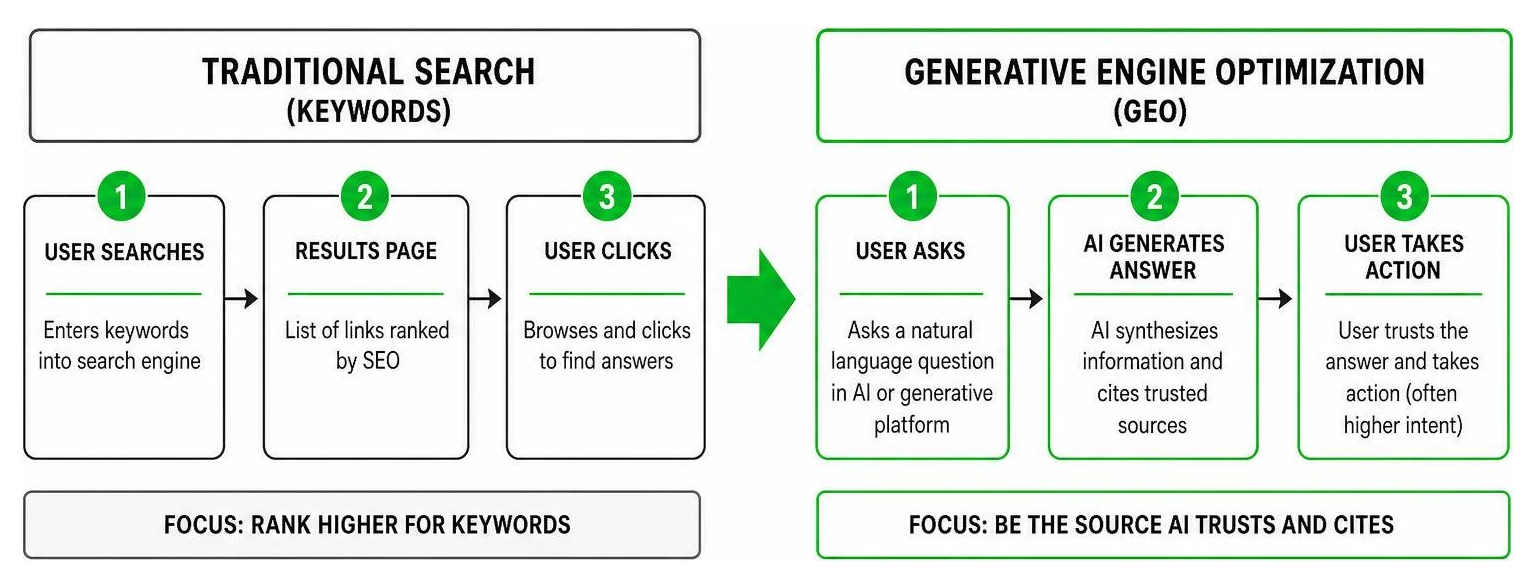
The way potential clients search for legal counsel has changed fundamentally. For decades, the standard path to finding a lawyer involved entering keywords into a search engine and browsing a list of blue links. Today, clients are increasingly bypassing traditional search engines entirely. Instead, they are turning to conversational assistants and generative search platforms to ask complex, nuanced questions and receive direct recommendations.
This shift has given rise to a new discipline known as Generative Engine Optimization, or GEO. Traditional search engine optimization focused on ranking for specific keywords. GEO, however, focuses on ensuring your firm is cited as a trusted authority when an artificial intelligence model synthesizes an answer for a user. Research indicates that these new generative search layouts can reduce traditional click-through rates by more than thirty percent, making traditional search visibility increasingly difficult to maintain.
Crucially, those clients who do click through from generative search recommendations convert at a rate that is more than four times higher than traditional search visitors. This is because conversational searchers have already had their intent qualified by the model before they ever reach your website. To learn more about how these dynamics are reshaping modern client acquisition, you can explore AI for Legal Marketing: Use Cases, Tools, and ROI for Modern Law Firms.
Technical SEO and Schema for AI Discovery
To be discovered and recommended by generative search engines, your firm’s digital assets must be structured in a way that machine learning models can easily crawl, parse, and verify. This requires a highly sophisticated approach to technical search engine optimization, specifically through the use of advanced schema markup and structured databases.
Generative models rely heavily on structured data to verify the authority, location, and credentials of a business. By implementing detailed organization, professional service, and article schema, you provide these models with clear, unambiguous data about your firm. Utilizing specific technical properties like spatial coverage and jurisdiction tagging helps these engines understand exactly which geographic regions and regulatory frameworks your firm is qualified to handle.
The power of this structured approach is clearly demonstrated in a recent analysis of digital discovery. In the study titled A practice-management legaltech firm, serving attorneys: Captured AI Mode citation share across 31 localized prompts in two quarters | OnyxRank Case Study, researchers documented how a structured content and technical program achieved a dramatic increase in generative engine citation rates. By focusing on highly structured databases and clear jurisdictional tagging, the subject of the study grew its citation share from a single-digit baseline to over forty percent in just two quarters. This proves that generative engines are highly hungry for structured, verifiable data, and they will consistently reward the firms that provide it.
Optimizing Content for AI Engine Citations
Optimizing your content for generative engines requires a complete departure from traditional writing practices. Generative engines do not look for keyword density. They look for high fact density, authoritative sourcing, and direct, clear answers to complex questions.
| Optimization Element | Traditional SEO | Generative Engine Optimization (GEO) |
|---|---|---|
| Primary Goal | Rank for specific high-volume keywords | Secure citations in generated AI answers |
| Content Structure | Long-form articles optimized for keyword placement | Answer-first layouts with high fact density |
| Authority Signals | Backlink profiles and domain authority | Verifiable credentials, schema, and direct citations |
| User Experience | Page design and click-through optimization | Direct value delivery and conversational relevance |
To align with this new framework, your content must adopt an answer-first structure. This means placing direct, clear answers to common legal questions at the very beginning of your articles, followed by deep, authoritative analysis. Furthermore, you must establish unquestionable authority by aligning your content with the established principles of experience, expertise, authoritativeness, and trustworthiness. This includes having your content written or thoroughly reviewed by named, licensed professionals whose credentials can be verified by the models crawling your site.
Redesigning Workflows: How AI Impacts Departmental Structure and Staffing
The integration of artificial intelligence is fundamentally changing how legal marketing departments must be structured and staffed. As mentioned earlier, many firms fall into the trap of quiet downsizing, choosing not to backfill junior roles like coordinators or assistants when they depart. This approach is built on a misunderstanding of what these technological tools can actually do.
Technology cannot autonomously manage a marketing department or maintain internal service levels. When you remove human coordination from the mix, the remaining team members are forced to spend their time managing tools rather than executing strategy. This creates a highly reactive operational environment where strategic planning is sacrificed for daily troubleshooting.
To build a high-performing marketing department, leadership must focus on true technology activation rather than simple cost-cutting. This means redesigning your team’s workflows so that technology handles the repetitive, administrative tasks, freeing up your human professionals to focus on high-value, relationship-driven work.

Balancing Human Talent with Technological Support
Legal marketing is, at its core, a relationship-driven endeavor. It requires deep emotional intelligence, an understanding of human psychology, and the ability to navigate complex stakeholder personalities within the firm. These are qualities that no machine learning model can replicate.
When firms rely too heavily on automation, their marketing often becomes cold, generic, and disconnected from their actual brand values. Clients seeking legal representation are almost always facing stressful, high-stakes situations. They are looking for empathy, trust, and human connection, not a perfectly optimized but completely sterile response.
Furthermore, over-reliance on technology without human oversight can lead to severe staff burnout. If your marketing team feels that their unique creative and strategic contributions are being undervalued or replaced by automated systems, morale will plummet. The most successful firms are those that strike a deliberate balance, using advanced technology to handle the data analysis and administrative heavy lifting, while relying on human talent to build genuine relationships and tell compelling stories.
Ethical Guardrails and Compliance in AI-Driven Campaigns
Operating in the legal industry means adhering to professional standards that do not apply to other business sectors. When using generative tools for marketing, firms must establish strict ethical guardrails to protect their clients and their own reputations.
The first and most critical rule is the absolute protection of client confidentiality. Under no circumstances should sensitive, identifying, or proprietary client information be entered into public generative models. Doing so can waive attorney-client privilege and violate strict confidentiality rules. All tools used by the firm must be thoroughly vetted to ensure they comply with industry-standard data security protocols.
Additionally, firms must maintain a strict human-in-the-loop review process for all generated content. Generative models are known to occasionally produce inaccurate information or make up facts entirely. Publishing unverified content can mislead the public, damage your firm’s credibility, and lead to disciplinary action from licensing authorities. A licensed professional must review, edit, and approve every piece of content before it is published.
Safe Implementation of AI Chatbots and Automation
Automated communication tools and website chatbots can be incredibly effective for managing initial client inquiries, especially after hours. However, their implementation must be handled with extreme care to avoid the unauthorized practice of law or the accidental creation of an attorney-client relationship.
To ensure compliance, automated chatbots must be configured strictly as administrative routing and information-gathering tools. They should never offer legal opinions, interpret regulations, or suggest specific courses of action. Instead, their sole function should be to collect basic contact information, identify the general nature of the inquiry, and route the lead to a human professional for proper evaluation.
Furthermore, transparency is essential. Your website visitors must always be clearly informed when they are interacting with an automated system rather than a human representative. This builds trust and ensures that the prospect has realistic expectations about the interaction.
Frequently Asked Questions about AI in Legal Marketing
How do law firms measure the ROI of AI marketing tools?
Measuring the financial return of these investments requires a dual approach. First, firms must track direct client acquisition metrics, such as changes in lead volume, conversion rates, and client acquisition costs after implementing the tools. Second, and perhaps more importantly, firms must quantify the internal operational time saved by automating administrative tasks. By calculating the hours reclaimed by your marketing and legal staff and multiplying that by their average billable rate, you can determine the true operational return on your technological investment.
Will AI replace human marketing coordinators in law firms?
No. While these tools can automate repetitive tasks like scheduling, data entry, and basic drafting, they cannot replace the strategic thinking, emotional intelligence, and relationship-building skills of a professional marketing coordinator. Firms that attempt to replace human staff with technology invariably experience slower turnaround times, lower internal service levels, and a decline in overall marketing quality. The technology should be used to empower your staff, not replace them.
Is AI-generated content penalized by search engines?
Major search engines do not penalize content simply because it was created with the assistance of artificial intelligence. Their primary focus is on the quality, accuracy, and value of the information provided to the user. However, search engines do actively penalize low-quality, generic, or mass-produced content that offers no unique value. To avoid penalties, any generated content must undergo thorough human review, editing, and enhancement to ensure it meets high standards of accuracy and professional authority.
Conclusion
The rapid integration of artificial intelligence is not a passing trend. It is a fundamental shift in how modern law firms must operate to survive and grow. The firms that will lead the industry over the next decade are those that treat these technological advancements not as simple marketing shortcuts, but as a core layer of their business infrastructure.
Achieving peak marketing performance in this new landscape requires a holistic approach that combines advanced technology, deep marketing psychology, and disciplined operational systems. It is no longer enough to simply buy software and hope your team figures it out. You must build a cohesive system where technology and human talent work in perfect alignment to drive measurable business growth.
At CC&A Strategic Media, we understand the complex operational challenges modern law firms face. That is why we developed our specialized service called Strategic Ops. Rather than offering generic marketing tactics, we provide the operational foundation behind your growth through a proven, systematic approach.
With CC&A Strategic Ops, you gain access to a complete fractional leadership team that develops custom, data-driven growth strategies aligned with your firm’s unique values. We provide dedicated marketing coordination to ensure flawless execution across all channels, alongside full-stack agency services including advanced website design, technical search engine optimization, paid media management, and performance-driven content creation. We act as an extension of your team, bringing experienced, growth-driven professionals focused entirely on delivering measurable business impact.
If you are ready to stop guessing and start building a disciplined, high-performing growth engine for your firm, I invite you to learn more about our Strategic Ops services and discover how we can help you turn technological change into a lasting competitive advantage.