
Why Fractional Staffing That Aligns Marketing, Sales, and Growth Is Changing How Companies Scale
Fractional staffing that aligns marketing, sales, and growth is one of the fastest-growing strategies companies are using to close the gap between strategy and revenue without the cost or commitment of full-time executive hires.
This model provides part-time senior leadership, typically ten to twenty hours per week, across your core revenue functions. It primarily serves companies generating roughly two million to fifty million dollars in revenue that need executive strategy without full-time overhead. By placing a Fractional CMO, CRO, or CGO in charge of cross-functional outcomes, businesses can bridge the gap between marketing pipeline and sales conversion. This strategic alignment typically costs between eight thousand and fifteen thousand dollars per month, which represents a significant reduction compared to a full-time executive hire. Organizations can expect initial strategic deliverables in four to eight weeks, with measurable ROI developing over four to six months.
The numbers reflect a real shift in how businesses think about growth leadership. Demand for fractional executives has grown rapidly year-over-year, and industry forecasts suggest that a significant portion of midsize enterprises will soon have at least one fractional executive on retainer. The reason is straightforward. Most growing companies do not have a marketing ideas problem. They have an alignment problem. Marketing runs one direction, sales runs another, and growth stalls in the middle. Fractional leadership is designed to fix exactly that.
As leaders looking to build stronger businesses, we must recognize that misalignment between marketing and sales quietly kills growth. The right fractional leadership model, built around fractional staffing that aligns marketing, sales, and growth, can turn that around fast. This guide walks you through how the model works, which roles matter most, and how to make it work inside your organization.
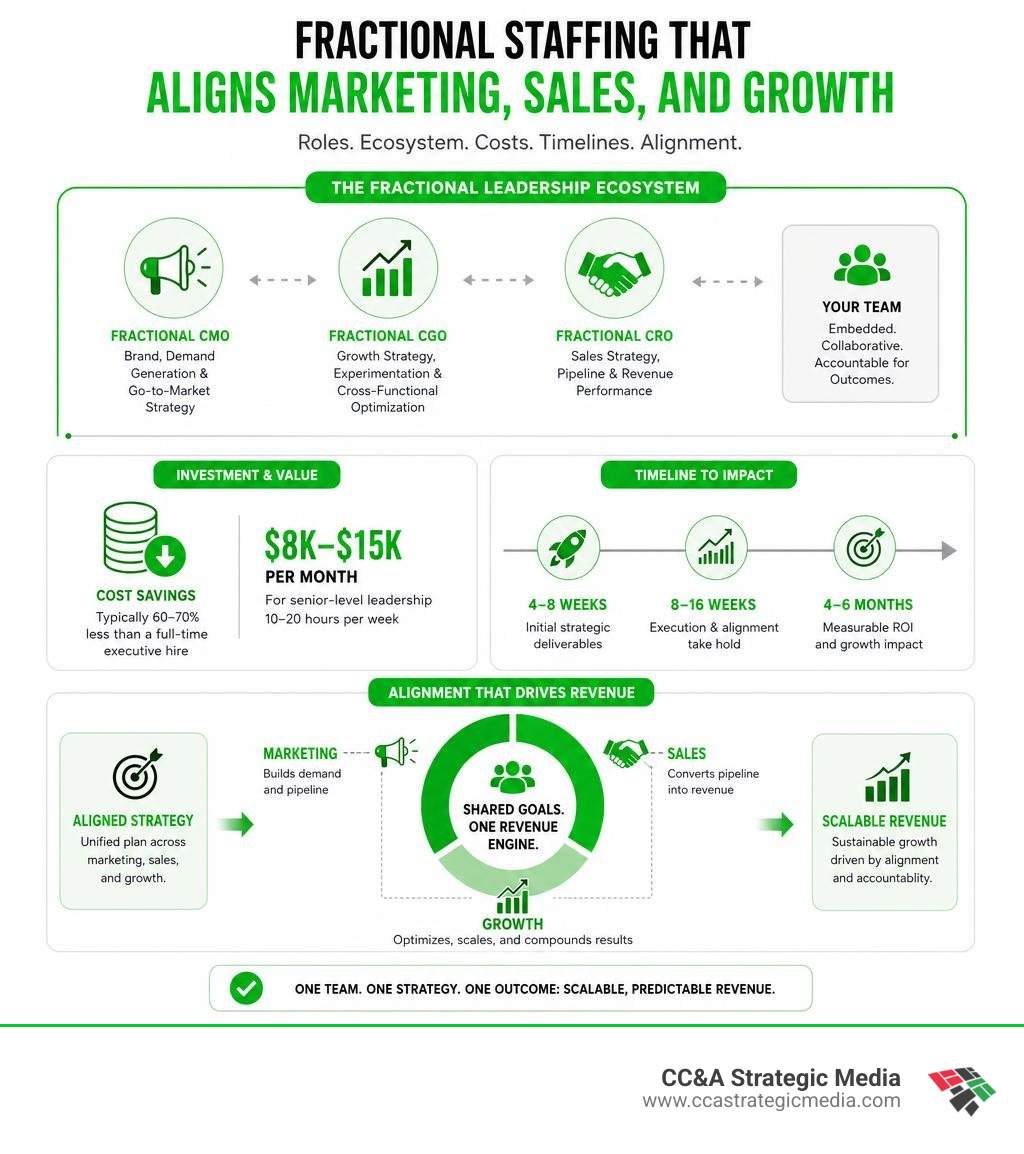
What is Fractional Staffing and How Does It Differ From Traditional Models?
To understand how fractional staffing transforms an organization, we must first define what it actually is and separate it from the models we have relied on for decades. Traditional hiring dictates that when you need senior leadership, you post a job, search for months, and commit to a massive salary, benefits package, and equity allocation. If the hire does not work out, the business suffers a major financial and cultural setback.
Consultants and freelancers offer a different path, but they come with their own limitations. A consultant typically steps in to analyze your business, writes a lengthy strategy document, and leaves you to figure out how to execute it. A freelancer is highly tactical, executing specific tasks like writing copy or managing ad campaigns, but they lack the strategic vision to align your entire business.
Fractional staffing sits precisely in the sweet spot between these approaches. A fractional executive is not an advisor standing on the sidelines, nor is he a task-focused gig worker. He is an embedded member of your leadership team. He attends your executive meetings, manages your internal staff, takes direct accountability for revenue outcomes, and implements systems designed to scale.
According to McKinsey’s report on flexible talent, more than seventy percent of companies now engage with fractional or flexible talent to navigate complex business challenges. This shift represents a fundamental evolution in organizational design. By leveraging fractional leaders, businesses gain access to the same caliber of talent that Fortune five-hundred companies employ, but they only pay for the exact slice of time and focus they actually need.
Fractional Staffing That Aligns Marketing, Sales, and Growth: A Strategic Paradigm
When we apply this model to the intersection of marketing, sales, and growth, we are not just filling an open seat on the organizational chart. We are installing a sophisticated business infrastructure layer. In my years of guiding organizations through complex transitions, I have observed that most scaling businesses hit a ceiling because their operational systems cannot support their ambitions.
This challenge is very similar to the hurdles companies face when structuring internal operations. For instance, businesses often look to external support to handle specialized operational burdens, which is why many explore the Reasons to Outsource HR or evaluate the Benefits of Using a PEO to streamline their administrative frameworks. In the same way that outsourcing human resources stabilizes your internal foundation, deploying fractional growth leaders stabilizes your revenue generation engine.
A fractional leadership model brings highly specialized, on-demand expertise that coordinates your outward-facing efforts. Instead of allowing marketing to operate in a creative vacuum while sales focuses purely on short-term transactions, fractional staffing introduces a unified strategic paradigm. This leadership model ensures that every dollar spent on marketing directly feeds a sales process designed to convert, creating a predictable path to sustainable growth.
Cost Comparisons: Fractional Leaders vs. In-House Teams vs. Agencies
The financial argument for fractional staffing is incredibly compelling, especially for mid-market companies and rapidly growing organizations. When you hire a full-time, seasoned Chief Marketing Officer or Chief Revenue Officer, you are looking at a base salary that easily reaches multiple six figures, plus bonuses, healthcare, retirement contributions, and equity. If you make a mistake, the cost of replacing that manager can easily double the initial investment.
Working with traditional marketing agencies can also become incredibly expensive. Many agencies charge high monthly retainers while focusing on siloed, tactical execution rather than high-level business strategy. They optimize for their own retainer size and deliver vanity metrics like clicks and impressions, rather than actual pipeline growth and revenue.
By contrast, a fractional leadership engagement typically costs a fraction of a full-time executive’s total compensation. Because you are only paying for the strategic hours required to run the function, you save significantly on overhead. These savings can then be directly reallocated to your actual marketing spend, product development, or sales enablement tools.
This approach also changes how you think about talent development. Instead of overpaying for a generalist executive who tries to do everything, you can use those savings to invest in your existing team. For detailed insights on how to build and develop your internal leadership, you can read our guide on Hiring and Promoting Great Managers to ensure your ground-level team is ready to execute the strategy laid out by your fractional leader.
How Fractional Staffing That Aligns Marketing, Sales, and Growth Drives Revenue Alignment
True revenue growth is not the result of a single brilliant marketing campaign or a highly aggressive sales team. It is the product of a unified revenue system where every department operates in harmony. Unfortunately, in most organizations, marketing and sales operate as separate kingdoms, often viewing each other with skepticism or outright frustration.
Marketing blames sales for not closing the leads they generate, while sales blames marketing for delivering low-quality prospects who have no interest in buying. This finger-pointing is a classic symptom of organizational misalignment. When you introduce fractional staffing focused on alignment, you introduce a neutral, highly experienced leader whose sole mission is to break down these silos and build a continuous revenue pipeline.
This leader looks at your growth holistically, analyzing how data flows from the first touchpoint to the closed deal. They align the team around a single source of truth, ensuring that everyone is measured by the same ultimate metric: profitable revenue growth. By restructuring the operating cadence and establishing clear communication channels, they turn friction into collaboration.
Key Fractional Roles: CMO, CRO, and CGO Functions
To drive this cross-functional alignment, you must deploy the right leadership roles. A Fractional Chief Marketing Officer focuses on brand positioning, market segmentation, and demand generation strategy. They ensure your message resonates with your ideal customer profile and oversee your external vendors to maintain strict accountability.
A Fractional Chief Revenue Officer takes a broader view, connecting marketing, sales, and customer success into a single, cohesive revenue engine. They optimize your pricing models, refine your sales processes, and ensure that your customer acquisition cost remains aligned with your customer lifetime value. A Fractional Chief Growth Officer operates at the intersection of product, marketing, and sales, identifying new market opportunities and driving rapid experimentation to unlock non-traditional growth channels.
Each of these roles requires a distinct leadership mindset that focuses on building sustainable systems rather than chasing short-term tactics. They also recognize that growth is a company-wide effort that extends far beyond the traditional boundaries of the sales department. To understand how to activate your entire organization in this effort, you can explore our analysis of Your Company’s Hidden Sales Team, which explains how every employee plays a critical role in the customer journey.
Bridging the Gap Between Marketing and Sales Pipelines
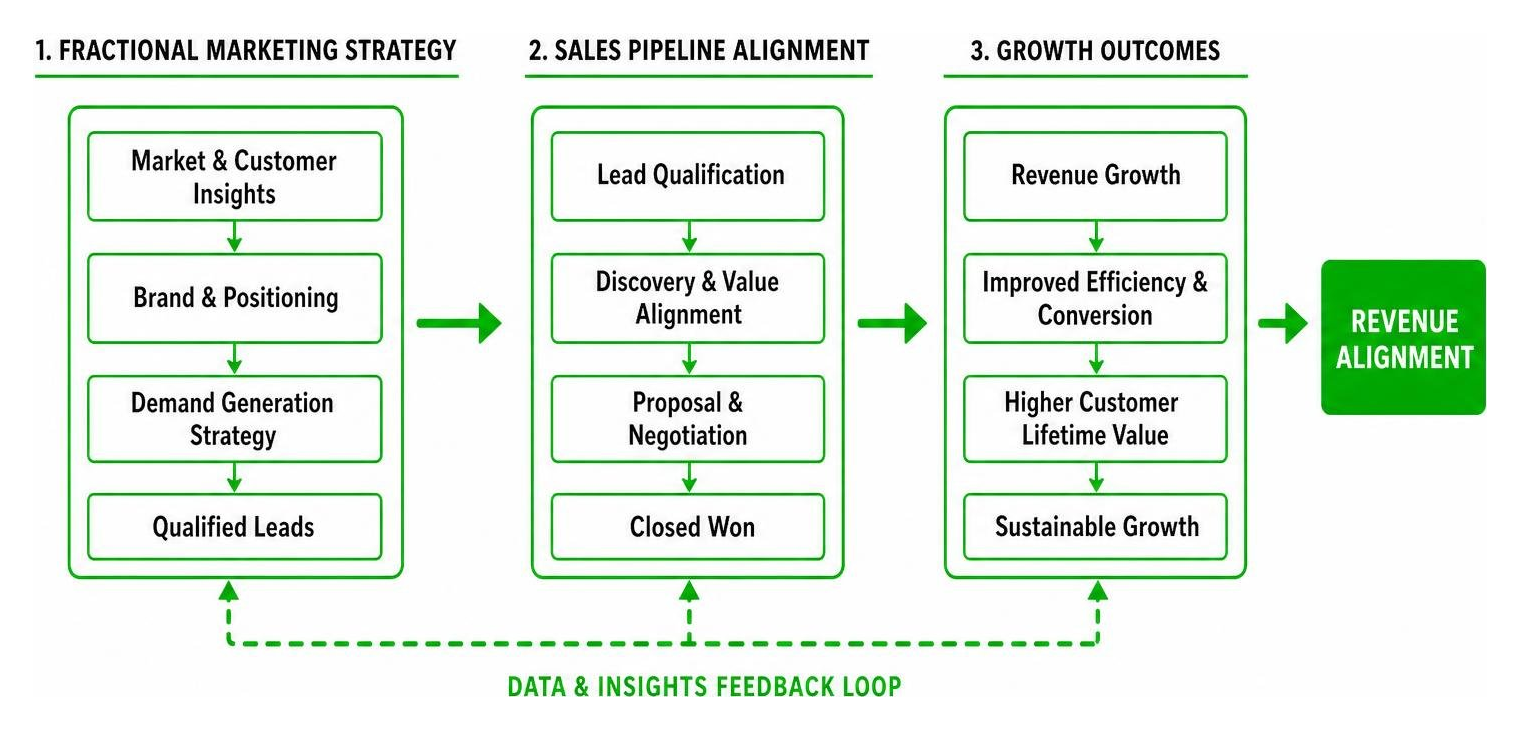
The most common point of failure in any growth engine is the handoff from marketing to sales. This is where leads go to die, and where massive amounts of marketing budget are routinely wasted. A fractional leader bridges this gap by establishing clear, documented definitions of what constitutes a qualified prospect and implementing automated systems to manage the transition smoothly.
This process begins with robust Lead Generation strategies designed to attract high-intent buyers rather than empty traffic. Once those prospects enter your ecosystem, the fractional leader establishes objective Lead Scoring Best Practices to ensure your sales team only spends their valuable time speaking with prospects who are genuinely ready to buy.
To make this system scalable, the fractional leader will design and deploy advanced technology systems. By choosing to Support Sales with Marketing Automation, you ensure that prospects receive the right message at the exact right moment in their buying journey, compressing your sales cycle and dramatically increasing your pipeline conversion rates.
Strategic Decision Framework: When to Build In-House vs. Hire Fractional Talent
Deciding whether to build an in-house executive team or leverage fractional staffing is a critical strategic decision that depends entirely on your current business stage and growth velocity. There is no one-size-fits-all answer, and making the wrong choice can stall your momentum for months or even years.
To make an informed decision, you must look at the modern landscape of buyer behavior. According to Gartner’s research on B2B buyer preferences, seventy-five percent of buyers now prefer a rep-free experience, meaning they do the vast majority of their research and decision-making online before they ever speak to a sales representative. This means your digital presence, content, and marketing systems must do the heavy lifting of selling long before a human gets involved, requiring highly sophisticated strategy that a generalist in-house team may not possess.
If your organization is generating under two million dollars in revenue, your primary focus should be on product-market fit and basic validation, where a founder-led approach or a simple tactical coordinator is often sufficient. Once you scale past fifty million dollars, the sheer operational complexity and volume of work typically justify the investment in a full-time, dedicated C-suite executive. However, for companies operating in the wide space between two million and fifty million dollars, the fractional model almost always delivers the highest return on investment.
Assessing Organizational Maturity and Growth Velocity
When evaluating your readiness for fractional staffing, you must look beyond your revenue numbers and assess your organizational maturity. Are your growth plans consistently falling short because your team is stuck in execution mode without strategic direction? Is your founder still wearing the Chief Marketing Officer hat, acting as a bottleneck for every creative and strategic decision?
If so, you are facing a classic maturity barrier. Your growth velocity is outpacing your internal capabilities. At this stage, trying to hire a full-time executive can actually increase your risk, as you may not yet have a clear understanding of the exact problems that leader needs to solve.
A fractional leader can step in to stabilize your operations, audit your current systems, and build a strong foundation. They also recognize that long-term, sustainable growth is built on keeping the customers you already have. By focusing on Client Retention and implementing proven frameworks on How to Increase Customer Retention, a fractional executive ensures that your new customer acquisition efforts actually compound your revenue rather than simply replacing lost clients.
Fractional Staffing That Aligns Marketing, Sales, and Growth: Agility and Time-to-Impact
One of the greatest advantages of fractional staffing that aligns marketing, sales, and growth is the sheer speed at which these leaders can deliver measurable impact. Finding and hiring a full-time executive often takes three to six months, followed by another three to six months of onboarding and ramp-up time before they truly understand your business and begin executing.
A fractional leader, on the other hand, is built for rapid deployment. Because they are experienced operators who have built growth engines across dozens of companies, they can typically integrate into your team within one to two weeks. They skip the standard learning curve and immediately begin auditing your spend, reallocating wasted budget, and optimizing your pipeline.
This agility allows your business to respond quickly to market changes and competitive pressures. By using sophisticated technology, such as leveraging Marketing Automation Customer Retention systems, they can quickly plug the leaks in your customer journey, delivering quick wins that build momentum and help fund the rest of your long-term growth strategy.
Best Practices for Onboarding, Integration, and Overcoming Challenges
While the fractional model offers incredible benefits, its success depends entirely on how well you onboard and integrate these leaders into your existing team. A fractional executive cannot operate as a disconnected vendor or an outside consultant. They must be treated as a true member of your leadership team, with the authority and access required to drive real change.
Some organizations struggle with this model because their internal staff feels threatened by an outside leader, or because the communication channels are not clearly defined. To prevent these challenges, you must approach the integration process with a clear, structured plan that sets your fractional leader up for success from day one.
Onboarding and Integrating Fractional Leaders into Existing Teams
The onboarding process for a fractional leader should be highly intensive and focused on rapid knowledge transfer. During the first thirty days, you must provide them with complete transparency into your financial data, sales pipeline, historical marketing performance, and current technology stack.
To ensure smooth integration, you should assign an internal liaison — typically a high-performing manager or director — who can help the fractional leader navigate your internal culture and processes. It is also critical to introduce the fractional leader to your entire team, clearly explaining their role, their authority, and the strategic goals they have been brought in to achieve. This clear communication prevents internal politics and ensures that your existing staff views the fractional leader as a valuable resource rather than a threat.
Mitigating Alignment Challenges and Measuring Success with KPIs
To keep your fractional engagement on track, you must move away from vanity metrics and establish clear, revenue-tied Key Performance Indicators from the very beginning. If your fractional leader is reporting on clicks, impressions, or social media followers, you are tracking the wrong things.
Instead, align your metrics around business outcomes that directly impact your bottom line. You should measure indicators like marketing-influenced pipeline value, customer acquisition cost reduction, lead-to-opportunity conversion rates, and average sales cycle length. By establishing a weekly operating cadence and monthly executive reporting, you ensure complete visibility into the progress of your growth engine and can make data-driven adjustments in real time.
Frequently Asked Questions About Fractional Staffing
The fractional staffing model is still relatively new to many business owners, and it is natural to have questions about how these engagements work in practice. Here are the answers to the most common questions we receive from leaders exploring this model.
How long does a typical fractional leadership engagement last?
Most fractional engagements last between nine and eighteen months. This timeline is typically divided into distinct phases, beginning with a thirty-day diagnostic audit, followed by several months of building and optimizing the growth engine, and eventually transitioning into an ongoing strategic advisory role. In many cases, the fractional leader will help you define the role of a permanent, full-time executive and lead the search and onboarding process when your company is ready to make that transition.
Can a fractional leader manage our existing in-house marketing and sales teams?
Yes, experienced fractional leaders are highly skilled at managing, coaching, and developing internal teams. They bring structure, accountability, and professional leadership to teams that may have previously reported directly to a founder or a non-technical executive. By establishing clear roles, setting performance standards, and documenting standard operating procedures, they elevate the capabilities of your existing staff and build a self-sustaining department.
What is the typical ROI timeline for a fractional staffing model?
While every business is unique, most companies begin to see strategic deliverables and foundational improvements within the first four to eight weeks of the engagement. You can typically expect to see initial performance improvements, such as optimized ad spend and improved lead quality, within two to three months. Significant, measurable revenue and pipeline ROI is typically realized within four to six months as your newly aligned marketing and sales systems begin to mature and compound.
Conclusion
Building a scalable, predictable revenue engine requires a holistic approach that connects marketing psychology, advanced technology, and disciplined execution. For mid-market companies and growing organizations, trying to build this complex infrastructure with full-time executive hires can be incredibly slow, expensive, and risky.
At CC&A Strategic Media, we believe that sustainable growth comes from deep operational alignment across your entire business. That is why we developed our signature service, Strategic Ops. Strategic Ops is not just marketing or fractional CMO support; it is the operational foundation behind your growth that is built from a proven system.
With CC&A Strategic Ops, you receive a Fractional Leadership Team that provides strategic planning from an entire fractional team working within a proven system to turn your brand into a compelling growth engine. You also benefit from Dedicated Marketing Coordination, which delivers focused execution across all outreach and engagement channels, powered by an aligned fractional staff within a proven system. Finally, we provide Full-stack Agency Service Execution, handling everything from websites, SEO, and social media to integrated funnel campaigns, paid media, performance-driven content, video, and PR.
We extend your team with experienced, growth-driven marketing professionals focused on measurable impact. If you are ready to stop settling for expensive, risky hires or disconnected agencies, discover how our holistic approach can transform your business. To learn more about how we can help you build your growth engine, explore CC&A Strategic Media Marketing Services and schedule a strategic consultation with our team today.