Why Lawyer Marketing Best Practices Determine Which Firms Grow in 2026
Lawyer marketing best practices are the difference between a firm that grows predictably and one that stalls — and in 2026, that gap is wider than ever.
Here is a quick answer if you need it fast:
Top lawyer marketing best practices in 2026:
- Optimize your Google Business Profile with accurate info, photos, and regular posts
- Build a mobile-first, fast-loading website with clear calls to action
- Invest in local SEO — 96% of people search for legal help online before calling
- Collect and respond to Google reviews — aim for 10+ to boost local search visibility
- Create practice area content that answers real client questions
- Use Google Local Services Ads (LSAs) for pay-per-lead visibility
- Leverage AI tools for client intake, chatbots, and content optimization
- Maintain consistent directory profiles on Avvo, FindLaw, Justia, and Martindale
- Build a referral system backed by strong online credibility
- Track KPIs monthly — cost per lead, conversion rate, and client acquisition cost
The strongest law firms are not simply good at marketing. They are disciplined in how every part of the business works together to create growth. Marketing is not a standalone campaign — it is a system. And right now, that system is being reshaped by AI search, shifting consumer behavior, and an increasingly crowded digital landscape.
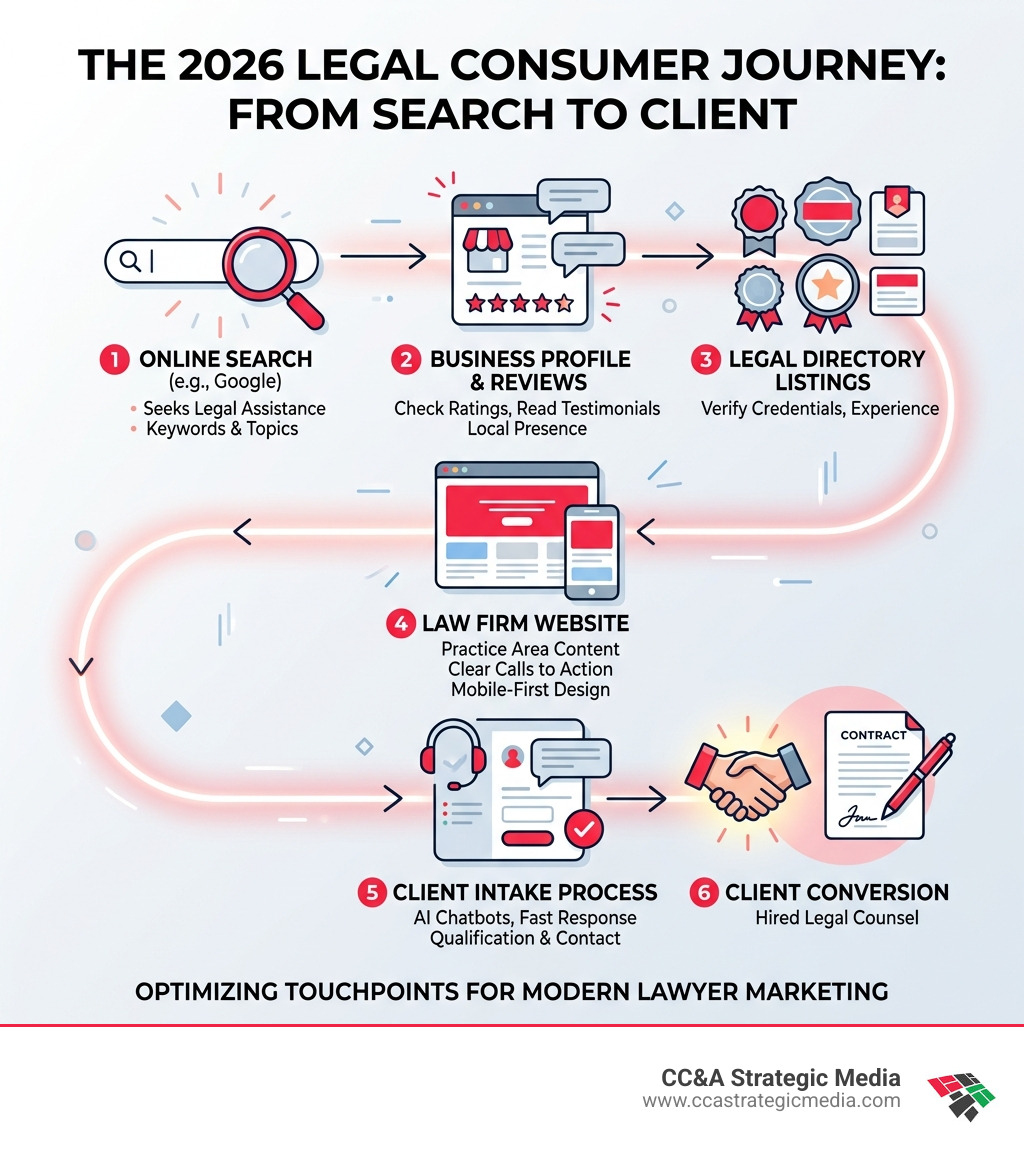
Consider this: 96% of people now begin their search for legal help online, reviewing websites, directory profiles, and peer recommendations before they ever contact a firm. This shift in consumer behavior, often highlighted in reports by national legal associations, means your digital presence is your first impression — and in most cases, your only shot.
Yet many firms still treat marketing as an afterthought. They run disconnected tactics, skip measurement, and wonder why growth is unpredictable.
This guide changes that.
I’m Roxanne St. Marie, and I’ve spent nearly two decades inside law firms and legal marketing organizations — from the front desk at one of the industry’s most high-profile firms to executive leadership roles building the marketing systems and intake strategies that actually move the needle on lawyer marketing best practices. Everything in this guide is grounded in what I’ve seen work at every level of a firm’s growth.
Explore more about lawyer marketing best practices:
The Strategic Blueprint: Aligning Brand with Business Growth
In my experience as a strategic advisor, I often see firms dive headfirst into tactics—buying ads or posting on social media—without a foundational business strategy. This is like trying to build a skyscraper on a sand dune. To achieve sustainable growth, your marketing must be an extension of your business infrastructure.
At CC&A Strategic Media, we believe in a holistic approach. We don’t just look at clicks; we look at how your brand values and sales psychology work together to drive true business growth. Before you spend a dollar on advertising, you need to understand the “why” behind your firm.
Developing a Unique Selling Proposition (USP)
Your Unique Selling Proposition is the soul of your firm. It’s the answer to the question: “Why should I hire you instead of the firm across the street?” In 2026, legal consumers are savvy. They can smell a generic “we fight for you” slogan from a mile away.
Effective lawyer marketing best practices require a USP that highlights a tangible competitive advantage. Are you the only firm in your market that uses a specific AI-driven discovery process to speed up cases? Do you offer a subscription-based model for small businesses? Your core messaging must reflect your brand values and speak directly to the pain points of your target audience. If you sound like everyone else, you’ll be priced like everyone else.
The Power of Niche Specialization in 2026
Market saturation is a real threat to solo and small firms. Trying to be a “general practitioner” in a digital world is a recipe for invisibility. Specialist positioning allows you to dominate long-tail search queries and attract highly qualified leads.
Think about it: if you need a heart surgeon, you don’t look for a general doctor. The same applies to law. We’ve seen firms achieve massive success by narrowing their focus—for example, a personal injury firm that only handles train accidents or a family law firm that specializes in high-net-worth divorce for business owners. Niche marketing isn’t about limiting your potential; it’s about becoming the undisputed authority in a specific area. This strategic focus makes your SEO efforts more effective and your ad spend more efficient.
The Complete Guide to Business Strategy for Lawyers
Mastering Lawyer Marketing Best Practices in the Digital Age
Digital marketing is no longer a “nice-to-have” luxury; it is the primary engine of client acquisition. However, the rules of the game have changed. It’s not just about having a website; it’s about creating a seamless digital experience that builds trust before the first phone call.
Local SEO: The Foundation of Lawyer Marketing Best Practices
For most law firms, the battle for clients is won or lost in the “Local Pack” — those top three map results on Google. Local SEO is critical because nearly half of all Google searches have local intent, a trend frequently analyzed by Search Engine Land.
To dominate local search, your Google Business Profile (GBP) must be immaculate. This means ensuring absolute NAP (Name, Address, Phone) consistency across the web. Even a small discrepancy, like “Street” vs. “St.”, can confuse search algorithms. Beyond the basics, you should treat your GBP like a social media feed — upload professional photos of your team, post weekly updates about firm news, and answer FAQs directly on the profile.
Optimizing Professional Directories for Maximum Visibility
While Google is king, legal directories like Avvo, FindLaw, Justia, and Martindale-Hubbell still hold significant weight. These sites often outrank individual law firms for broad search terms like “best divorce lawyer near me.”
A key tip for lawyer marketing best practices is maintaining profile freshness. An outdated profile with a 2021 headshot and a broken link suggests a firm that isn’t paying attention to detail. We recommend a multi-directory presence to create a “surround sound” effect. When a potential client sees your name on Google, then on Avvo, and then on LinkedIn, your credibility skyrockets.
High-Performance Website Architecture and Conversion
Your website is your digital storefront. If it takes more than two seconds to load, you’ve already lost 32% of your visitors. In 2026, mobile-first design is the only design that matters, as over 60% of legal searches happen on smartphones.
Technical SEO — including secure HTTPS hosting and clean site architecture — is the baseline. But to truly grow, your site needs to be optimized for conversion. This means having a frictionless intake process. Features like 24/7 AI-powered chat agents, online scheduling, and clear, benefit-driven headlines can turn a casual browser into a signed client.
The Complete Guide to Improving Law Firm Efficiency
Integrating AI into Your Lawyer Marketing Best Practices
AI is not just a marketing tool; it is becoming the infrastructure of modern business operations. At CC&A Strategic Media, we view AI as a way to operate smarter and faster, allowing attorneys to focus on high-level strategy rather than administrative bottlenecks.
Leveraging Generative Engine Optimization (GEO)
As AI-driven search engines like ChatGPT and Google’s Search Generative Experience (SGE) become dominant, traditional SEO is evolving into GEO—Generative Engine Optimization. This involves creating content that AI models can easily parse and cite.
To future-proof your firm, your content needs to be authoritative and highly relevant. AI search engines prioritize “E-E-A-T” (Experience, Expertise, Authoritativeness, and Trustworthiness). This means your blog posts shouldn’t just summarize the law; they should provide unique insights, case studies, and clear answers to complex questions.
AI-Driven Client Intake and Engagement Systems
One of the biggest leaks in a law firm’s revenue is slow response time. Research shows that 37% of firms are now using AI-powered chatbots to handle initial inquiries. These agents provide 24/7 availability, qualifying leads and even scheduling consultations while you sleep.
Integrating AI into your intake process isn’t just about technology; it’s about operational efficiency. When paired with a professional answering service, AI ensures that no lead falls through the cracks, allowing your firm to scale without a linear increase in headcount.
Why Your Law Firm Needs a Professional Answering Service
Building Authority Through Content and Social Proof

In 2026, visibility is the currency of the legal market. But visibility without authority is useless. You must prove to potential clients that you are the expert they need.
Video Marketing and Thought Leadership
Video is the most powerful medium for building trust. Websites with video are 53 times more likely to reach the first page of Google, and users retain 95% of a message delivered via video compared to just 10% in text.
| Content Type | Average Engagement Rate | Conversion Lift |
|---|---|---|
| Text-only Blog | 1.2% | Baseline |
| Short-form Reel/Video | 4.8% | +157% |
| Educational Webinar | 12.5% | +80% |
Short-form reels on LinkedIn and Instagram are excellent for personality-driven branding, while YouTube remains the home for long-form educational content. By answering common client questions on camera, you position yourself as a strategic advisor before the client even hires you.
Reputation Management and the “Magic Number” of Reviews
Online reviews are the digital version of word-of-mouth. 87% of consumers read reviews before choosing a local business, and 58% are willing to pay more for a highly-rated firm.
The “magic number” to aim for is at least 10 positive Google reviews. This is often the threshold where Google begins to significantly favor your profile in local search results. However, it’s not just about the number; it’s about review velocity (getting new reviews regularly) and your response strategy. Responding professionally to every review — especially the negative ones — shows that you are engaged and care about client satisfaction.
Content Marketing as a Growth Engine
Content marketing isn’t just about blogging; it’s about creating a resource center for your clients. Use pillar pages to cover broad topics (like “The Ultimate Guide to Personal Injury Law”) and link them to more specific long-form blogs and FAQ pages.
This approach demonstrates your E-E-A-T and helps you capture traffic at every stage of the client journey — from someone just starting to research their problem to someone ready to hire an attorney today.
The Ultimate Guide to Law Firm Marketing and Growth
Paid Acquisition and Performance Measurement
While organic SEO is a long-term play, paid acquisition provides the immediate lead flow necessary for growth. However, without proper measurement, paid ads can become a “money pit.”
Strategic PPC and Local Services Ads (LSAs)
Google Ads (PPC) and Local Services Ads (LSAs) are the heavy hitters of legal advertising. LSAs are particularly effective because they operate on a pay-per-lead basis and feature the “Google Screened” badge, which instantly builds trust.
For traditional PPC, success lies in understanding keyword intent. Targeting “DUI lawyer near me” is high-intent and expensive, while “what is the penalty for a DUI” is lower-intent. A sophisticated strategy uses negative keywords to filter out irrelevant traffic and dedicated landing pages to maximize conversion.
The Legal Guide to Dominating Facebook Advertising
Measuring Marketing ROI and Key Performance Indicators
You cannot manage what you do not measure. The most successful firms track their KPIs with religious discipline. At a minimum, you should review your metrics quarterly to ensure your marketing spend is generating a positive return.
Key metrics to track include:
- Cost Per Lead (CPL): How much are you paying for an inquiry?
- Client Acquisition Cost (CAC): How much does it cost to sign a new client?
- Conversion Rate: What percentage of website visitors take action?
- Data Attribution: Which specific channel (SEO, PPC, Referral) actually brought in the case?

Frequently Asked Questions about Lawyer Marketing
What is the most effective marketing channel for law firms in 2026?
For most firms, a combination of Local SEO and Google Local Services Ads provides the highest ROI. SEO builds long-term authority and “free” traffic, while LSAs provide immediate, high-trust leads.
How much should a law firm budget for digital marketing?
A standard rule of thumb is 7-8% of gross revenue for maintenance, while firms in aggressive growth stages often invest 15-20%. Smaller or newer firms should expect to spend a higher percentage initially to build their digital infrastructure.
How does AI impact law firm search visibility?
AI is shifting search from “list of links” to “direct answers.” Firms that create comprehensive, structured, and authoritative content will be cited as sources by AI models, while firms with thin, generic content will see their visibility decline.
Conclusion: Leading Your Firm into the Future
The firms that will dominate the legal market in 2026 and beyond are those that view marketing not as a series of chores, but as a sophisticated business system. It requires strategic leadership, a commitment to technology, and a holistic approach that aligns your brand with your growth goals.
At CC&A Strategic Media, we specialize in helping law firms navigate this complex landscape. By combining sales psychology with advanced technology and data-driven insights, we build marketing engines that drive true, sustainable growth.
Ready to make your firm iconic? Start by building a system, not just a campaign.