Turn More Law Firm Calls Into Signed Clients
To improve law firm call conversion, answer promptly, listen before screening, and give each qualified caller a clear next step before the call ends. Track how many calls are answered, how many lead to consultations, and how many become signed clients. Those numbers show law firm owners where prospects are slipping away.
A missed call cannot become a client. Neither can a good call with no follow-up. Strong intake depends on trained staff, reliable coverage, and a system that keeps each inquiry moving.
I’m Roxanne St. Marie, and I’ve spent nearly two decades working in legal intake, marketing, and client growth, from the front desk to leadership roles. My work in law firm call conversion has shown me that speed helps, but a clear process and genuine care build the trust that turns prospects into long-term clients.
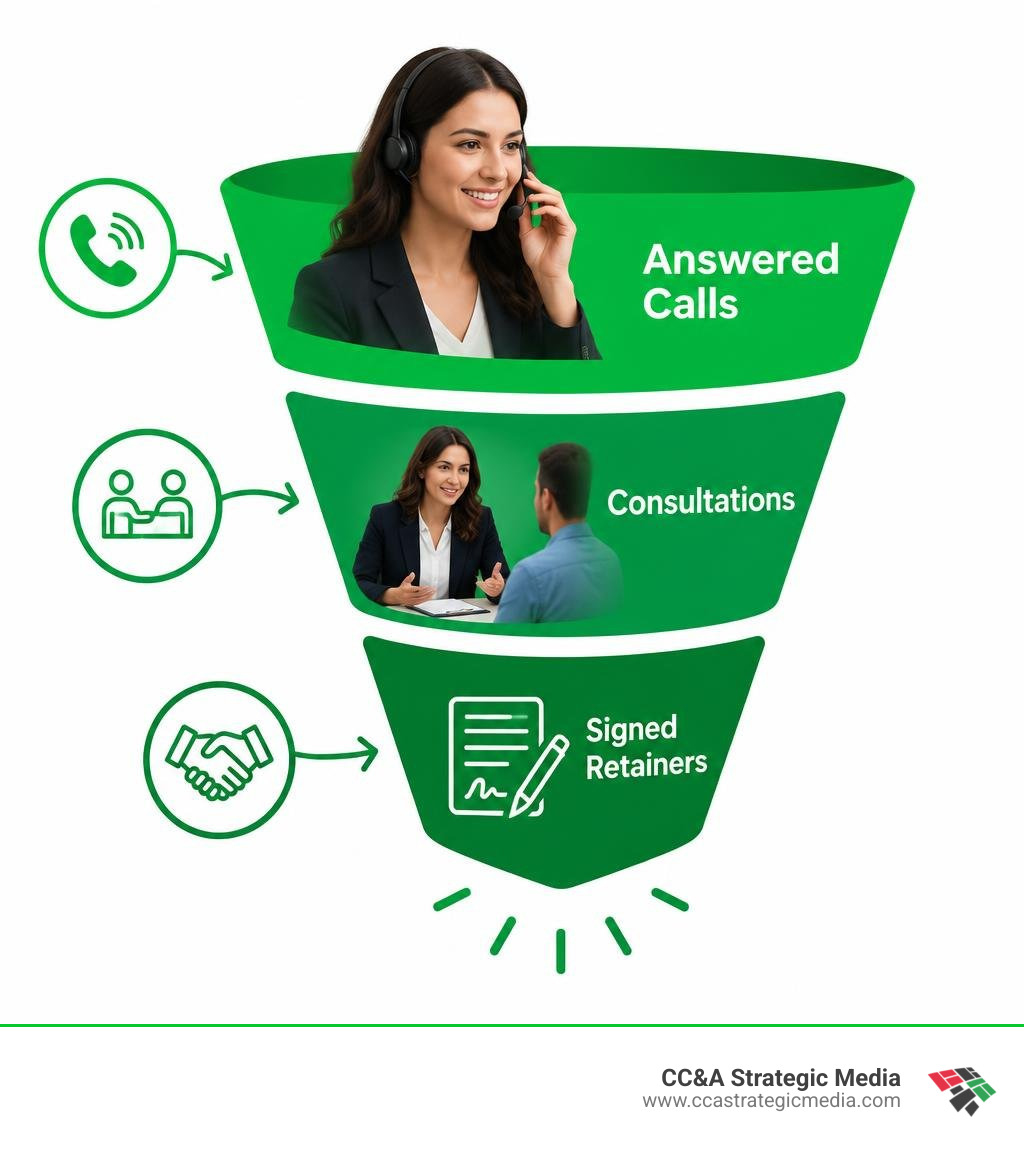
Know your law firm call conversion terms: lead generation law firm, legal intake automation, and legal intake services.
Deconstructing the Intake Funnel and Baseline Benchmarks
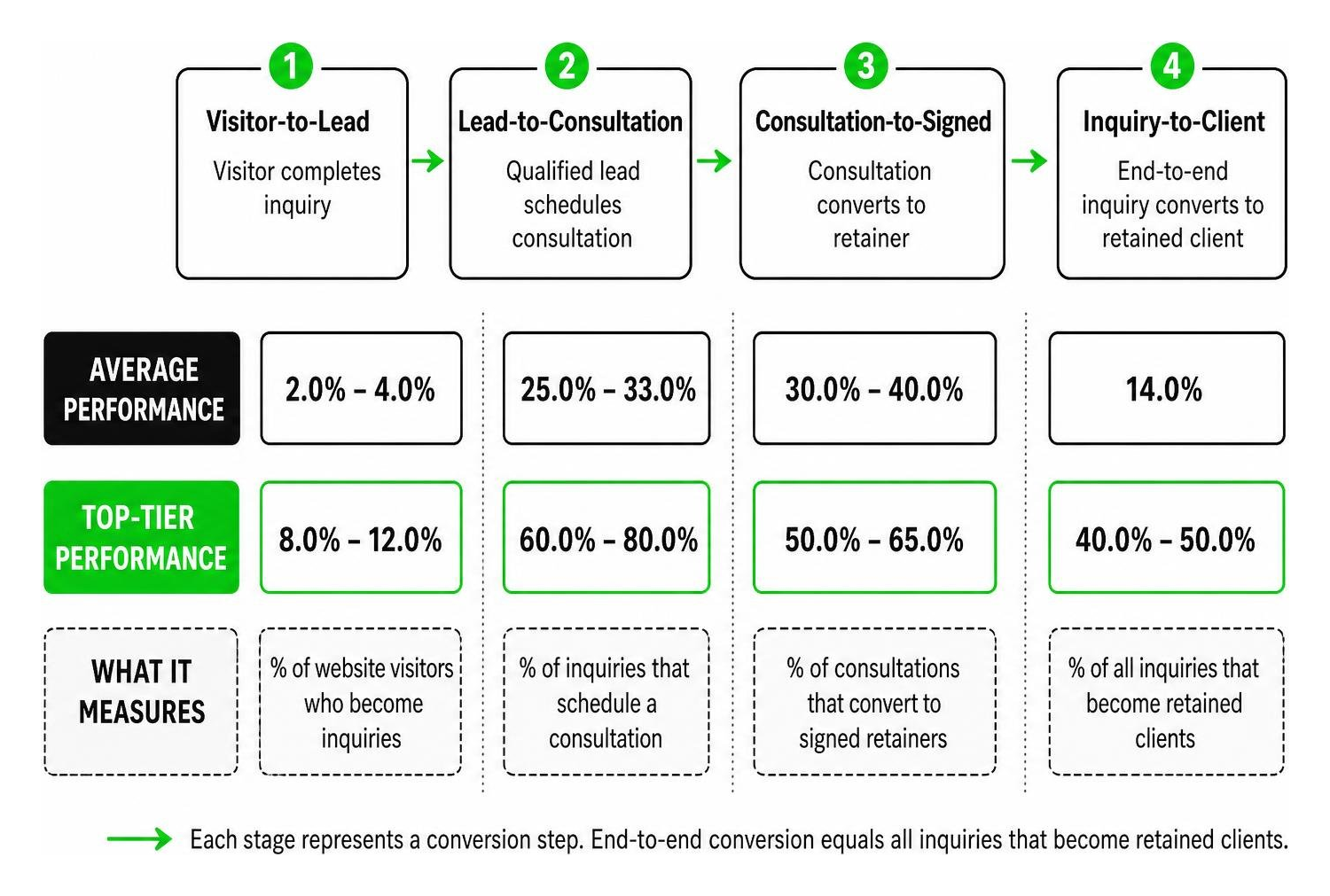
When evaluating legal business operations, the intake funnel represents the operational bridge between marketing investments and realized firm revenue. Many executive teams treat intake as a monolithic metric, yet it comprises several distinct conversion stages that demand independent diagnostic measurement. Across the legal landscape, the average organization converts approximately fourteen percent of initial inquiries into retained matters, whereas high-performing organizations achieve conversion rates ranging between forty and fifty percent. Understanding the underlying drivers of this performance gap requires analyzing how prospects transition through every operational stage.
The initial stage begins with visitor-to-lead acquisition, where standard legal landing pages typically yield conversion rates between two and four percent, though well-structured digital funnels reach eight to twelve percent, with median benchmarks hovering near 6.3 percent. Once an individual contacts the firm, the lead-to-consultation stage establishes operational momentum, typically moving twenty-five to thirty-three percent of general inquiries into scheduled appointments, while automated qualification protocols can elevate this rate significantly. The final stage involves converting consultations into executed retainers, where standard operations convert thirty to forty percent of prospects, whereas elite operational teams routinely achieve rates between forty and fifty percent as documented in comprehensive legal industry benchmark studies.
Measuring Every Funnel Stage for True Law Firm Call Conversion
Misinterpreting conversion metrics frequently causes firm leadership to misdiagnose operational bottlenecks, leading to misguided marketing expenditures when the underlying issue resides within intake execution. An inquiry-to-client conversion metric tracks every raw inbound contact against executed agreements, offering an overarching view of operational efficiency. In contrast, lead-to-signed ratios evaluate only vetted prospects who meet fundamental case criteria, and consultation-to-signed metrics isolate the closing efficacy of legal professionals during formal evaluations.
Confusing these distinct metrics creates significant strategic blind spots within management reporting. For instance, a firm experiencing a high consultation closing rate might assume its front-office operations are performing exceptionally well, entirely overlooking the fact that a cumbersome intake screening process is eliminating seventy percent of viable prospects before an evaluation is even scheduled. By systematically separating these operational indicators, leadership teams can identify precise friction points, align their investments in holistic lead generation strategies for law firms, and systematically plug pipeline leaks before expanding marketing budgets.
Matter Complexity and Client Decision Timelines
Conversion dynamics vary dramatically across different matter types due to prospect emotional urgency, decision timelines, and qualification complexity. High-urgency inquiries exhibit compressed sales cycles where prospective clients frequently retain the first responsive professional they contact, yielding consultation-to-signed conversion rates between forty and sixty percent. In contrast, high-volume intake models encounter large inquiry volumes but maintain lower end-to-end realization rates between ten and twenty-five percent because rigorous screening filters out substantial numbers of non-viable inquiries.
Complex, emotionally intensive disputes introduce extended consideration periods, where intake-to-client rates typically range between fourteen and thirty percent as individuals weigh significant personal decisions before committing. Routine consultative and advisory engagements operate across deliberate evaluation windows where nearly three-quarters of prospects explore alternative options within twenty-four hours if immediate engagement fails to establish definitive value. Navigating these varied client journeys requires tailored intake protocols, an understanding explored further in An Essential Guide to Where Your Best Cases Come From.
The Anatomy of an Intake Call: Where Leads Are Won or Lost
An inbound intake call functions as an operational diagnostic environment where prospective clients evaluate firm competency, empathy, and professionalism within seconds. Converting distressed individuals requires balanced communication that blends emotional intelligence with systematic qualification. When intake personnel rely on rigid, interrogative scripts, callers often experience unnecessary emotional resistance, feeling treated as transactional data points rather than vulnerable individuals seeking authoritative guidance.
Successful legal intake relies on conversational frameworks rather than mechanical scripts, enabling team members to establish immediate rapport while systematically gathering crucial matter details. Research into operational bottlenecks highlights how structural friction causes significant inquiry loss across the client acquisition journey. By shifting from rigid questioning to guided dialogues, intake professionals create safe environments that encourage transparency, address underlying apprehensions, and smoothly guide prospects toward definitive retainers.
The Five Intake Failure Points That Sabotage Law Firm Call Conversion
Inbound prospective client calls generally succeed or fail across five distinct conversational moments. The first critical failure occurs within the initial thirty seconds, where an unenthusiastic greeting, lengthy automated interactive voice response menus, or abrupt hold times signal administrative indifference to an anxious caller. The second failure point involves internal transfers; bouncing a caller between multiple staff members forces them to repeat painful narratives, dramatically eroding trust and prompting immediate abandonment.
The third vulnerability lies in the qualification phase, where an aggressive or insensitive line of questioning makes prospective clients feel interrogated rather than supported. The fourth point of failure arises during objection handling, where intake coordinators struggle to provide clear, reassuring answers regarding process expectations, operational timelines, or consultation parameters. The fifth and most prevalent breakdown is the failure to secure a commitment, where staff conclude conversations passively by suggesting the caller think things over rather than scheduling a definitive consultation or transmitting an electronic agreement while engagement remains high.
Why 94 Percent of Intake Calls Go Unreviewed
Despite the substantial capital invested in generating inbound inquiries, approximately ninety-four percent of law firm intake calls are never reviewed by operational leadership. Managing partners and executive directors frequently prioritize active legal production, operating under the unverified assumption that administrative staff handle front-line communications effectively. This lack of quality control allows poor conversational habits, missed opportunities, and procedural errors to compound over time without internal detection.
Implementing a structured quality assurance protocol—such as auditing ten recorded calls per month per intake coordinator—yields immediate operational insights that transform front-office performance. Regular evaluations using structured scorecards allow leadership to assess greeting warmth, active listening, qualification precision, and closing assertiveness. Furthermore, establishing a consistent review rhythm introduces an accountability effect across the intake department, driving immediate behavioral improvements and reinforcing the standards taught through specialized legal intake services and training methods.
Operational Speed and Infrastructure: The Core Drivers of Conversion
Establishing robust technical infrastructure is vital for modern legal practices seeking to maintain competitive conversion rates. Organizations utilizing dedicated client relationship management platforms convert forty-seven percent more leads than firms relying on manual tracking spreadsheets or informal communication methods. A centralized system provides clear visibility into every inbound touchpoint, tracking prospect progression, automating reminder sequences, and eliminating operational blind spots across the firm.

Integrating dynamic call tracking with structured customer relationship systems enables automated routing that connects prospective clients to qualified intake professionals instantly. This operational architecture minimizes administrative friction, ensures comprehensive data capture, and delivers real-time visibility into front-line capacity. When leadership pairs sophisticated technology with clear operational accountability, the intake process evolves from an ad-hoc administrative task into a scalable engine for sustainable business expansion.
Speed-to-Lead Thresholds and the First-Responder Advantage
Speed-to-lead serves as a primary determinant of legal conversion success, often carrying more operational weight than traditional sales acumen. Prospective clients facing pressing legal concerns rarely engage in prolonged comparison shopping; between sixty and eighty percent of consumers ultimately retain the first attorney or representative who provides a helpful, authoritative response. Industry studies confirm that contacting an inbound inquiry within five minutes increases the likelihood of qualifying that prospect by twenty-one times compared to waiting thirty minutes.
Operating within elite performance thresholds requires connecting with prospective clients in under sixty seconds, with five minutes representing the outer limit of acceptable responsiveness. When operational response times extend beyond thirty minutes, prospective clients begin contacting alternative firms, causing conversion probabilities to drop precipitously. For prospects who do not execute an agreement during their initial live conversation, conversion rates fall below twenty percent, demonstrating the immense value of rapid, comprehensive first-contact resolution.
Solving Structural Staffing and After-Hours Coverage Issues
Operational data indicates that forty-two percent of inbound calls to legal practices go completely unanswered, representing an enormous loss of potential revenue. Furthermore, between thirty and forty percent of all inbound legal inquiries occur outside traditional business hours, including evenings, weekends, and holidays. Law firms that restrict their intake operations to a standard eight-hour workday inadvertently abandon more than a third of their prospective market to agile competitors who maintain around-the-clock availability.
Overcoming these staffing constraints requires a strategic combination of internal talent, dedicated overflow support, and automated intake infrastructure. Forward-thinking firms bridge operational gaps by implementing a professional answering service to guarantee twenty-four-hour live engagement. By systematically evaluating legal intake automation tools, firms deploy intelligent routing systems and automated appointment scheduling that capture high-intent inquiries instantly, ensuring no viable matter is lost to administrative delays.
Strategic Consultation Models: Balancing Free Versus Paid Consultations
Determining whether to offer complimentary case assessments or require paid initial consultations represents a strategic operational decision that profoundly shapes funnel metrics. Complimentary consultations maximize top-of-funnel inquiry volume and typically yield higher initial lead-to-consultation scheduling rates, making them exceptionally effective for high-volume practices and urgent inquiries where rapid lead capture is paramount. However, free models frequently generate lower attendance rates and attract a higher proportion of non-viable prospects, placing substantial screening burdens on intake personnel.
Conversely, paid consultation models introduce intentional operational friction that filters out casual inquiries, attracting serious, high-intent prospects who value specialized counsel. While paid models naturally produce lower initial booking volumes, they routinely achieve consultation-to-signed conversion rates between forty and fifty percent alongside near-perfect appointment attendance. Structuring the consultation framework to match the specific operational goals of the firm ensures sustainable lead flow and aligns with law firm marketing services delivering real ROI.
The Financial Blueprint and Economics of Law Firm Call Conversion
Mastering intake operations generates substantial financial leverage by lowering acquisition costs and expanding operating margins without requiring additional advertising investments. When an organization enhances its intake conversion efficiency, every marketing dollar deployed yields a greater volume of retained business, compounding top-line growth. Modern legal leadership must view intake optimization as an essential business discipline that directly governs firm profitability, enterprise valuation, and long-term organizational health.

Evaluating client acquisition through detailed unit economics reveals that operational friction within front-office communications significantly inflates effective marketing expenses. When prospective clients are lost due to slow response times or poor qualification handling, the financial resources expended to generate those inquiries are entirely wasted. By refining front-line operations, leadership captures hidden revenue, protects marketing investments, and establishes a predictable operational framework for scalable firm expansion.
Calculating Cost Per Signed Case and Call Volume Formulas
Accurately determining the financial investment required to acquire a new client demands a comprehensive formula that accounts for both front-end promotional spend and administrative intake overhead. Evaluating marketing expenditures in isolation produces an incomplete financial picture that obscures the true cost of acquiring retained matters.
The total cost per signed case is determined by dividing total marketing and advertising expenditures plus intake operational costs by the total number of executed retainers within a specified period.
To illustrate, consider an organization investing fifty thousand dollars in monthly advertising while allocating fifteen thousand dollars toward dedicated intake personnel and operational technology. If this operational system processes three hundred inbound inquiries to secure forty signed retainers, the realized cost per signed case equals one thousand six hundred twenty-five dollars. Under this operational model, the organization requires approximately seven and a half total inbound inquiries—or roughly 2.9 qualified contacts—to successfully secure one retained client, highlighting the immense value of optimizing front-line conversion pathways.
The Compounding Revenue Impact of a Ten Percent Conversion Lift
Improving intake conversion rates produces an outsized, compounding impact on annual revenue across organizations of every scale. Because marketing investments remain static, revenue generated from conversion rate enhancements flows directly to bottom-line profitability, maximizing operational leverage across the entire firm.
For a smaller practice processing fifty qualified leads monthly with an average matter value of ten thousand dollars, increasing conversion from fourteen to twenty-four percent yields five additional retainers each month, translating to six hundred thousand dollars in new annual revenue. For an enterprise organization handling four hundred qualified inquiries per month, that same ten-percentage-point enhancement secures forty additional clients monthly, creating nearly five million dollars in incremental top-line expansion without adding a single dollar to the promotional budget.
Frequently Asked Questions About Law Firm Call Conversion
How many calls does it take to sign a new client?
Securing a single retained client typically requires handling between seven and ten raw inbound telephone inquiries. Because firms must enforce rigorous qualification thresholds, only a portion of initial inquiries meet formal acceptance criteria. Within an efficient intake environment, an intake team typically converts one executed agreement for every 2.9 qualified inquiries they evaluate, demonstrating the critical need for swift, accurate front-line qualification.
Why do law firms lose prospective clients during the first thirty seconds?
Prospective clients frequently abandon initial intake calls within thirty seconds due to unhelpful administrative greetings, lengthy automated interactive voice response menus, impersonal hold recordings, or noticeable empathy gaps from front-line staff. Individuals reaching out to legal practices are frequently experiencing high levels of personal distress and require immediate reassurance, active listening, and authoritative professionalism. When an intake greeting feels cold, hurried, or bureaucratic, callers quickly disengage and contact alternative firms.
How does after-hours call coverage impact intake conversion rates?
Maintaining comprehensive after-hours call coverage protects the thirty to forty percent of prospective client inquiries that occur outside standard business hours. Distressed legal consumers who reach voicemail systems rarely leave actionable messages; the vast majority disconnect immediately and continue calling competing practices until they connect with a live representative. Providing immediate twenty-four-hour intake coverage captures high-intent prospects instantly, preventing lead decay and significantly elevating overall conversion metrics.
Conclusion
Maximizing intake conversion efficiency represents one of the most powerful levers for driving predictable, sustainable firm growth. By replacing mechanical scripts with empathetic communication frameworks, eliminating administrative bottlenecks, implementing rigorous call auditing protocols, and ensuring rapid response coverage around the clock, legal practices transform raw inquiries into high-value client relationships. Sustainable operational success requires aligning people, processes, and technology into a cohesive client intake engine.
At CC&A Strategic Media, we partner with growth-minded law firm leaders to design and implement holistic marketing, operational, and intake strategies that fuel measurable organizational expansion. If you are ready to eliminate pipeline leaks and optimize your client acquisition infrastructure, begin by building high-performing intake teams with legal intake training basics and establish the operational systems your firm needs to thrive.