Why CRM in Marketing Management Is the Growth Engine Your Business Can’t Afford to Ignore
CRM in marketing management is the practice of using customer relationship management systems and strategy to attract, engage, and retain customers — turning raw data into personalized experiences that drive real business growth.
Quick Answer: What Is CRM in Marketing Management?
| Element | What It Means |
|---|---|
| What it is | A strategy and technology framework for managing customer relationships across the full lifecycle |
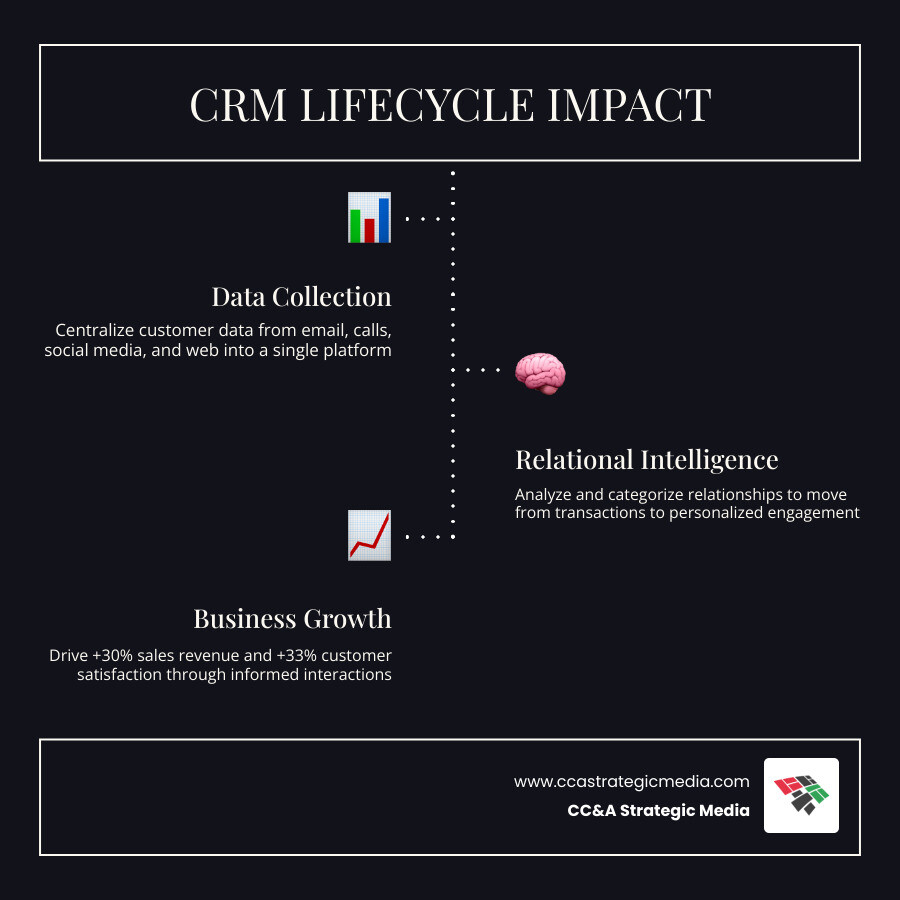
| What it does | Centralizes customer data from email, calls, social media, and web into one platform |
| Why it matters | Enables personalized marketing, improves retention, and drives measurable ROI |
| Who it’s for | Businesses of all sizes — from startups to large enterprises and non-profits |
| Key result | CRM users report up to +30% sales revenue and +33% customer satisfaction |
Here’s the hard truth: most businesses are sitting on a goldmine of customer data and doing very little with it. Emails live in one tool. Sales notes live in another. Customer service history is somewhere else entirely. And marketing keeps firing off campaigns into the void, hoping something sticks.
That disconnect is expensive. When your teams can’t see the full customer picture, you lose deals, miss retention opportunities, and waste budget on outreach that doesn’t land.
CRM changes that. It brings your data, your teams, and your customer conversations into one place — so every interaction is informed, intentional, and more likely to convert.
And with 82% of service professionals saying customer expectations are higher than ever, getting this right isn’t optional anymore. It’s the baseline for competing.
I’m Stephen Taormino, Founder and CEO of CC&A Strategic Media, and over 25 years of leading full-service digital marketing strategy, I’ve seen how CRM in marketing management transforms businesses that were stuck in reactive mode into growth-focused organizations with systems that actually work. In the sections ahead, we’ll break down exactly how to make that happen for your business.
The Strategic Architecture of CRM in Marketing Management
To truly understand CRM in marketing management, we must look beyond the software itself. Too many executives view a CRM as merely a digital Rolodex or an administrative chore for sales representatives. In reality, CRM is a holistic business strategy and a technology framework designed to manage and optimize customer interactions throughout their lifecycle. It represents a fundamental shift from transaction-driven operations to relationship-driven growth.
This transition requires what we call relational intelligence. Relational intelligence is the systematic ability of an organization to understand, categorize, and act on the complex dynamics of its customer relationships. When you treat CRM as an organizational philosophy, you align your entire operational structure around the customer. It forces a change in leadership mindset, shifting focus from short-term campaign metrics to long-term customer equity.
Without this strategic alignment, technology adoption fails. If your teams operate in silos, the customer experience becomes fragmented. Marketing sends generic promotions, sales makes uninformed cold calls, and customer support lacks the historical context to solve problems quickly. By establishing a unified CRM strategy, you build a shared business infrastructure that integrates these disparate departments into a cohesive, customer-centric system. You can explore how this strategic alignment shifts company dynamics in our analysis of CRM and Relational Intelligence.
Operationalizing CRM in Marketing Management for Omnichannel Engagement
Once the strategic foundation is in place, the operational work begins. Modern marketing demands omnichannel execution, which means delivering a consistent, personalized message across email, social media, web, and direct communication channels. Your CRM acts as the central engine for this orchestration, turning static profiles into active customer journeys.
By capturing first-party data directly from customer behaviors—such as website visits, email interactions, and purchase histories—the CRM allows you to build highly dynamic segments. Instead of relying on third-party cookies or guesswork, you use real-time behavioral data to trigger automated marketing messages that match the customer’s exact stage in their journey.
This level of scalable personalization is what differentiates a standard sales tool from a dedicated marketing platform. A marketing-driven CRM actively connects data, marketing, and analytics across multiple channels rather than just storing profiles. For those looking to understand how modern platforms handle this at scale, you can read more about building an automated, data-driven ecosystem through CRM with Marketing: AI-Powered Omnichannel Platform – Klaviyo .
The Role of Collaborative Systems in Unifying Sales and Service
A major operational bottleneck for growing businesses is the application gap. The average organization uses close to 900 different applications, but only 29% of these applications are integrated. This lack of integration creates massive operational silos, where valuable customer information is trapped in departmental software.
Collaborative CRM systems break down these barriers by ensuring that every employee has instant access to a unified customer history. When a customer contacts support, the representative immediately sees their purchase history, active marketing offers, and previous sales conversations. This shared visibility prevents duplicate efforts, reduces administrative overhead, and ensures a seamless transition as a lead moves from marketing to sales and eventually to customer service. By centralizing these communication streams, you significantly improve organizational productivity. To see how this operational alignment directly translates to business performance, review our guide on How a CRM System Can Boost Efficiency.
Core Types and Features of Modern CRM Systems
To choose the right system for your organization, you must understand the different types of CRM architectures. While some platforms attempt to do everything, most are engineered to excel in one of three primary areas: operational, analytical, or collaborative. Some modern definitions also include strategic CRM, which places customer-centricity at the absolute core of all business decisions.
| CRM Type | Primary Focus | Key Marketing Objective | Core Capabilities |
|---|---|---|---|
| Operational | Process Automation | Lead management and campaign execution | Contact management, lead routing, workflow automation |
| Analytical | Data Analysis | Customer profiling and predictive modeling | Data warehousing, segmentation, behavior forecasting |
| Collaborative | Departmental Alignment | Seamless omnichannel customer experiences | Shared customer records, interaction tracking, system integration |
Choosing the right mix depends entirely on your organizational goals. A business looking to automate daily outreach will lean heavily on operational features, while an enterprise focused on long-term customer behavior modeling will prioritize analytical data warehousing.
Essential Features of CRM in Marketing Management
Regardless of the system architecture you select, there are several non-negotiable features required to manage marketing effectively. The first is robust contact management, which consolidates communication history, social media activity, and personal preferences into a single profile. The second is dynamic segmentation, allowing marketers to group customers based on real-time actions rather than static demographics.
Campaign automation is equally critical, enabling your team to build multi-stage customer journeys that run autonomously. Furthermore, in an increasingly mobile business environment, your team must be able to access this data securely from anywhere. Providing your field teams and executives with real-time customer insights on the go prevents operational delays and ensures rapid response times. You can read more about implementing mobile-first data strategies in our article on why you should Make Mobile CRM a Top Priority.
Planning and Budgeting Campaigns with Enterprise CRM Tools
At the enterprise level, CRM systems evolve into comprehensive marketing resource management platforms. Managing large-scale campaigns requires precise coordination of budgets, assets, and operational capacity. If you launch a massive marketing campaign to millions of recipients simultaneously, you risk overwhelming your inbound call centers or sales teams.
Enterprise platforms solve this by allowing marketers to phase campaign delivery using waves. This strategic staggering of outreach ensures your internal teams can handle the influx of customer responses. Additionally, enterprise CRMs link daily marketing tactics directly to high-level corporate initiatives. By tracking actual expenses against forecasted budgets within the CRM, leaders can measure the exact financial return of every creative asset and campaign wave. For a technical deep dive into how large organizations structure these complex marketing programs, refer to the Siebel documentation.
Driving Measurable Business Growth and Customer Retention
The ultimate validation of any CRM strategy is its impact on the bottom line. Implementing a structured CRM system is not just an operational upgrade; it is a direct driver of revenue growth, customer satisfaction, and long-term retention. By maintaining a single source of truth, businesses can systematically identify cross-selling and up-selling opportunities that would otherwise go unnoticed.
The financial impact is clear. Organizations utilizing integrated CRM platforms report up to a 30% increase in sales revenue, a 32% increase in ROI, and a 33% increase in customer lifetime value. These results stem from a simple psychological truth: when customers feel understood and valued, they stay longer and spend more. By analyzing customer behaviors and predicting their needs, you transition from transactional interactions to sustained relational equity. To learn more about how to design systems that keep your clients engaged over the long term, read our insights on how to Increase Client Retention with a CRM System.
Rewarding Loyalty and Building Relational Equity
A critical, yet frequently overlooked, component of customer retention is the deliberate reinforcement of positive customer behavior. Customer loyalty is not a passive state; it is an active relationship that must be nurtured. A sophisticated CRM system allows you to identify your most valuable advocates and design targeted initiatives to reward their ongoing commitment.
Instead of generic discount programs, CRM-driven loyalty strategies use behavioral data to deliver personalized, meaningful rewards. Whether it is early access to new services, exclusive content, or tailored recognition, these efforts build deep relational equity. When you reward your customers systematically, you transform them from buyers into brand advocates. For a closer look at how to structure these initiatives effectively, explore our guide on An Overlooked Way to Impact CRM: Rewarding Loyal Customers.
The Rise of AI-Powered CRM and Agentic Workflows
We are currently witnessing a massive technological paradigm shift: the transition from traditional, passive database CRMs to active, AI-powered systems. AI is no longer just a marketing tool; it is becoming a foundational business infrastructure layer that allows organizations to operate with unprecedented speed and precision.

Modern AI-powered CRMs introduce agentic AI—autonomous software agents that can analyze data, predict customer needs, and execute complex workflows within assigned guardrails. These systems act as a continuous listening engine, monitoring customer interactions to gauge sentiment and identify potential issues before they escalate. Instead of waiting for a human marketer to run an analysis, the AI autonomously segments audiences, optimizes email send times, and serves hyper-personalized content in real time. This level of automation frees your team from routine administrative tasks, allowing them to focus on high-level strategic decision-making.
Strategic Implementation: Advantages, Risks, and Best Practices
Implementing a CRM system in marketing management offers undeniable advantages, including centralized data, automated workflows, and highly targeted marketing capabilities. However, a successful deployment requires a balanced understanding of the associated risks. Without careful planning, organizations can face significant challenges.
The primary risks of CRM implementation involve data security, privacy compliance, and user adoption. Storing sensitive customer information in a centralized cloud environment requires rigorous security protocols and strict adherence to data privacy regulations. Furthermore, the greatest barrier to CRM success is often internal resistance. If your staff lacks confidence in the new system or finds the software too complex, user adoption will plummet, turning an expensive technology investment into an underutilized database.
To mitigate these risks, organizations must invest heavily in training, establish clear data governance policies, and create collaborative environments where employees can share best practices. Building a custom internal forum or portal can significantly ease this transition, allowing your team to troubleshoot issues and optimize their workflows collectively. You can explore the benefits of structured user networks in our article on building a Custom CRM Community.
Frequently Asked Questions about CRM in Marketing
What is the primary role of CRM in marketing management?
The primary role of CRM in marketing management is to centralize customer data across all touchpoints to manage the entire customer lifecycle. By unifying information from sales, marketing, and customer service, it allows organizations to align their strategies, personalize customer engagement, and drive relationship-based growth rather than relying on transactional outreach.
How does AI-powered CRM differ from traditional CRM systems?
Traditional CRM systems function primarily as static databases that require manual data entry and human analysis to trigger campaigns. AI-powered CRMs utilize agentic AI, predictive analytics, and machine learning to autonomously analyze customer behavior, predict future needs, automate complex workflows, and deliver real-time personalization without constant human intervention.
What are the main challenges when implementing a new CRM?
The most significant challenges are user adoption, data integration, and security risks. Employees often resist changing their established workflows, which can lead to low system utilization. Additionally, integrating a new CRM with existing, disconnected applications can be technically complex, and centralizing sensitive customer data requires robust security measures to protect against breaches.
Conclusion
Mastering crm in marketing management is no longer a luxury reserved for massive corporations with unlimited budgets. It is the core operational foundation required by any business aiming for sustainable, scalable growth. Without a unified system to capture customer data, align your internal teams, and automate personalized experiences, your business risks falling behind.
At CC&A Strategic Media, we understand that technology is only as powerful as the strategy behind it. That is why we developed our proprietary service, Strategic Ops.
Strategic Ops is not just standard marketing support or fractional leadership; it is the comprehensive operational foundation behind your business growth. When you partner with us, you receive a complete fractional leadership team that works within a proven system to transform your brand into a compounding growth engine. We provide dedicated marketing coordination to ensure focused, aligned execution across all channels, alongside full-stack agency execution—covering everything from websites, SEO, and social media to integrated funnel campaigns, performance-driven content, and public relations.
If you are ready to stop reacting to the market and start building a disciplined, data-driven business infrastructure, let’s connect. Explore our comprehensive services and take the first step toward transforming your organization today at CC&A Strategic Media Marketing Services.