Why Defining Strategic Executive Leadership Goals Matters in 2026
Setting deliberate, clear benchmarks at the executive tier has never been more consequential. In our current business climate, broad intentions simply do not survive quarterly volatility. Research from McKinsey reveals that a CEO’s direct choices and actions account for up to 45% of an entire organization’s performance. When leaders fail to articulate specific, measurable objectives, that ambiguity cascades rapidly across every department, diluting operational efficiency and eroding profitability.
The IESF Study 2026, which surveyed 909 CEOs across 23 countries, highlights a profound shift: leadership has permanently moved away from reactive crisis handling toward disciplined financial stewardship, selective value-driven growth, and systemic operational execution. Cost discipline and sustainable profitability are no longer emergency measures—they represent standard operating procedure for modern leadership teams.
Setting clear executive goals establishes the strategic guardrails necessary to calibrate risk, preserve capital, and ensure that every strategic initiative ties directly back to enterprise-level health.
Navigating AI Integration and Workplace Complexity
Technological acceleration is reshaping executive responsibilities at every level. Industry research shows that 92% of companies plan to increase their artificial intelligence investments, yet remarkably, only 1% of executives consider their organizations mature in AI integration. If AI were an actual colleague sitting in your boardroom, it would probably ask for a coffee break just to process the sheer volume of unstructured data leaders throw at it daily.
Bridging the divide between ambition and technological maturity requires structural governance. Over 60% of organizations have appointed a Chief AI Officer (CAIO), with another 26% planning to add one. Yet technological literacy cannot remain isolated within technical departments; every C-suite executive must understand how automated workflows, predictive analytics, and algorithmic tooling impact operational workflows.
Through Strategic Ops, we integrate technological capability with marketing intelligence and operational rigor. Executives must set objectives that treat AI not as an unguided experiment, but as an operational baseline to sharpen decision-making, optimize resource allocation, and eliminate routine friction.
Driving Performance and Employee Retention
Gallup findings indicate that only 31% of employees report feeling actively engaged at work. Simultaneously, nearly seven out of ten workers state they would quit their jobs over poor managerial oversight. These metrics point to an undeniable truth: talent capacity serves as the primary constraint on enterprise execution.
When leaders fail to set structured personal and organizational benchmarks, middle management operates in the dark. Establishing explicit goals centered on communication transparency, talent mentorship, and managerial accountability creates organizational stability. By investing deliberate effort into hiring and promoting great managers, executives create an operational environment where strategic goals are consistently translated into daily front-line execution.
Core Pillars of High-Impact Leadership Development
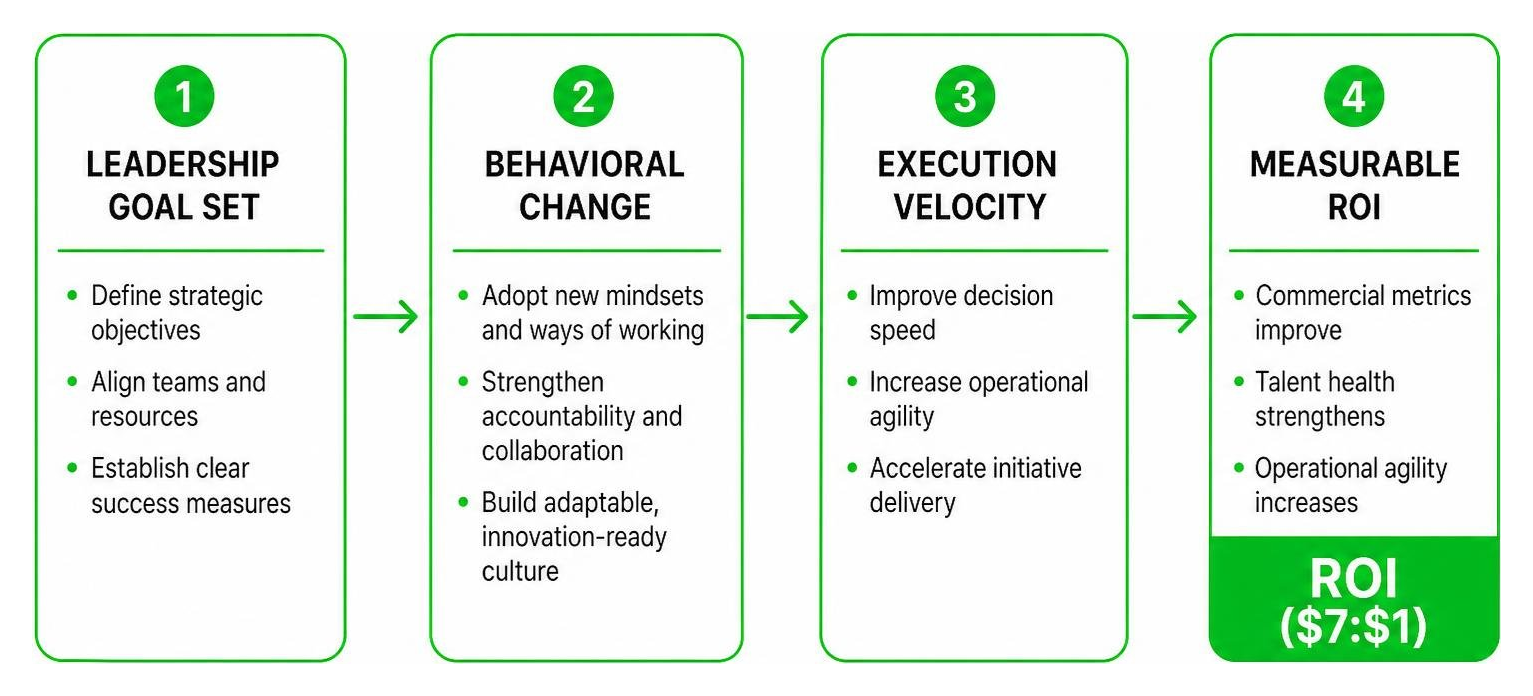
Sustained enterprise success demands that executive development be treated as a core business capability rather than a periodic HR workshop. Data demonstrates that organizations investing in focused, continuous leadership development realize a 25% increase in business outcomes and generate an average return on investment of $7 for every $1 spent. Furthermore, 59% of companies report direct retention gains from structured leadership frameworks.
High-impact development rests upon three structural pillars. First, strategic clarity ensures every personal leadership behavior directly aligns with the enterprise’s most urgent business priorities. Second, behavioral accountability measures leadership efficacy through observable routines rather than subjective intent. Third, continuous capability building ensures leaders continually expand both their technical capabilities and their emotional intelligence.
Frameworks for Setting Executive Leadership Goals
Transforming an executive vision into tangible results requires proven goal-setting frameworks that eliminate distractions.
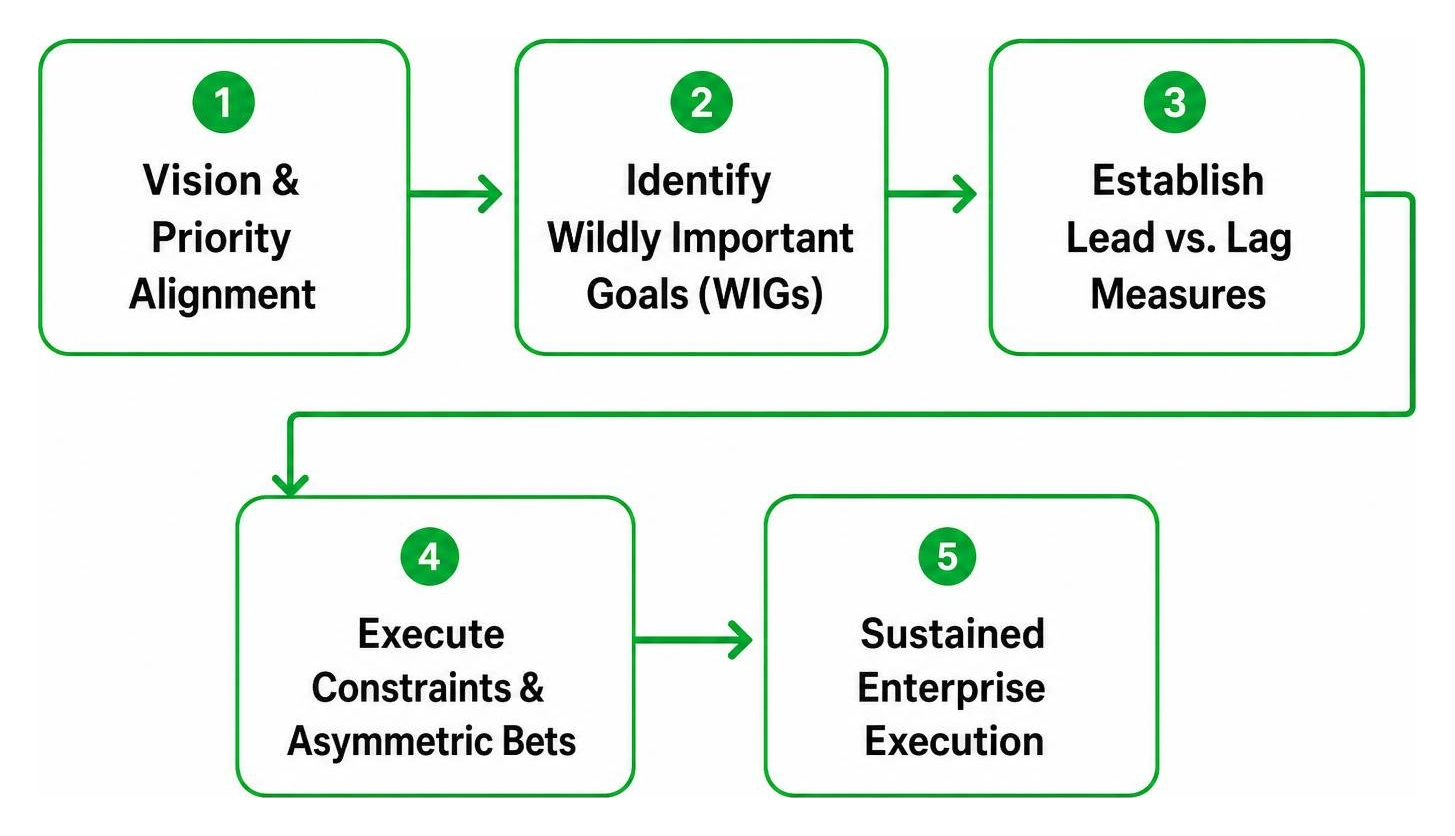
To establish operational focus, executives should leverage several structured methodologies. Wildly Important Goals, drawn from the 4 Disciplines of Execution, require identifying the one or two critical targets that make all other efforts secondary, addressing the reality that only 15% of employees can accurately name their organization’s primary objectives. Leaders must also balance lead and lag measures, where lag measures record past performance like quarterly revenue or net margin, and lead measures track high-impact predictive behaviors such as holding weekly alignment sessions. Additionally, constraint-based planning helps leaders identify the primary operational bottleneck holding the business back, while a single “one-thing filter” isolates the specific metric—such as profit per employee or client retention velocity—that creates compounding momentum across the enterprise.
When defining these strategic targets, executives must ensure they are distinguishing business value and personal value with the end in mind, aligning individual executive performance metrics directly with long-term enterprise valuation.
Balancing Technological Acumen with Human-Centered Empathy
While digital literacy has become an executive prerequisite, technical capability without empathy produces organizational friction. Leading effectively requires establishing psychological safety—an environment where team members voice concerns, share insights, and challenge assumptions without fear of reprisal.
Organizations whose leadership actively champions employee well-being experience 2.5 times higher workforce engagement. Empathy is not a soft sentiment; it is a vital operational competency. Executives must master active listening, recognize signs of burnout across distributed teams, and model healthy boundaries.
Understanding how to manage mental health in the workplace protects institutional knowledge and sustains team energy during complex market shifts. By pairing transparent operational metrics with authentic, supportive communication, leaders succeed in inspiring trust from your employees across every tier of the organization.

Translating Vision into Measurable Enterprise Execution
A well-crafted strategy is only as valuable as the organization’s capacity to execute it. Closing the gap between high-level executive vision and operational delivery requires concrete workflows, visible progress metrics, and intentional alignment routines.
Operationalizing Executive Leadership Goals Across Hybrid Teams
With 70% of employees citing flexible work arrangements as essential to overall job satisfaction, managing distributed and hybrid teams has become a foundational executive responsibility. Remote environments cannot rely on physical presence or casual hallway conversations to maintain strategic alignment.
To operationalize goals across dispersed units, executives must focus on four foundational disciplines. Outcome-based management evaluates teams on verifiable deliverables and measurable value creation rather than hours logged. Structured communication cadences implement brief, weekly check-ins focused on progress, lead measures, and active roadblocks. Transparent change management ensures shifts in corporate strategy or market positioning are articulated with complete clarity by communicating change as a leader. Finally, constructive conflict resolution addresses friction points early through proactive communication and dealing with difficult conversations before operational delays compound.
Fostering an Adaptable and Innovative Culture
Market conditions reward organizations built to adapt quickly. Research shows that innovative enterprises are three times more likely to outperform their industry competitors in top-line revenue growth. However, true innovation does not happen by decree—it requires an environment where measured experimentation is systematically supported.
Leaders foster resilience by establishing safe parameters for calculated risk-taking, breaking down functional silos, and actively recognizing creative problem-solving across departments. Cultivating this atmosphere requires deliberate intention behind how to create the company culture you want.
By viewing managing people: a blend of art and science, executives combine data-driven performance targets with psychological insight, creating an adaptable workforce capable of navigating continuous change.
Evaluating Return on Investment and Long-Term Value
To confirm that leadership objectives yield measurable enterprise value, organizations must track both quantitative metrics and behavioral baselines over 60- to 90-day cycles. Commercial metrics monitor revenue per employee, net margin expansion, and new initiative time-to-market. Talent health indicators evaluate voluntary turnover rates, internal promotion velocities, and engagement survey results. Furthermore, operational agility tracks project completion cycles and cross-functional alignment scores.
When enterprise growth requires scaling leadership bandwidth without overextending internal overhead, adopting strategies like fractional staffing 101: aligning marketing and sales for scalable revenue offers a flexible path to achieve strategic outcomes while preserving executive focus.
Frequently Asked Questions About Executive Leadership Goals
What are the primary executive leadership goals leaders should focus on this year?
Leaders should concentrate on five core areas: establishing disciplined financial management, executing responsible AI integration, developing human-centered empathy to protect employee well-being, building clear communication frameworks for hybrid workforces, and cultivating high-potential talent pipelines.
How do organizations measure the ROI of leadership development initiatives?
ROI is measured through a combination of leading behavioral indicators and hard commercial outcomes. Key metrics include improvements in employee retention (which delivers an average $7 return per $1 invested), accelerated project delivery times, higher engagement scores, and direct contributions to margin growth and overall revenue.
How can executives balance technological tools with authentic leadership?
Executives should utilize AI and automation to handle routine reporting, scheduling, and data analysis, freeing up valuable time for strategic thinking and personal mentorship. Technology should inform decision-making, while emotional intelligence, transparent ethics, and active listening guide human relationships and team governance.
Conclusion
Developing meaningful executive goals is not an annual check-the-box exercise. It is a continuous discipline that converts high-level corporate strategy into predictable, scalable performance. By grounding your executive goals in financial rigor, responsible technology adoption, empathetic communication, and disciplined execution frameworks, you position your entire enterprise to navigate market complexity with clarity and confidence.
At CC&A Strategic Media, we combine advanced data analytics, strategic marketing operations, and organizational psychology to help executives build resilient, high-performing businesses. If you are ready to refine your leadership framework, align your marketing and operational engines, and drive sustainable growth, connect with Steve Taormino and our team to start building your strategic roadmap today.