
How Leadership and Goals Create Measurable Growth
Strong leadership and goals turn a broad business vision into clear actions people can own. Start by choosing one priority tied to growth, defining the few leadership behaviors that will move it forward, measuring progress each week, and adjusting when results show the plan is off track. The goal is not more activity. It is better focus, clearer ownership, and visible progress.
This matters because many teams lack a shared direction. Only 15% of employees can name their organization’s most important goals, while employee engagement remains low. Leaders close that gap when they explain why a goal matters, connect each role to the outcome, and make success feel both important and reachable.
For business owners and law firms, leadership goal setting should link people, operations, and marketing performance. A useful goal might improve how leaders delegate, use data in decisions, communicate priorities, or develop future managers. It needs a business purpose, a deadline, and a simple way to see whether the new behavior is producing a real result.
I am Stephen Taormino, founder and CEO of CC&A Strategic Media. For more than 25 years, I have helped organizations connect leadership and goals with marketing strategy, human behavior, data, and measurable business growth.
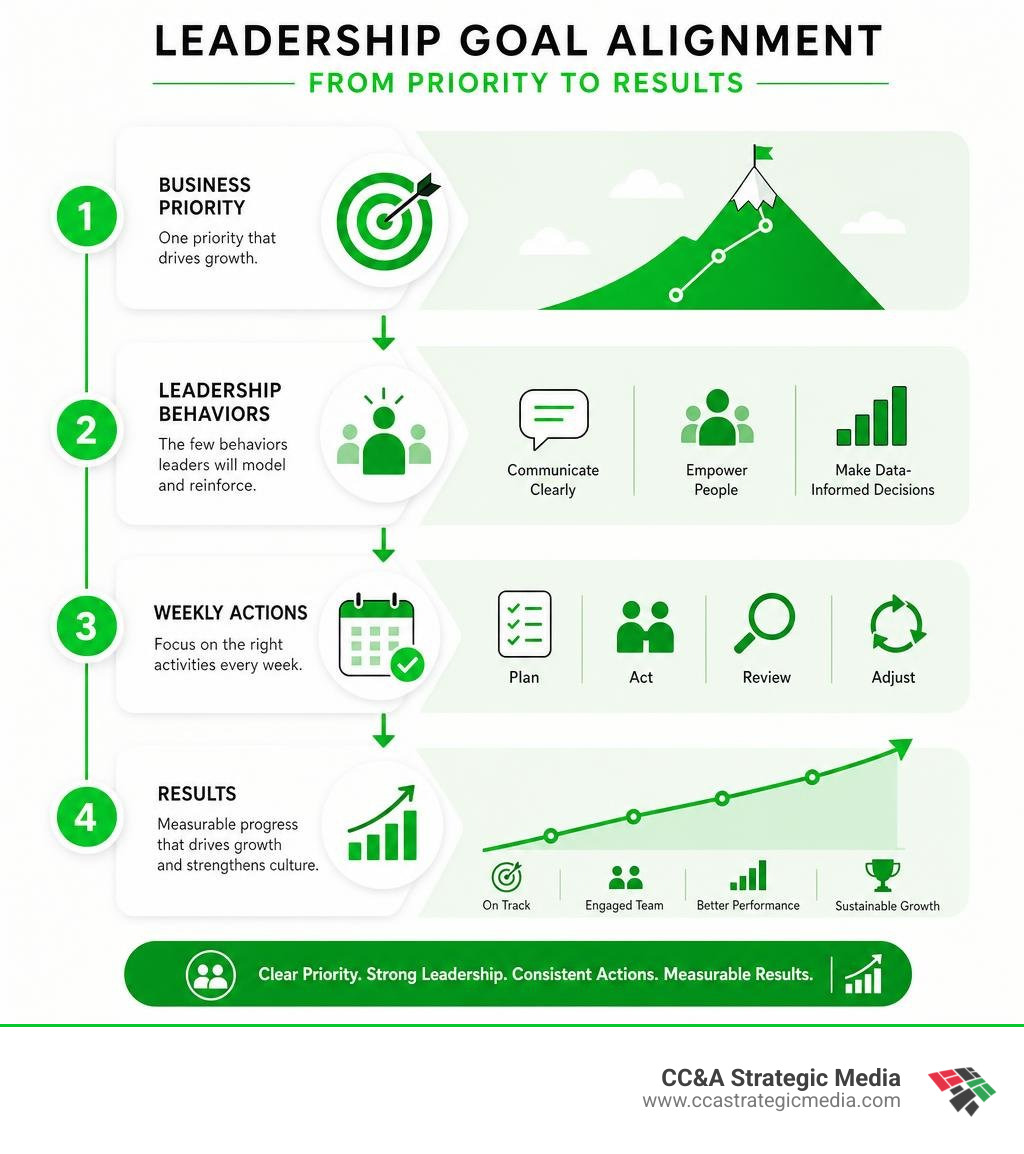
The Fundamental Intersection of Leadership and Goals
When I evaluate why organizations hit growth ceilings, the breakdown rarely stems from a lack of ambition. It almost always traces back to a breakdown in how executive vision gets translated into daily execution. As of September 2026, global workplace research reveals a persistent engagement crisis: only 27% of employees worldwide are engaged with their work, a mere 29% trust their leaders, and just 21% feel their leaders actively support their individual growth.
Goal setting is not merely an administrative management exercise; it is an active leadership discipline. Without deliberate goal setting, strategic vision remains an aspiration. When leaders establish structured targets, they give their teams clarity, eliminate ambiguity, and build an environment where individuals understand how their daily efforts ladder up to meaningful outcomes.

Aligning Leadership and Goals with Organizational Strategy
Every leadership objective must serve as a direct bridge to overarching business priorities. In my experience advising corporate enterprises and managing partners at law firms, organizational goals fundamentally reduce to three drivers: driving sustainable revenue, cutting operational drag, or mitigating enterprise risk.
If a leadership goal cannot be explicitly linked to one of these core pillars, it is a distraction. Leaders must ask themselves: What behavioral shift will directly unlock our top strategic priority?
When you learn how to create the company culture you want, setting clear operational goals is what moves cultural values from decorative wall plaques into standard operating procedures. Setting fewer, high-impact goals prevents leadership burnout and keeps teams focused on what truly drives enterprise value.
The Psychology of Transformational Goal Pursuit
Goal setting functions differently under transformational leadership than under purely transactional oversight. Groundbreaking research published in Frontiers | The Path Is the Goal: How Transformational Leaders Enhance Followers’ Job Attitudes and Proactive Behavior demonstrates that transformational leaders drive employee satisfaction, organizational commitment, and proactive behavior by shaping how followers perceive their goals.
Specifically, transformational leaders influence two vital psychological variables. First, they elevate goal importance by communicating the ethical, emotional, and strategic reason behind an initiative, helping team members internalize company targets as personal goals. Second, they enhance goal attainability by opening new paths to success, granting decision-making autonomy, and providing psychological safety so teams feel empowered to solve problems proactively.
By connecting daily execution to higher-order purpose, leaders turn assigned organizational tasks into shared personal commitments.
Essential Frameworks for Setting Actionable Executive Objectives
Setting effective goals requires structured methodologies that hold up under real-world operational pressure. Vague resolutions like “improve team communication” fail because they lack measurable behavioral definitions.
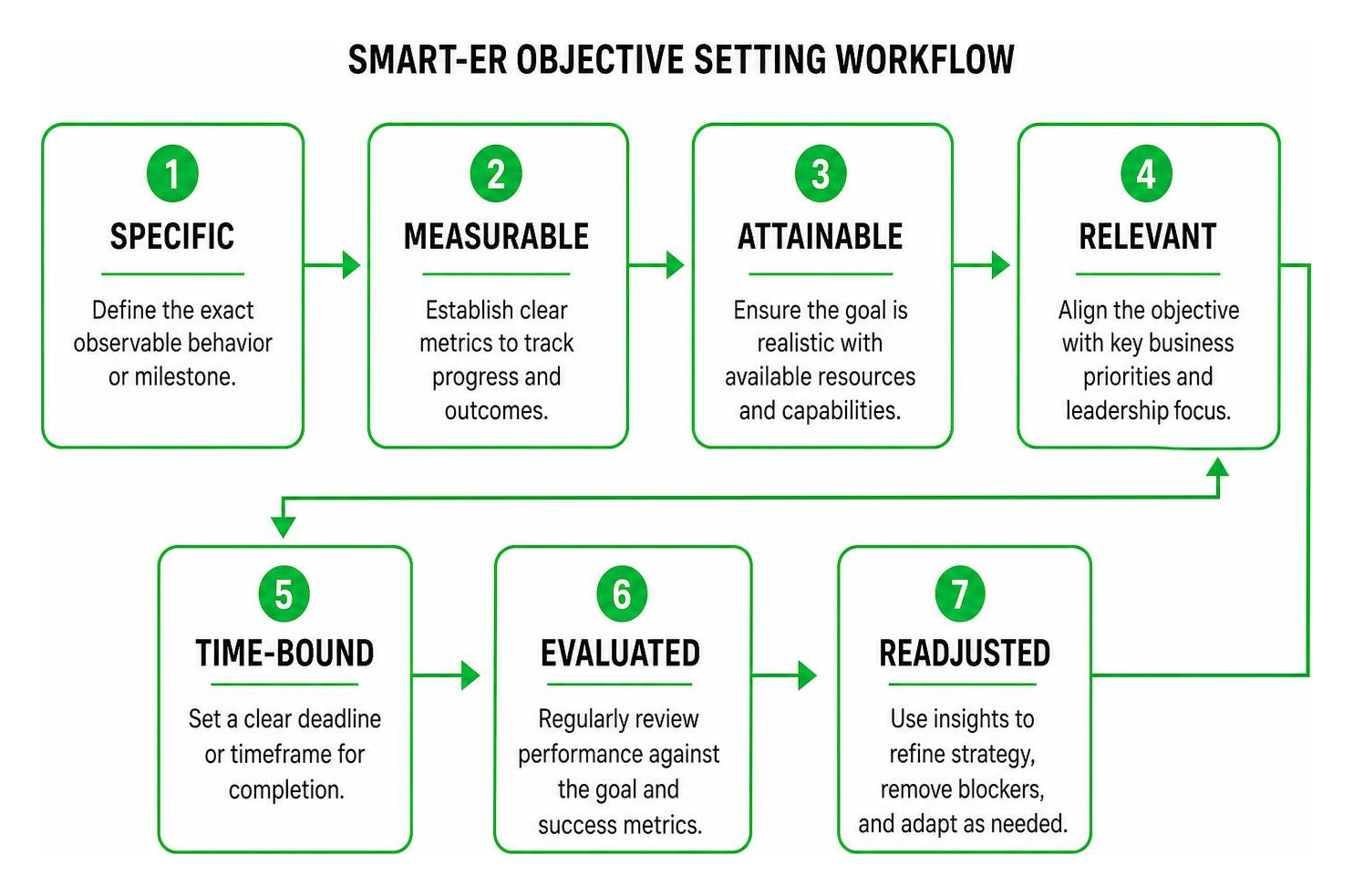
Structuring Actionable Milestones with SMART-ER Criteria
The standard SMART criteria (Specific, Measurable, Attainable, Relevant, Time-bound) provides a solid baseline, but modern organizational leadership demands an agile extension: SMART-ER (Evaluated and Readjusted).
Leaders must define specific observable behaviors, establish measurable quantitative tracking mechanisms such as weekly coaching sessions, and set attainable targets that stretch capability without causing operational paralysis. Furthermore, each objective must remain relevant to high-stakes business priorities, include time-bound checkpoint dates, be evaluated regularly against performance baselines, and be readjusted whenever real-time indicators reveal execution drift.
Applying this framework ensures goals remain dynamic roadmaps rather than rigid annual documents that get filed away and forgotten.
Balancing Daily Lead Measures and Strategic Lag Measures
One of the most common pitfalls I observe among executive leaders is fixating entirely on lag measures—the end results like quarterly revenue, gross margins, or annual client retention rates. By the time a lag measure arrives, the outcomes are locked. You cannot change the past.
High-impact leaders focus their energy on lead measures. Lead measures represent the high-impact, daily and weekly predictive behaviors that directly influence the lag outcome. Research indicates that employees who set at least four daily goals per week are 34% more likely to achieve their KPI targets compared to those who do not.
| Measure Type | Focus | Control Level | Executive Example |
|---|---|---|---|
| Lead Measure | High-impact predictive behaviors | High (within direct control) | Scheduling 4 structured client feedback sessions per week |
| Lag Measure | Downstream end results | Low (result of past actions) | Increasing annual client retention by 15% |
| Lead Measure | Delegation & team upskilling | High (within direct control) | Delegating 3 administrative reporting tasks to mid-level managers weekly |
| Lag Measure | Executive capacity | Low (result of past actions) | Freeing 10 hours of executive time per week for business development |
By maintaining a visible scoreboard tracking weekly lead measures, leaders ensure their teams focus on actionable execution rather than passive outcome monitoring.
Critical Development Areas for High-Impact Leadership
Technical competence might get a professional promoted into management, but human interpersonal skills determine whether an organization scales. Leadership goals must specifically target behavioral and communication development.

Cultivating Trust and Emotional Intelligence
Trust is the bedrock of organizational velocity. When team members trust their executive leaders, cross-departmental friction drops and innovation accelerates. Masterful leaders actively practice managing people: a blend of art and science by balancing structured operational accountability with deep empathy.
Key leadership development goals in this domain focus on active listening to genuinely absorb input, fostering psychological safety so team members can raise red flags without fear of retribution, and practicing transparent communication. Leaders can focus on inspiring trust from your employees by consistently aligning executive actions with stated values.
Balancing Leadership and Goals Across Autonomous Teams
Modern organizations thrive on decentralized decision-making, but granting autonomy without operational clarity creates chaos. Empirical findings in The Influence of Goal Setting Autonomy and Commitment to Organization Goals on Performance: A Mediation Moderation Model | Journal of the Knowledge Economy | Springer Nature Link highlight an essential dynamic: giving team members goal-setting autonomy improves motivation and effort, but it also causes workers to prioritize preferred tasks over essential secondary duties like compliance, documentation, or administrative reporting.
To balance autonomy and execution, leaders need deep operational knowledge of multi-task workflows. When delegating goals, leaders should assess employee readiness across specific tasks before granting full autonomy, maintain clear psychological contracts regarding baseline operational requirements, and establish regular feedback loops to ensure primary production targets do not cannibalize secondary compliance tasks.
Leading Strategic Change and Overcoming Execution Barriers
Strategic transformations frequently stall due to organizational inertia and unaddressed friction. When rolling out new operational procedures, software integrations, or corporate reorganizations, leaders must focus on communicating change as a leader by breaking massive strategic milestones into bite-sized, incremental wins.
Celebrating early, small victories validates the strategic roadmap and builds team resilience, turning organizational apprehension into collaborative momentum.
Establishing Long-Term Accountability and Measuring Progress
Goal setting without a continuous accountability architecture inevitably fails. To build a sustainable leadership system, organizations must align executive behaviors with multi-dimensional performance scoreboards.
Navigating Sector-Specific Priorities from Tech to Legal Practices
Leadership priorities vary across industries. Recent research published in Frontiers | Selecting self-and-follower goal-aware leadership styles across sectors: a decision support approach demonstrates that while innovation metrics dominate technology and automotive sectors, employee engagement and operational risk mitigation take precedence in healthcare and professional services.
For professional service firms and corporate legal departments, establishing rigorous operational discipline is paramount. Implementing the complete guide to improving law firm efficiency requires firm leadership to set clear benchmarks around workflow automation, digital file organization, and capacity management.
Furthermore, the Self-and-Follower Goal-Aware Leadership (SFGAL) study underscores that a win-win leadership style—one where the leader actively balances their own professional health and developmental goals alongside their team’s growth—outperforms self-neglecting or authoritarian styles across all sectors. Leaders who sacrifice their own well-being eventually burn out, damaging team morale and organizational outcomes.
Continuous Cadences and Feedback Loops
To maintain momentum toward strategic milestones, high-performing leadership teams implement structured operational cadences. Teams establish weekly lead check-ins through disciplined fifteen-minute sessions to review lead measure commitments, update the visual scoreboard, and clear operational roadblocks. They also conduct formal quarterly strategic resets to review lag outcomes, assess market shifts, and readjust targets using SMART-ER principles, while leveraging bi-annual or annual 360-degree feedback reviews to evaluate observable behavioral shifts rather than relying solely on self-reporting.
Frequently Asked Questions About Leadership and Objectives
How do leadership goals differ from individual task objectives?
Individual task objectives focus on immediate functional outputs (e.g., closing a set number of support tickets, drafting a contract). In contrast, leadership goals target strategic capability, behavioral evolution, and systemic impact. They focus on how a leader communicates vision, delegates responsibility, coaches emerging talent, and aligns cross-functional teams with overarching business priorities.
Why do many leaders struggle to maintain goal accountability?
Most leaders fail to maintain accountability because they get consumed by daily operational firefighting, set vague or unquantifiable goals, track only lagging indicators, or lack a disciplined weekly rhythm of accountability. Without real-time lead measure tracking, long-term strategic goals are easily eclipsed by immediate daily demands.
How does goal autonomy impact overall team performance?
When applied properly, goal-setting autonomy significantly boosts employee intrinsic motivation, job satisfaction, and task performance. However, if leaders detach completely without monitoring task interdependencies, autonomy can lead team members to neglect essential administrative, legal, or compliance functions in favor of high-visibility tasks. Balanced leadership combines autonomy with operational alignment.
Conclusion
Translating executive vision into lasting business value requires an intentional connection between leadership and actionable goal setting. When leaders ground their objectives in strategic priorities, focus on daily lead measures, foster psychological safety, and maintain a disciplined operating rhythm, organizational growth becomes predictable and sustainable.
At CC&A Strategic Media, we combine big data, consumer psychology, advanced technology, and full-stack agency execution to help business owners build comprehensive strategies that deliver measurable growth. If you are ready to align your leadership vision with a scalable operational and marketing foundation, connect with me, Stephen Taormino, and let us build your path forward.