
The Strategic Foundation of Coaching Leadership
Coaching goals give leaders a practical way to turn good intentions into better decisions, stronger teams, and measurable progress. The process starts with one clear question: which leadership behavior, if improved, would create the greatest benefit for the business?
A useful goal connects a specific behavior to an operational priority. A leader might focus on delegating decisions, improving feedback conversations, or helping managers solve problems without waiting for executive intervention. The goal should be observable, tied to a business outcome, and reviewed on a defined cadence.
Coaching leadership is not passive management. It asks leaders to replace automatic answers with thoughtful questions, clear expectations, and accountability. Gallup research on engagement underscores why manager habits matter. That shift builds capability across the organization instead of creating another bottleneck at the top.
Start With Self-Reflection
Before setting milestones, leaders need an honest baseline. Feedback from peers, direct reports, and trusted advisors can reveal where leadership habits are helping the organization and where they are limiting growth. Self-reflection matters, but it is more valuable when tested against real feedback and business results.
Build Trust Before Asking for Change
Coaching works when people can raise concerns, acknowledge mistakes, and test better ways of working without fear of embarrassment. Leaders build that environment by listening carefully, asking direct questions, and treating constructive mistakes as information that can improve the next decision.
A Practical Framework for Setting Coaching Goals for Leaders
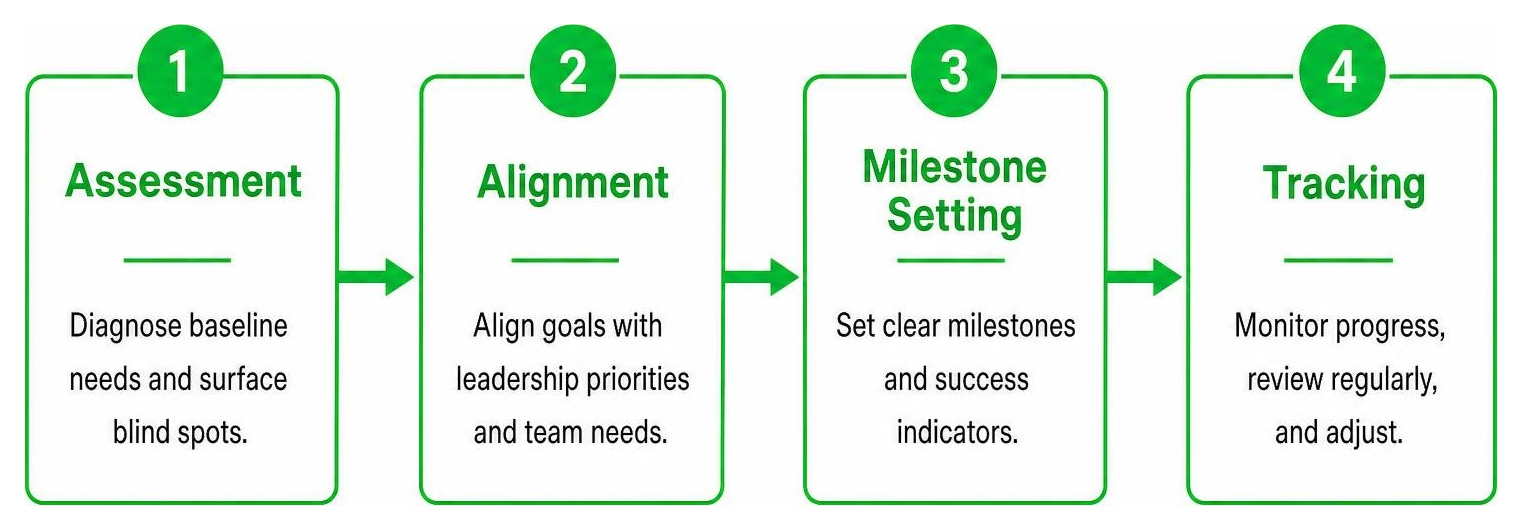
Effective coaching goals follow a repeatable process: establish the baseline, align the goal with the business, define the behavior, and review progress.
Step 1: Identify the Real Gap
Start with evidence, not assumptions. A structured 360-degree assessment, performance data, and candid stakeholder feedback can show whether the real issue is delegation, communication, decision quality, accountability, or another leadership habit.

Step 2: Connect the Goal to Strategy
A coaching goal should support a business priority. The framework for setting leadership goals effectively starts with the same principle. If the organization needs faster execution, the leader may need to clarify decision rights and coach managers to resolve routine issues independently. If retention is the priority, the goal may focus on better feedback, recognition, and team communication.
Use setting leadership goals effectively to connect a leadership milestone to the business priority it is meant to improve.
Use SMART milestones to define what will change, how progress will be observed, and when the leader will review results. For example: over the next 90 days, open each leadership meeting with a concise strategic context, ask managers for recommended solutions, and review whether decisions are being made closer to the work.
Step 4: Review and Adjust
Monthly coaching conversations and periodic stakeholder feedback keep the goal active. Track the leadership behavior alongside relevant operating signals, such as project flow, decision speed, team clarity, and retention. The objective is not to complete a coaching exercise. It is to build a leadership habit that improves how the business operates.
Avoiding Common Coaching Pitfalls
Leadership coaching loses value when it becomes a private, occasional conversation disconnected from daily work. Reading, workshops, and assessments can be useful, but progress comes from applying one new behavior consistently and reviewing the result.
A second mistake is setting goals without accountability. Leaders need an executive coach, peer partner, or internal leadership team that can challenge assumptions, review commitments, and keep development connected to the organization’s priorities.

Handle Resistance With Clarity
When leaders begin coaching instead of giving every answer, some team members may initially push back. The response should be clear and consistent: support is available, expectations remain high, and people are expected to develop sound judgment. Guidance for dealing with difficult conversations should address the business impact, clarify the next step, and preserve respect.
Dealing with difficult conversations requires leaders to address the business impact, clarify the next step, and preserve respect.
Leaders should arrive prepared with real situations, decisions, and outcomes to examine. Between sessions, document what was tried, what changed, and where friction remains. That discipline turns coaching into a management advantage rather than an isolated professional-development activity.
Frequently Asked Questions About Leadership Coaching
Why should leaders define the end goal first?
A clear end goal keeps coaching focused on a business-relevant outcome. It guides the conversations, the experiments, and the feedback needed to make progress visible.
What helps leaders track progress?
Combine stakeholder feedback with a small number of observable behaviors and operating indicators. The best measurement approach is simple enough to sustain and specific enough to show whether the leader’s new habits are improving execution.
Conclusion
Strong coaching goals help leaders turn leadership development into better execution. The right goal is specific, connected to strategy, supported by feedback, and reinforced through consistent accountability.
At CC&A Strategic Media, we provide leadership and marketing growth solutions that help leadership teams connect growth goals with the systems, marketing coordination, and operational discipline needed to execute them. Our CC&A Strategic Ops approach brings together a Fractional Leadership Team, Dedicated Marketing Coordination, and Full-stack Agency Service Execution so leaders have informed guidance as they build stronger teams and more sustainable growth.
Authored by Steve Taormino