The Survival Blueprint Most Law Firms Don’t Have — Until It’s Too Late
Law firm succession planning is the process of preparing your practice for a future without you — whether that future arrives on your schedule or not.
Here is what you need to know right away:
- What it is: A documented strategy to transfer leadership, client relationships, and firm operations to a successor, partner, or acquiring firm
- Why it matters: Without a plan, your clients, staff, and life’s work are left exposed when you retire, become ill, or pass away unexpectedly
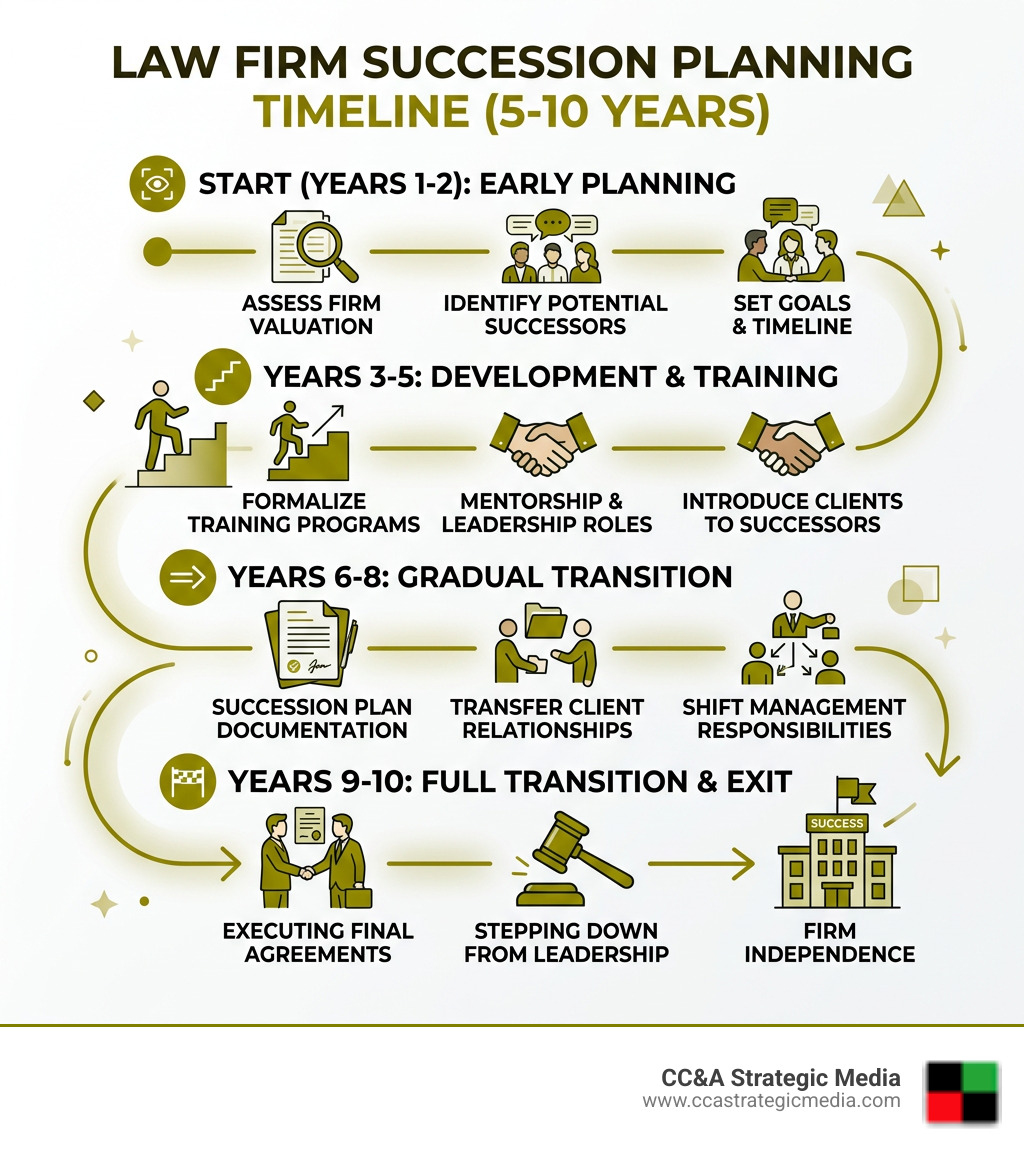
- When to start: Ideally 5 to 10 years before your intended transition — mid-50s is the sweet spot, not your late 60s
- What it covers: Client file disposition, IOLTA account access, passwords, vendor contracts, successor compensation, and ethical compliance
- Who needs it: Solo practitioners, small firms, and large partnerships alike — no firm is exempt from succession risk
The numbers tell a sobering story. Only 37% of law firms had — or were in the process of creating — an official succession plan, according to a Thomson Reuters survey. A 2021 Remsen Group study found fewer than 13% of lawyers had a documented plan in place. And 70% of first-generation law firms do not survive their founding partners.
The consequences of inaction can be swift and catastrophic. Consider this: a thriving 30-attorney firm with three offices went from flourishing to out of business within a single year — triggered by the sudden death of the managing partner and a cancer diagnosis affecting another key leader. Within days, lawyers began leaving. Within months, the firm was gone.
That is not a cautionary tale. That is a pattern.
The strongest law firms are not simply good at practicing law. They are disciplined in how every part of the business — including its future — is architected and protected.
I’m Roxanne St. Marie, and over nearly two decades working inside law firms and legal marketing organizations, I’ve seen how law firm succession planning (or the absence of it) shapes the long-term health of a practice. That experience, from the front desk to the executive level, informs every insight in this guide.
Why Law Firm Succession Planning is a Non-Negotiable Business Strategy

At CC&A Strategic Media, we often tell our clients that a law firm is not just a place where you work; it is a business architecture that requires a foundation, a frame, and a roof. If you don’t have a plan for who maintains that structure when you’re gone, the whole thing eventually collapses.
In our experience, most first-generation (founder-owned) law firms do not become second-generation firms. Why? Because they operate with a “worker bee” mentality rather than an institutional mindset. An institutional mindset means you are building something that can exist independently of your daily billable hours.
Law firm succession planning is an essential risk mitigation tool. It isn’t just about retirement; it’s about Expecting the Unexpected: Succession Planning for Lawyer- CNA Insurance. Whether you are managing a boutique practice or a mid-sized firm, your revenue protection and client continuity depend on a formal strategy. For those in Maryland, particularly around Perry Hall, ensuring your firm’s digital presence remains robust during these transitions is part of that strategy. We’ve seen how Digital Marketing Strategies for Business Law Firms can bridge the gap during a leadership change by keeping the brand visible and authoritative.
The High Cost of Inaction
The legal industry is volatile. In April 2020 alone, the industry shed 64,000 jobs as firms scrambled to react to global shifts. When a firm lacks a plan, a sudden disability or the death of a key partner doesn’t just cause a hiccup—it triggers an exodus. According to Law Firm Succession Planning: Preparing For The Baby Boomer Retirement Wave, insurers view the lack of a plan as a major risk factor. If you have one foot out the door without a designated successor, your malpractice risk increases, and your firm’s value plummets.
Preserving Your Professional Legacy
Your legacy is more than your win-loss record. It is the brand equity you have built over decades. Effective planning involves Business Law Marketing to ensure that the community still trusts the firm name even when the founding partner’s name is the only thing left on the door. It requires developing “rainmakers”—younger associates who don’t just know the law but know how to bring in the business.
Ethical Obligations and the “Triage Lawyer” Framework
We cannot talk about law firm succession planning without talking about ethics. As lawyers, you have a professional responsibility to protect your clients’ interests, even if you are no longer capable of doing so yourself. Various ethics opinions, such as the State Bar of Arizona, Op. 04-05, highlight the necessity of having protocols for the disposition of client files and property.
Appointing a Caretaker Attorney
One of the most critical steps for a solo practitioner or a small firm partner is appointing a “triage lawyer” or caretaker. This is a designated attorney authorized to step in during an emergency to close, sell, or transfer your practice.
- Written Authorization: You must have a formal agreement in place.
- Emergency Protocols: Your caretaker needs to know where your IOLTA access is and how to handle immediate court deadlines.
- Locum Tenens: Sometimes, this means hiring a temporary “locum tenens” lawyer to maintain the practice during a short-term disability.
The American Bar Association State-by-State Caretaker Rules provide a roadmap for how these arrangements should be structured. Without a designated caretaker, the court may have to appoint someone, which is often a slow, expensive, and public process that can damage your reputation and your clients’ cases. Referencing Oregon State Bar, Formal Op. 2005-129 and Massachusetts Bar Ass’n, Op. 76-2 can provide additional clarity on how to handle client property and file disposition ethically.
State-Specific Mandatory Requirements
While not every state mandates a written plan, the trend is moving in that direction. States like Florida and Maine have specific rules regarding the sale of a practice and the protection of clients. For example, Planning Ahead: Establish an Advance Exit Plan (NYSBA) and the Succession Planning Handbook for New Mexico Lawyers serve as excellent templates for what a compliant plan looks like. In Maryland, we advise firms to stay ahead of these requirements by building a plan that exceeds the minimum ethical standards.
Transition Strategies: From Associate Buyouts to Mergers
When it comes to the “how” of law firm succession planning, you generally have four paths: closing the firm, internal buyouts, lateral hires, or mergers.
| Strategy | Pros | Cons |
|---|---|---|
| Internal Buyout | Preserves legacy; gradual transition; keeps culture intact. | Requires finding a “business-minded” associate. |
| External Merger | Immediate liquidity; larger resource pool. | Potential culture clash; loss of autonomy. |
| Lateral Hire | Fills specific gaps; brings new revenue. | High acquisition cost; integration risks. |
| Wind Down | Total control over the end. | No residual value; zero retirement payout. |
For many small firms, an internal associate buyout is the “lowest-hanging fruit.” This allows you to mentor your successor over a period of 5 to 10 years, ensuring they understand the Personal Injury Law Marketing strategies that keep the phone ringing. We often suggest that Digital Marketing Strategies for Personal Injury Law Firms be integrated into this training so the successor understands the firm’s growth engine.
Structuring the Multi-Year Internal Transition
A successful internal transition usually happens in three phases:
- Phase 1: Probation (Years 1-3): The associate buys a small minority stake, often funded by forgoing bonuses. This is where you test their business judgment.
- Phase 2: Buildup (Years 4-6): The associate increases their ownership. You begin transitioning client relationships and management duties.
- Phase 3: Majority Transfer (Years 7-10): The successor becomes the majority owner. The founder may move into an “Of Counsel” role, providing guidance while stepping back from daily operations.
Firms like Dunlap Bennett Ludwig have navigated growth and transitions by maintaining clear structures for their attorneys. As a majority owner in the early phases, you maintain discretion over compensation and governance—ownership percentage does not have to equal profit-sharing percentage immediately.
Evaluating Potential Successors
Being a great lawyer does not make someone a great law firm owner. When evaluating a successor, look for:
- Business Judgment: Do they understand the P&L?
- Marketing Skills: Can they generate their own leads?
- Leadership Qualities: Do the staff respect them?
- Expense Control: Are they disciplined with the firm’s capital?
Building Your Law Firm Succession Planning Checklist
A plan is only as good as its execution details. You need a “break glass in case of emergency” file.
- Password Management: Use tools like Lastpass or 1Password to ensure your successor can access the firm’s website, email, and social media accounts.
- Financial Details: List all bank accounts, IOLTA signatories, and tax ID numbers.
- Client File Disposition: Where are the original wills? Who has the keys to the physical file storage?
- Vendor Contracts: Include office leases, software subscriptions, and Planning Ahead: A Guide to Protecting Your Client’s Interests (Oregon) protocols for insurance policies.
The Role of Technology in Law Firm Succession Planning
Technology is the “silent partner” in your succession plan. Modern practice management software provides the data-driven valuation you need to sell your practice or structure a buyout. It allows for seamless knowledge transfer—every email, document, and billable minute is recorded and accessible to the successor. For firms focusing on growth, Digital Marketing Strategies for Family Law Firms should be documented so the successor knows exactly how to maintain the firm’s lead flow.
Avoiding Common Pitfalls in Law Firm Succession Planning
The biggest hurdle isn’t usually the paperwork; it’s the ego.
- Control Issues: Founders often struggle to “let go,” which can frustrate and drive away talented successors.
- Generational Imbalance: If all your partners are 65, you don’t have a succession plan; you have a retirement party. You need a spread of ages to ensure continuity.
- Origination Credit Traps: If the senior partner keeps all the credit for “firm clients,” the younger partners have no incentive to stay. Transition these credits early to reward the next generation for managing the relationship.
- Short-Term Focus: Don’t sacrifice the firm’s future for this year’s draw. Investing in Family Law Marketing today ensures there is a practice worth buying tomorrow.
Frequently Asked Questions about Law Firm Succession Planning
When should a law firm start the succession planning process?
The ideal time is 5 to 10 years before you plan to exit. If you are in your mid-50s, the time is now. This gives you enough time to identify a successor, mentor them, and transition client relationships without rushing.
How is the value of a law firm determined for a sale or buyout?
Valuation is often a mix of tangible assets (cash, equipment) and “goodwill” (brand reputation, recurring client base). Most firms use a formula based on a multiple of annual revenue or a weighted average of the last three years of profit. Getting a professional valuation is highly recommended to ensure marketplace fairness.
What happens to client files if a solo practitioner dies without a plan?
Without a plan or a designated triage lawyer, the state bar or a court-appointed receiver may have to step in. This can lead to significant delays, potential breaches of confidentiality, and a loss of client trust. It is a messy end to a professional career that can easily be avoided with a simple caretaker agreement.
Conclusion
At CC&A Strategic Media, we believe that law firm succession planning is the ultimate expression of leadership. It is the process of “planting trees whose shade you know you shall never sit in.” By architecting a future for your firm that extends beyond your own career, you protect your clients, your employees, and your own hard-earned legacy.
Whether you are in Perry Hall, MD, or anywhere else in the country, your firm’s growth and its eventual transition are two sides of the same coin. We provide the holistic marketing and strategic alignment necessary to build a firm that isn’t just profitable today, but valuable for decades to come.
Ready to secure your firm’s future? More info about marketing services can help you build the brand authority that makes your practice an attractive asset for the next generation.