Why Brand Equity Is Your Business’s Most Valuable (But Often Overlooked) Asset
Brand equity building is the process of creating intangible value for your business through positive customer perceptions, experiences, and associations. It’s what makes customers choose your product over a competitor’s—and even pay more for it.
Quick Answer: How to Build Brand Equity
- Increase Brand Awareness – Make your brand recognizable through consistent marketing and presence.
- Deliver Exceptional Experiences – Ensure every customer touchpoint reinforces positive perceptions.
- Create Emotional Connections – Build relationships beyond transactions through storytelling and shared values.
- Maintain Consistency – Keep your messaging, quality, and promises aligned across all channels.
- Measure and Adapt – Track awareness, loyalty, and financial metrics to guide your strategy.
When you think of the Starbucks mermaid or the Nike swoosh, your brain fills with associations and emotions. These aren’t just logos; they’re valuable intangible assets that drive business growth.
Brand equity isn’t mystical. It’s a measurable asset that directly impacts your bottom line. Companies with strong brand equity enjoy superior shareholder returns, greater resilience during economic downturns, and the ability to charge premium prices. Research shows that consistent brand presentation can increase revenue by 33%, yet many businesses struggle to build it systematically.
The challenge? Many companies focus on short-term metrics like clicks and conversions, while their brand equity slowly erodes. They’re trapped in what marketing experts call “the ROI cycle,” investing in tactics that deliver immediate results but fail to build long-term value.
Brand equity is the difference between a plain black t-shirt and one from a luxury brand. Same product, vastly different perceived value. That gap is what we’re here to build.
I’m Stephen Taormino, and over 25 years of leading CC&A Strategic Media, I’ve guided businesses through the strategic process of brand equity building using marketing psychology and data-driven approaches. This guide will show you how to transform your brand from a commodity into a valuable asset that drives measurable business growth.
Understanding Brand Equity and Its Critical Importance
At its core, brand equity building is about cultivating a powerful, positive perception of your brand in the minds of consumers. It is the intangible value your brand name holds, stemming from everything customers know, feel, and believe about you. As Shopify succinctly puts it, brand equity is “the brand value determined by consumer experiences and perception.” When people think highly of a brand, it has positive brand equity. Conversely, if it consistently under-delivers, it develops negative brand equity.
This “value in the minds of consumers” is a strategic asset that profoundly impacts a business’s success, translating directly into increased revenue, improved customer loyalty, and a larger market share. For example, a branded pain reliever often commands a higher price than a generic one with identical ingredients, demonstrating how a recognizable name adds value beyond the product’s function. This ability to charge a premium, retain customers, and expand market share is a clear benefit of high brand equity. In fact, consistent brand presentation has been shown to increase revenue by 33%, underscoring the tangible financial returns of investing in your brand’s perception.
The Spectrum: Positive vs. Negative Brand Equity
Brand equity exists on a spectrum, with significant consequences at both ends.
Positive Brand Equity
When a brand has positive equity, consumers have favorable associations, strong awareness, and a high degree of trust. This translates into several key benefits:
- Premium Pricing: Customers are willing to pay more for products from a brand they trust.
- Customer Loyalty: Strong equity fosters loyalty, turning one-time buyers into repeat customers and brand advocates.
- Reduced Marketing Costs: A strong reputation attracts customers organically, reducing the need for extensive advertising.
- Easier Product Expansion: Trust in the parent brand makes consumers more willing to try new products.
- Resilience: Brands with positive equity are better equipped to weather crises or economic downturns.
Negative Brand Equity
On the other hand, negative brand equity occurs when a brand’s reputation suffers, causing consumers to avoid it. This can be triggered by:
- Product Recalls: Safety issues or product failures can severely damage trust.
- Poor Customer Service: Negative interactions can quickly erode positive perceptions.
- Scandals and Ethical Lapses: Public controversies or unethical practices can inflict lasting damage. The Volkswagen “dieselgate” scandal, where the company was found to be cheating emissions tests, is a prime example. This single incident cost the company billions and severely tarnished its image. Similarly, Goldman Sachs faced backlash for its perceived role in the 2008 financial crisis.
- Inconsistent Quality: Failure to deliver consistent quality leads to customer dissatisfaction.
One negative incident can undo years of positive brand equity building. Maintaining transparency, authenticity, and consistency is crucial.
Brand Equity vs. Brand Identity vs. Brand Image
While often used interchangeably, brand equity, brand identity, and brand image are distinct concepts that play interconnected roles in how a brand is perceived. Understanding their differences is fundamental to effective brand equity building.
| Concept | Definition |
|---|---|
| Brand Identity | The collection of all brand elements that a company creates to portray a specific image to the consumer. This includes the logo, color palette, typography, and voice. It is how the company wants to be seen. |
| Brand Image | The current perception of the brand in the minds of consumers. It is how the public actually sees the brand, which can be influenced by personal experiences, word-of-mouth, and marketing. |
| Brand Equity | The commercial value derived from consumer perception of the brand name, rather than from the product or service itself. It is the tangible result of a strong brand identity and positive brand image, measured in terms of customer loyalty, price premium, and market share. |
How to Measure Brand Equity: From Perception to Profit
Measuring brand equity building efforts is not merely an academic exercise; it’s a strategic imperative. Without accurate measurement, we can’t track progress, justify marketing investments, or develop data-driven strategies for future growth. It allows us to quantify the intangible perceptions that contribute to our enterprise value.
Qualitative and Quantitative Measurement for Brand Equity Building
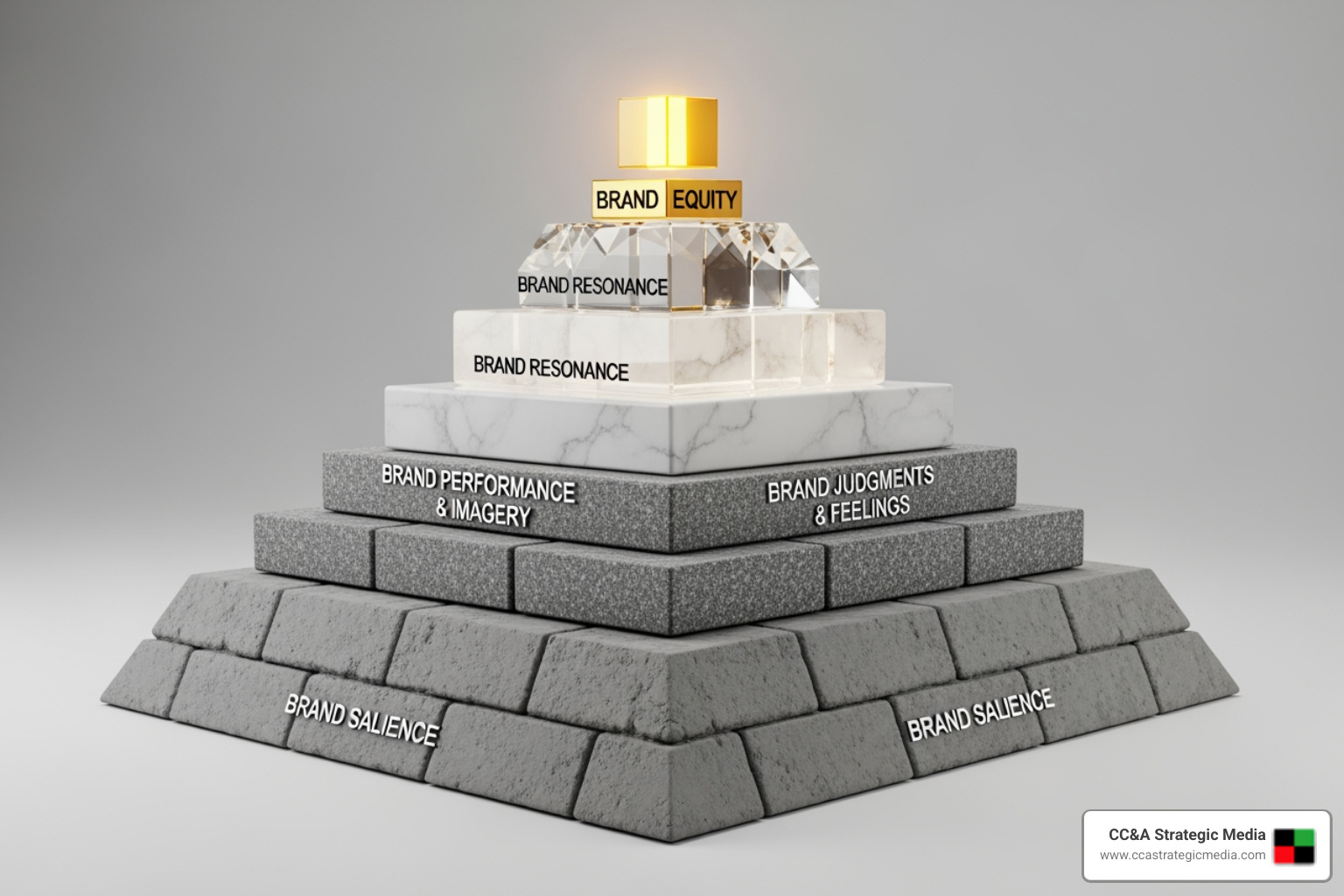
To comprehensively assess brand equity, we employ a combination of qualitative and quantitative methods, often guided by established frameworks like Kevin Lane Keller’s Customer-Based Brand Equity (CBBE) model.
Qualitative Methods: These approaches help us understand the “why” behind consumer perceptions and associations.
- Focus Groups: Bringing together small groups of target consumers to discuss their attitudes, feelings, and associations with your brand. This provides rich, nuanced insights into brand meaning and resonance.
- In-depth Interviews: One-on-one conversations that allow for a deeper exploration of individual customer experiences and perceptions.
- Social Listening and Sentiment Analysis: Monitoring online conversations (social media, forums, review sites) to gauge public sentiment and identify emerging themes related to your brand.
Quantitative Methods: These methods provide measurable data that allows us to track trends and compare our brand against competitors.
- Surveys: Standardized questionnaires distributed to a large sample of consumers to measure various aspects of brand equity, such as awareness, loyalty, and perceived quality.
- Brand Tracking Studies: Ongoing surveys conducted at regular intervals to monitor changes in brand metrics over time, helping us identify the impact of marketing activities.
- Using Keller’s customer-based brand equity model as a guide: This model provides a structured framework for measurement, progressing from basic awareness to deep resonance. Each level of the pyramid (Salience, Performance/Imagery, Judgments/Feelings, Resonance) can be assessed through specific questions and metrics in surveys and qualitative research.
Key Metrics and Models for Brand Equity Building
To transform perception into actionable data, we focus on a range of metrics:
-
Brand Awareness Metrics:
- Unaided Recall: Asking consumers to name brands in a category without any prompts (e.g., “Name a brand of coffee.”). This measures top-of-mind awareness.
- Aided Recall: Providing consumers with a list of brands and asking them to identify those they recognize (e.g., “Have you heard of Starbucks?”). This measures broader recognition.
- Search Volume & Social Media Mentions: Analyzing how often your brand is searched for online or mentioned on social platforms.
-
Brand Association Metrics:
- Net Promoter Score (NPS): A simple yet powerful metric that measures customer loyalty by asking how likely customers are to recommend your brand to others.
- Customer Satisfaction (CSAT): Directly asking customers about their satisfaction with your products, services, or overall experience.
- Brand Attributes: Surveys that ask consumers to rate your brand on specific characteristics (e.g., innovative, reliable, high-quality, friendly).
-
Financial Metrics: These metrics connect brand equity directly to the bottom line.
- Price Premium Analysis: Measuring how much more customers are willing to pay for your branded product compared to an unbranded or competitor’s equivalent.
- Market Share: Your brand’s proportion of total sales in a given market.
- Customer Lifetime Value (CLV): The predicted revenue a customer will generate throughout their relationship with your brand. High CLV indicates strong loyalty and positive equity.
- Return on Marketing Investment (ROMI): Analyzing the financial return from your brand equity building campaigns.
By continuously monitoring these metrics and leveraging frameworks like Keller’s CBBE, we gain a comprehensive understanding of our brand’s health and can make informed decisions to strengthen its position in the market.
The Financial Impact and Real-World Examples
The ultimate goal of brand equity building is to translate positive perceptions into tangible financial gains and sustained business success. Strong brand equity is not just a marketing asset; it’s a corporate asset that directly impacts a company’s financial performance and shareholder value. Research underscores this, revealing that branding and brand value represent some 20% of the value of the entire S&P 500. This clearly illustrates that brands are not merely logos or slogans, but critical drivers of market capitalization and long-term stability.
Companies with high brand equity can command higher margins, expand more easily into new markets, and possess greater resilience during economic downturns. They also enjoy increased marketplace power, which can lead to better negotiation terms with suppliers and distributors. When consumers consistently choose and purchase from a strong brand, it creates stable and predictable cash flow, directly contributing to increased shareholder value.
Examples of Strong Positive Brand Equity
Let’s look at some real-world brands that have mastered brand equity building:
- Apple: Apple’s brand equity is legendary. It’s built on a foundation of constant innovation, intuitive user experience, and clean, neat design. Consumers associate Apple with creativity, sophistication, and a seamless ecosystem. This allows them to charge premium prices for their products—from iPhones to MacBooks—and maintain fierce customer loyalty. Their consistent messaging and product quality, coupled with a strong emotional connection, have made them a global powerhouse.
- Nike: The Nike swoosh instantly conjures images of peak athletic performance, dedication, and inspiration. Nike’s brand equity building success stems from associating itself with top athletes, compelling advertising campaigns like “Just Do It,” and a relentless focus on product innovation. Consumers feel a sense of aspiration and empowerment when they wear Nike, making them willing to pay more for their products.
- Coca-Cola: This global beverage giant has built immense brand equity over more than a century. Coca-Cola’s success lies in its consistent ability to adapt to customer lives through personalized labels, holiday advertising, and positive taglines. It’s about evoking feelings of happiness, togetherness, and refreshment. Its distinct taste, iconic branding, and pervasive advertising have made it instantly recognizable worldwide, allowing it to maintain market dominance and expand into numerous other brands.
- Fenty Beauty: Launched by Rihanna, Fenty Beauty rapidly built strong positive brand equity by prioritizing inclusivity. While Rihanna’s star power provided an initial boost, the brand’s sustained success comes from high-quality products, an extensive range of foundation shades catering to diverse skin tones, and a commitment to making beauty accessible to all. They tapped into an underserved market, creating a powerful emotional connection and strong loyalty.
These brands demonstrate that a combination of consistent messaging, quality products, emotional connection, and a deep understanding of consumer needs are vital for successful brand equity building.
Cautionary Tales: Examples of Negative Brand Equity
Just as positive brand equity can create immense value, negative brand equity can inflict severe damage, highlighting the importance of authenticity and ethical conduct.
- Volkswagen “Dieselgate” Scandal: In 2015, Volkswagen faced a colossal hit to its brand equity when it was revealed that the company had installed software in its vehicles to cheat emissions tests. This scandal shattered consumer trust, led to billions in fines, and resulted in a significant drop in sales and a tarnished reputation that took years to rebuild. The lesson here is clear: a lack of transparency and a breach of ethical conduct can quickly erode even a well-established brand’s value.
- Goldman Sachs: While not a single event, the investment bank Goldman Sachs experienced a significant decline in brand value due to its perceived role in the 2008 financial crisis and subsequent controversies, including allegations that it helped clients evade taxes. These incidents created a lasting public perception of greed and unethical behavior. The damage happened over time, illustrating that a brand’s reputation can be chipped away by a series of negative associations, leading to decreased trust and a reluctance among some to engage with the brand.
These cautionary tales underscore that brand equity building is an ongoing responsibility. A strong brand is built on trust, and that trust can be lost in an instant or eroded over time by actions that contradict its perceived values. Transparency, ethical behavior, and a genuine commitment to customer and societal well-being are non-negotiable for safeguarding brand equity.
A Strategic Framework for Brand Equity Building
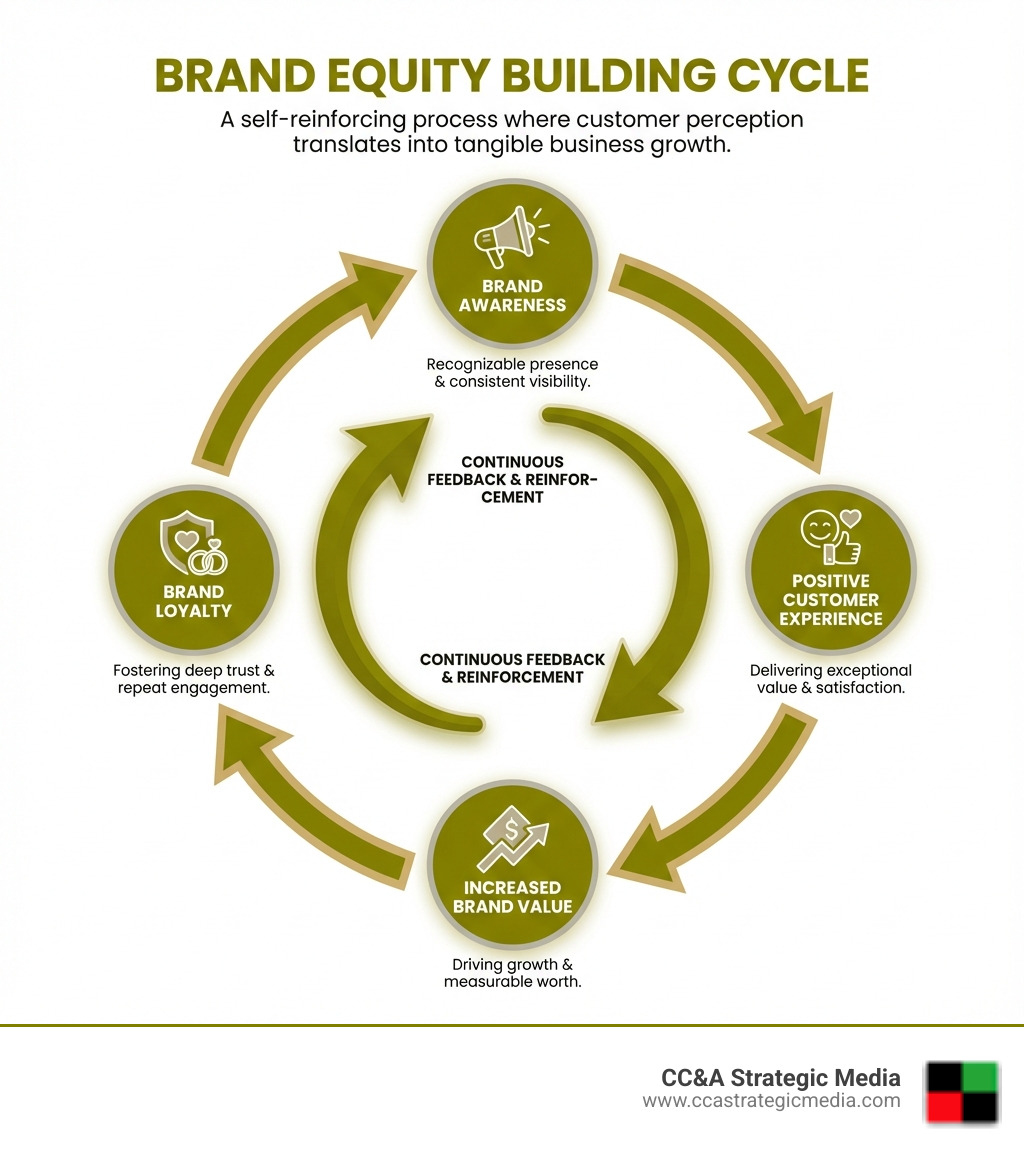
At CC&A Strategic Media, we approach brand equity building as a continuous journey centered on the customer. We use proven frameworks like Kevin Lane Keller’s Customer-Based Brand Equity (CBBE) model, which provides a clear roadmap for creating a brand that resonates deeply with its audience and becomes a significant business asset.
Step 1: Establish Foundational Brand Awareness
The first step is ensuring your brand is recognized and easily recalled by consumers. This is brand salience. We achieve this through:
- Consistent Presence: Being visible across all relevant touchpoints, from digital ads to physical locations.
- Search Engine Optimization (SEO): Dominating local and relevant search results so customers find you first.
- Content Marketing: Creating valuable content that educates your audience and keeps your brand top-of-mind.
- Social Media Engagement: Interacting with your community to build relationships and increase visibility.
- Distinctive Brand Elements: Using a unique logo, slogan, and color scheme to stand out.
The goal is for your brand to become synonymous with the product or service itself, as seen with how 77% of consumers use brand names as generic terms.
Step 2: Shape Meaning Through Performance and Imagery
Once people know who you are, the next step in brand equity building is to define what your brand stands for. This is achieved through two key dimensions:
Brand Performance: This is about how well your product or service meets customer needs. It includes:
- Product Quality: Consistently delivering a high-quality product or service.
- Service Effectiveness: Providing excellent, reliable customer support.
- Reliability: Ensuring your offerings are dependable over time.
Brand Imagery: This covers the intangible associations consumers have with your brand. It’s about the personality and values your brand represents:
- Brand Personality: Defining whether your brand is seen as innovative, trustworthy, or sophisticated.
- Values and Purpose: Communicating what your brand stands for, such as sustainability or community support, which resonates deeply with modern consumers.
- Brand Storytelling: Crafting compelling narratives that create an emotional connection and make your brand memorable.
By managing both performance and imagery, we ensure your brand is not just recognized, but also understood and valued.
Step 3: Cultivate Positive Judgments and Feelings
With awareness and meaning established, the focus shifts to fostering positive reactions. This involves influencing both rational judgments and emotional responses to your brand.
Customer Judgments: These are logical evaluations of your brand based on its performance and imagery:
- Quality: Is your product perceived as high-quality?
- Credibility: Is your brand seen as trustworthy and an expert in its field?
- Consideration: Is your brand a top choice for purchase?
- Superiority: Is your brand viewed as better than its competitors?
Customer Feelings: These are the emotional connections customers have with your brand, which are powerful drivers of loyalty:
- Warmth and Fun: Does your brand evoke positive emotions like happiness or comfort?
- Excitement and Security: Does it inspire enthusiasm or provide a sense of safety and trust?
- Social Approval: Does using your brand improve a customer’s social standing?
Building this emotional bond is crucial. We achieve it by actively listening to customer feedback, communicating your brand’s values, and demonstrating a commitment to your community. When customers feel a psychological connection, they are on the path to becoming loyal advocates.
Step 4: Foster Resonance and an Unforgettable Customer Experience
The ultimate goal of brand equity building is brand resonance—a deep, psychological bond where customers see your brand as an indispensable part of their lives. This is the highest level of brand loyalty.
Brand resonance is characterized by:
- Behavioral Loyalty: Customers make repeat purchases and choose your brand over others.
- Attitudinal Attachment: Customers genuinely love your brand and consider it special.
- Sense of Community: Customers feel connected to other people who use the brand.
- Active Engagement: Customers actively follow your brand, participate in discussions, and become advocates.
A key driver of resonance is an exceptional customer experience (CX). Every interaction matters, from the first website visit to post-purchase support. As PwC notes, 73% of consumers consider customer experience a vital factor in their purchasing decisions. Furthermore, 84% of companies that improve their CX see an increase in revenue, proving its direct impact on the bottom line.
To build this level of connection, we focus on:
- Personalization: Tailoring experiences to individual needs, like Spotify’s custom playlists.
- Social Proof: Using testimonials, reviews, and user-generated content (UGC) to build trust. A remarkable 93% of marketers find UGC more effective than branded content.
- Community Building: Creating spaces for customers to connect with each other and the brand.
- Proactive Support: Anticipating and solving customer problems efficiently, like Amazon’s streamlined returns process.
By consistently delivering superior experiences, we transform customers into loyal advocates, achieving true brand resonance.
Conclusion: Transform Your Brand into Your Most Valuable Asset
Building strong brand equity is a strategic imperative, not just a marketing buzzword. It’s the sum of every interaction and perception, creating a powerful asset that drives financial performance, customer loyalty, and long-term resilience.
The path to market leadership through brand equity building is a marathon, not a sprint. It requires a deep commitment to understanding and serving your customers, consistently delivering on your brand promise, and fostering genuine emotional connections.
At CC&A Strategic Media, we specialize in this journey. We blend data-driven insights with a nuanced understanding of consumer psychology to build brands that are not only recognized but revered. Our holistic approach ensures your brand becomes your most valuable asset, driving sustainable growth and securing your place in the market.
Ready to open up your brand’s full potential? Explore our strategic marketing services and let us help you build a brand that truly resonates.